
Notes on a Colonial Situation in Hell opens with a crime. Mr. Bagshaw, a Methodist missionary who runs a church plantation at Gilgal, on the outermost frontier of the colony, disappears, only to be found shortly afterward hanging from a tree, his eyes gouged out and his severed genitalia stuffed into his mouth. Happens to the best of us. Lieutenant Wrigley, a zealous young colonial officer dispatched with a squad of soldiers, takes charge of the investigation, assisted—though frequently obstructed—by MacTavish, the weary, whiskey-soaked district commissioner of Scortatus. Fine; who doesn’t like a good contrivance or seven? Then there’s Bridget, a brave and sharp-tongued Irish orphan, who travels with five other girls and a timorous escort, Mr. Quarington, to be assigned among colonial households as servants; she also wants to find her missing brother Sam. Sure thing. But the author isn’t done yet. Let’s not forget George Cavendish, manufacturer and colonial magnate; his wife unmoored by repeated miscarriages; and Penelope, the spiritist charged with relieving the bereaved mother’s “hysteria.” Can the reader expect a séance or two with dead babies? You can bet your ass!
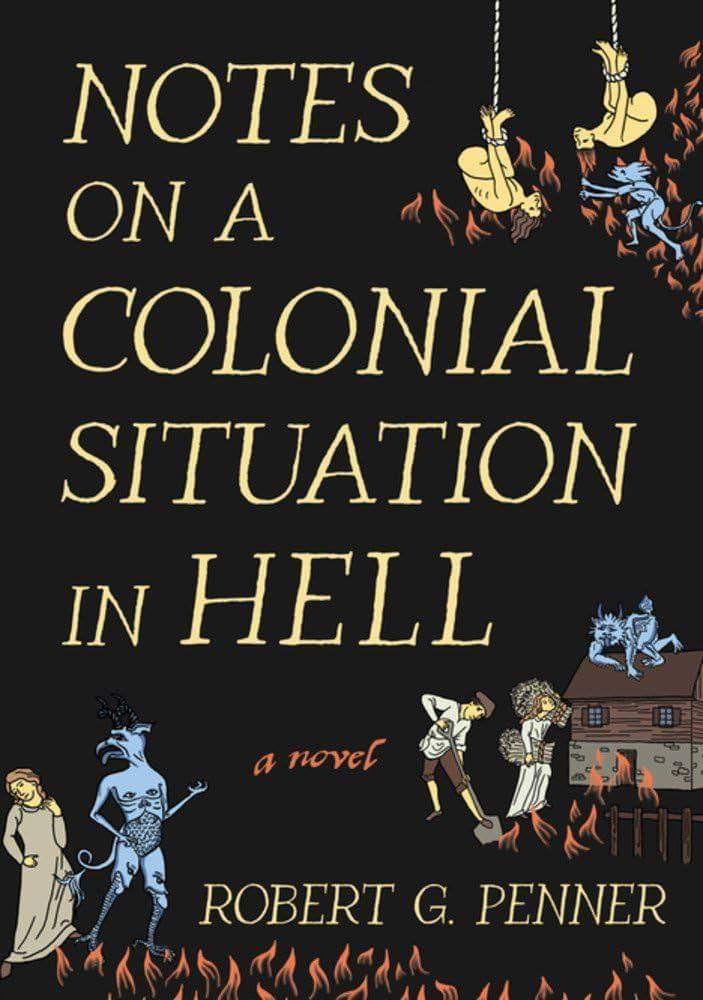
Notes on a Colonial Situation in Hell
By Robert Penner
McNally Editions, 304pp
These tangled plots arrive wearing familiar, if slightly mangled, costumes: Wrigley’s is stitched together from Sherlock Holmes’s Inverness cape and Dr. Watson’s shooting jacket; Bridget wears the rags of Oliver Twist (no stolen handkerchief, but a watch); and Mrs. Cavendish inherits the nightgown of Rochester’s wife in Jane Eyre as the novel’s “madwoman in the attic” (minus the attic).
It is worth noting, and not at all a spoiler, that this colonial hinterland is located, geographically, in Hell. Literally. Lasciate ogne speranza, voi ch’intrate!
Having once turned the American road novel into a postapocalyptic parable about capitalist extractivism (Strange Labour, Radiant Press, 2020), and then enlisted British folktales to recount the imperial politics of World War II England (The Dark King Shallows the World, Radiant Press, 2024), Canadian author Robert G. Penner now imagines the inferno as a territory of the British Crown. Britain has supplanted Satan as the governing authority of Hell’s first two circles (Dis and Hell Undiminished remain beyond its effective control). Her Majesty’s army has surveyed the underworld, parceled it into private property, expropriated and subdued the demons, and enslaved the dead souls. The great genres of nineteenth- and early-twentieth-century British literature—the detective story, the social-realist, and the Gothic novels—have followed the colonists down, where they reveal themselves as shifting shards of glass in the same kaleidoscope: the investigator (the state) maintains the rule of the Crown, the orphan (the dispossessed working class) is conscripted to keep the machinery of the colonial project running, and the hysteric (madness, women, and their attendant remedies) channels the dreadful violence required to keep the great house, and the empire beyond it, standing.
Turn the mirrors however you like; the same specters continue to haunt literature: Imperialism. Colonialism. Capital.
One scarcely needs to read the first few pages of the novel to grasp its motivations; the title lays its heavy hand on the table. Notes on a Colonial Situation in Hell yokes Georges Balandier’s essay “La Situation coloniale: approche théorique” (1951), wherein colonized societies are given to be understood through the structure of domination imposed upon them (racial hierarchy, exploitation, the colonizer’s claim to cultural superiority), to the language of the field report. Here, the title’s “Notes on” evokes the amateur ethnographies, travelogues, surveys, memoranda and journals through which the conqueror objectified and classified the conquered.
For all its ambition to erect a critique as monumental as colonialism itself, the novel too often resembles a house of cards. Hell is a colonial territory; but don’t ask it to clarify its racialized, colonized, and enslaved subjects. Maybe it’s the expropriated demons or the dead souls, whom the settlers own and put to work on plantations. If the souls are the enslaved, what are the demons—an Indigenous population, a class of intermediaries, reluctant collaborators who facilitate the souls’ exploitation, or all three? The ruling class treats demons and souls as different orders of being, and Herbert, Penelope’s abolitionist gardener, insists that the dead are sentient (rather than property), yet the novel never locates each group within its hierarchy. A book that appeals to Balandier curiously does not accomplish the relational analysis his work demands. Penner swallowed an entire syllabus on racial capitalism only to regurgitate a Frankenstein’s monster stitched together from a lobotomized Cedric J. Robinson, Stuart Hall, and Nancy Fraser. Even a squint at any of its load-bearing conceits and the house buckles, its foundations unequal to the grand architecture they are meant to support.
Granted, Hell can be located only on maps drawn by myth and scripture—but that allows Penner to reduce it to a nonspecific, homogenized landscape. For long stretches, his inferno consists of the same razor grass, thorn trees, brown hills, dry heat, and sickly yellow light. So much yellow. Bridget, Wrigley, MacTavish, Penelope, and the Cavendishes all live beneath it; beyond the towns, their surroundings become “only yellow—yellow sky and yellow grass,” a world “almost entirely bereft of depth.” Dante, another underworld enthusiast, offers contrast after contrast. So much contrast. Contrast everywhere. Every sin has its own climate and terrain: the heretics lie in sepulchers heated by scattered flames; the violent boil in a “river of blood”; the suicides inhabit a wood of “gnarled and intertangled” branches; the wrathful choke in a “filthy fen,” while traitors are fixed in a frozen lake resembling “glass, and not water.” What did I do to deserve this? the Italian poet might lament, rolling in his grave and wondering whether his soul has been consigned to an unanticipated tenth circle, where he must read déguenillé versions of his own work for eternity.
If only Notes on a Colonial Situation in Hell amounted to more than a Sisyphean punishment devised for the red-robed and laurel-crowned; the reader, unfortunately, is condemned to share their torture—and worse: anyone opening the novel in search of the substance of politically engaged literature will find only its affect. One might ask, however, whether literature that advertises its own political engagement can ever entirely escape posture. Here, geographical monotony produces more than aesthetic boredom; it dehistoricizes and, in turn, depoliticizes.
This doesn’t have to be the case. In J.M. Coetzee’s Waiting for the Barbarians, for example, the unnamed Empire and its indeterminate frontier resist exact identification, yet it is through this ambiguity that the novel forces the reader to think about how empire manufactures its enemies, legitimizes its violence, and absorbs the conscience of those who oppose it. By contrast, Penner convolutes his narrative to a degree that undermines his “noble” intentions. Maybe it’s because he wants to be funny, and he sometimes is. Coetzee is never funny.
Take the occasion of Bagshaw’s murder, which is declared the opening salvo of a demonic uprising—or so the authorities allege. His killer is never identified and may well have been human—providing the Crown with a pretext to dispatch troops and reassert its control. After the rebels destroy the army train, railway workers, Chinese miners, Irish laborers, deserters, and settlers salvage its weapons and form a makeshift Workers’ Army, led by Elijah Biddle, a Black Nova Scotian railway engineer. They refuse the colonial garrison’s demand to disarm and turn the empire’s own artillery upon Vespers and Alexandra. (Don’t worry, the names, at some point, cease to gesture toward any greater meaning.) Meanwhile, Bridget ventures deeper into Hell with Chickenhead (I liked this name for reasons I don’t care to admit); rain falls for the first time, and flowers erupt from the formerly yellow earth. Penner gestures toward a brighter tomorrow. It’s like a Soviet propaganda poster: a white teenage girl holding hands with a native teenage boy, both possessed of implausibly strong jawlines, gazing toward the brighter tomorrow emerging from the darkest reaches of Hell—which is colonial capitalism, in case the point had not been hammered home quite enough. White and nonwhite, human and nonhuman insurgents—the proletarianized, the enslaved, Gramsci’s subalterns, Fanon’s wretched of the earth, Rancière’s “part of those who have no part,” converge into an (almost) single revolutionary subject, destabilizing the colonial order. The problem is not the image’s idealism—socialist revolutions have been waged in the name of a utopia many times before—but that Penner’s multitude belongs less to the future than to the afterimage of Bandung, the Tricontinental, and 1968: a last flash of Third Worldist solidarity projected onto Hell’s newly flowering horizon. At the end of the novel, the rainbow coalition rides through a landscape suddenly in bloom; even the narrator concedes that it is “certainly a very sentimental scene.”
“If only Notes on a Colonial Situation in Hell amounted to more than a Sisyphean punishment devised for the red-robed and laurel-crowned; the reader, unfortunately, is condemned to share their torture—and worse: anyone opening the novel in search of the substance of politically engaged literature will find only its affect.”
By stuffing the bureaucracy of British India and Canada, the settler frontier and veldt of southern Africa, and the cotton-and-tobacco plantation slavery of the Caribbean and American South into a single underworld topography—as though British rule crossed oceans without ever adapting its modus operandi—Penner posits a colonial situation in Hell that operates everywhere and therefore nowhere. It might as well take place on Mars. Penner is going for a Swiftian thing, it seems. Droll imagined worlds, signifying very little, or, more accurately, not enough. John Darwin observes in Unfinished Empire: The Global Expansion of Britain that “[t]he hallmark of British imperialism was its extraordinary versatility in method, outlook and object.” British power assumed different forms—direct administration, indirect rule through local elites, settler government, plantation slavery, or informal commercial control—depending on the territory, commodity, labor regime, and population being subordinated. One might argue that by turning these variegated histories into interchangeable scenarios, Penner is pointing to imperialism’s de-differentiating and universalizing force. That is the generous reading. The less generous reading is that he mistakes totality for uniformity, forcing distinct colonial experiences into a generic mold and effacing the differences among colonized peoples until the peoples themselves all but disappear—a blur in representation not entirely unlike the colonial project itself. As Fanon writes, colonialism “turns to the past of the oppressed people, and distorts, disfigures, and destroys it.” What of the history of their oppression? To distort that history in turn is a perverse form of epistemic neocolonialism. Perhaps that is one step too far. Let me retreat a few inches and grant Penner the emancipatory politics toward which his fiction reaches: he has described his own orientation as “Marx-y,” acknowledged his Jamesonian affinities, and the novel means to be anti-capitalist, anticolonial, and socialist in sympathy. But the novel’s decolonialism amounts to something like saying “Free Palestine” at a literary reading or in an Oscar acceptance speech, then going home satisfied that one has fulfilled their revolutionary obligations.
What ground does this vision occupy in the present, when imperial power operates less often beneath a colonial flag than through sovereign debt, global supply chains, multinationals, military partnerships, and digital infrastructures? Just as ecology without class struggle dwindles into gardening, anticolonialism without history curdles into an empty and hackneyed moral posture, bubble gum evangelical liberationism: white and Western guilt kneeling for absolution without having learned even the rudiments of its catechism, accepting forgiveness while skipping the Ave Marias and Pater Nosters. Having already flattened the colonial past, the novel stops short of confronting our neocolonial present.
This is not a plea for realism. But speculative fiction undertaken without sufficient care for material reality liberates neither memory nor imagination; it is a pox upon both houses. Its emancipatory vision has neither an archive behind it nor a blueprint before it, no dialectic connecting the inherited conditions of oppression to the possibility of future liberation. We’re stuck! And you needn’t guess where.