The Morgan Library and Museum is a wellspring of arcane knowledge and strange little pockets of inspiration. Recent exhibits have showcased everything from Caravaggio to the weather, the Psalms in Medieval life and a newly discovered waltz by Chopin. TAROT!: Renaissance Symbols, Modern Visions, curated by Claire Gilman, Joshua O’Driscoll, and Francisco H. Trujillo, opened on June 26 in the midst of New York City’s summer tempests. It is accompanied by a 196-page catalogue awash in luxe reproductions and comprehensive essays, giving shape to 600 years of the eclectic art form and the strange figures who populate its history.
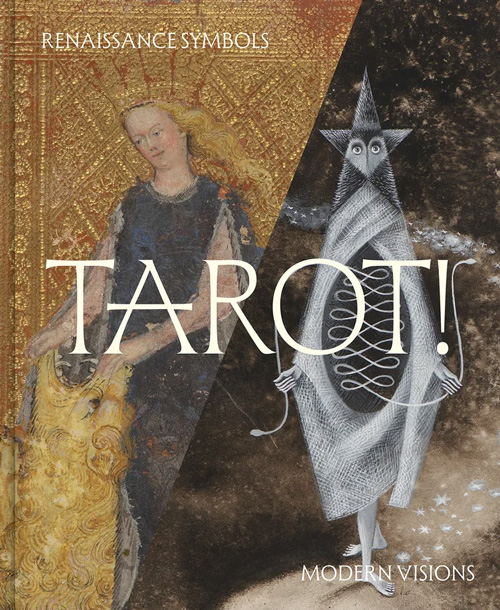
TAROT! Renaissance Symbols, Modern Visions
Edited by Claire Gilman, Joshua O’Driscoll, and Francisco H. Trujillo
224 pp
At the exhibition’s press preview, Trujillo described the serendipitous nature of the exhibition’s conception. He’d begun work on a massive tarot conservation project at the Morgan in 2019, and when Claire Gilman took up her role as a curator there in 2024, she had a tarot show of her own in mind. According to the two curators, that’s why there’s a “!” in the catalogue’s title: two distinct approaches to showcase hundreds of years’ worth of history and artistry in one exclamatory exhibition. Both in situ and on the page, TAROT!: Renaissance Symbols, Modern Visions offers up fresh research from a vast collection of art into a timeless, approachable, and educational experience. It’s also full of extraordinary artwork.
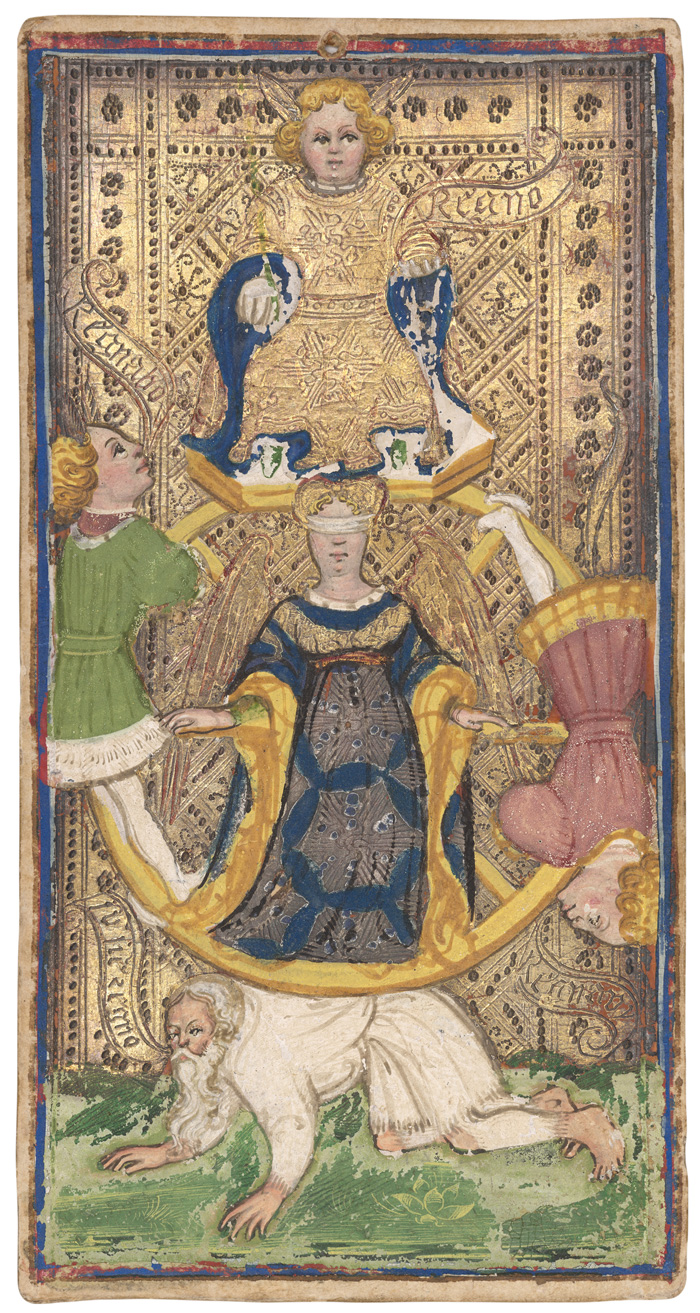
Bonifacio Bembo, The Wheel of Fortune from the Visconti-Sforza Tarot Cards. Italy, Milan or Cremona, ca. 1456–58. The Morgan Library & Museum, MS M.630.12. Photography by Graham S. Haber.
The first portion of the catalogue combines the history of tarot with discoveries made by librarians and curators in the field of manuscripts and conservation science. It focuses on three decks from Lombardy, commissioned by the Visconti and Sforza dukes of Milan during the fifteenth century: the Visconti di Modrone, Brambilla, and Visconti-Sforza decks. Anna Delle Foglie describes how major workshops like those helmed by the Zavatarri and Bembo families used models as part of their practices—drawings and older artworks that served as reference tools, artistic touchstones, etc.—thus making the individual attribution of these decks difficult.
The symbolism in these decks is twofold: each card represents its triumph, or trump—what we refer to today as the Major Arcana, which are the twenty-two cards that accompany the Minor Arcana, or the four suits, which is to say, the visual depiction of the card’s function—while also giving a window into the context of its commission. Regarding the Love card from the Visconti di Modrone deck, Foglie writes that it “bears the alternating arms of the Visconti and Savoy families on the pavilion behind the pair of figures, in reference to the marriage of Duke Filippo Maria Visconti with Mary of Savoy.”
The conservation team’s section of the catalogue, led by Trujillo, Marie-France Lemay, and Lydia Aikenhead, provides a rare and surprising look under the hood of how tarot decks get made, layer by layer, through a roughly eleven-step process: pasteboard layers; the preliminary outlining (including leadpoint sketching on the pasteboard to set the groundwork for the design followed by iron gall ink and incised lines to indicate the main figure); metal leaf layered on top (not just silver and gold, but a cost-effective gold-alternative, oro di mèta); tooling with a stylus, compass, or metal punch to add decorative designs; and, of course, pigments and glazes, among other steps. The research shared here showcases an almost alchemical human touch and fine craftsmanship that, in an era of AI slop, underscores the transformative potential of art made by actual human hands, the fruit of a centuries-long process of knowledge-sharing and collective curiosity and passion. The section is peppered with close readings of various artisanal techniques that explain how the available resources and technologies of the time made their way to the artists’ workshops and into the cards: a rare Kermes vermilion insect dye, for example, or animal glue from boiling bones and soft tissues, procured from local butchers.
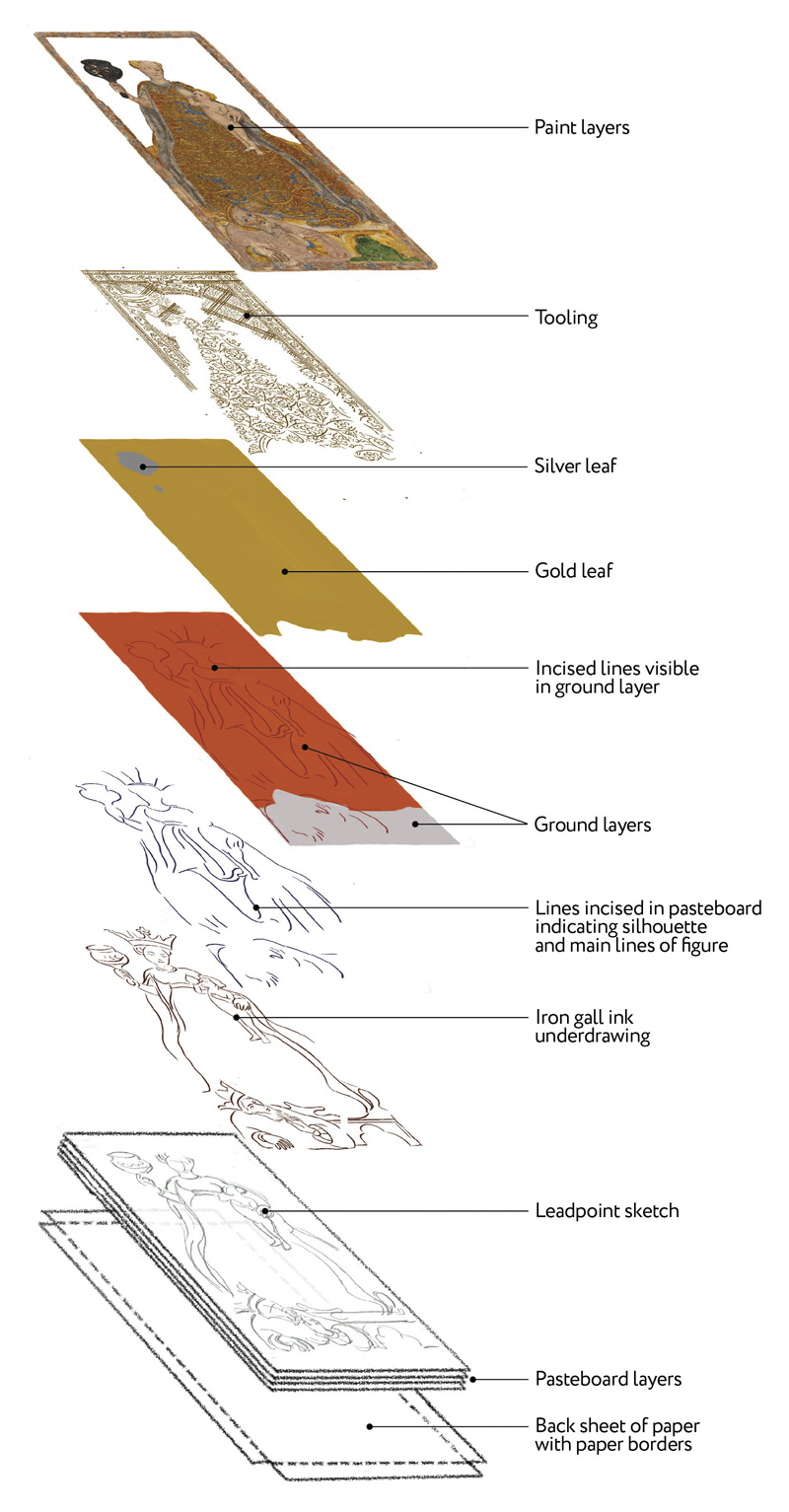
Image created by Marie-France Lemay. Morgan Library and Museum.
The exhibition reminds those unfamiliar with its Renaissance origins that in its infancy, tarot was a card game, not a practice tethered to the occult. The latter only emerged around the end of the nineteenth century, three hundred years after the creation of the Big Three decks—the Tarot of Marseille, the Rider-Waite-Smith Tarot, and the Thoth Tarot. Thierry Depaulis’ contribution to the catalogue covers the rules of the trick-taking game—in the genre of bridge or Wizard—and its varieties and changing card hierarchies across the centuries, especially when it comes to dealing with different numbers of players and cards leftover, or with the convention of French suit symbols (hearts, diamonds, clubs, spades) in place of Latin ones (Coins, Cups, Swords, Batons). Anyone who has been cajoled by a friend into a “board game night” knows that it is difficult to explain the rules of a game abstractly, that it’s usually best just give it a go, but Depaulis handles this material adeptly before shifting to a question for the collectors among us: were these decks intended as ostentatious displays of wealth, or were these hand-painted works of art actually used for play? I’ll let the reader pick up the book or visit the Morgan to find out for themselves, but personally, I don’t let just anyone smudge their grubby fingers on my rare photo books when they come into my home!
Then there’s the question of what separates an everyday deck of cards from a tarot deck. The earliest known example of “trump” cards in tarot (which we now refer to as the Major Arcana) are included in a deck commissioned by Duke Filippo Maria Visconti of Milan, one of the family’s last prominent rulers before the Sforza dynasty came to power in 1450. These sixteen hierarchical additions are what transformed a normal deck into a game called trionfo or trionfi, eventually known as tarocco or tarocchi. Images were derived from poetry: Petrarch’s series of six allegorical triumphs that chart a person’s spiritual journey from sin to redemption, for example, with each preceding allegory trumping the next: Love, Chastity, Death, Fame, Time, Eternity (more formally known as God). Petrarch, the poet and scholar, was a quintessential Renaissance man, an ideal figure for discussing the sensibilities of the time. He was a lifelong yearner, a loverboy who explored the human condition, turning his nose up somewhat at the medieval thinkers who came before him, reaching back instead to Greek and Roman classical literature, especially Cicero and Virgil. Having survived the Black Plague, a time when many waited for death and the afterlife, he wanted time on earth to count for something too, to urge his fellow mortals to look inward and around and not just beyond…
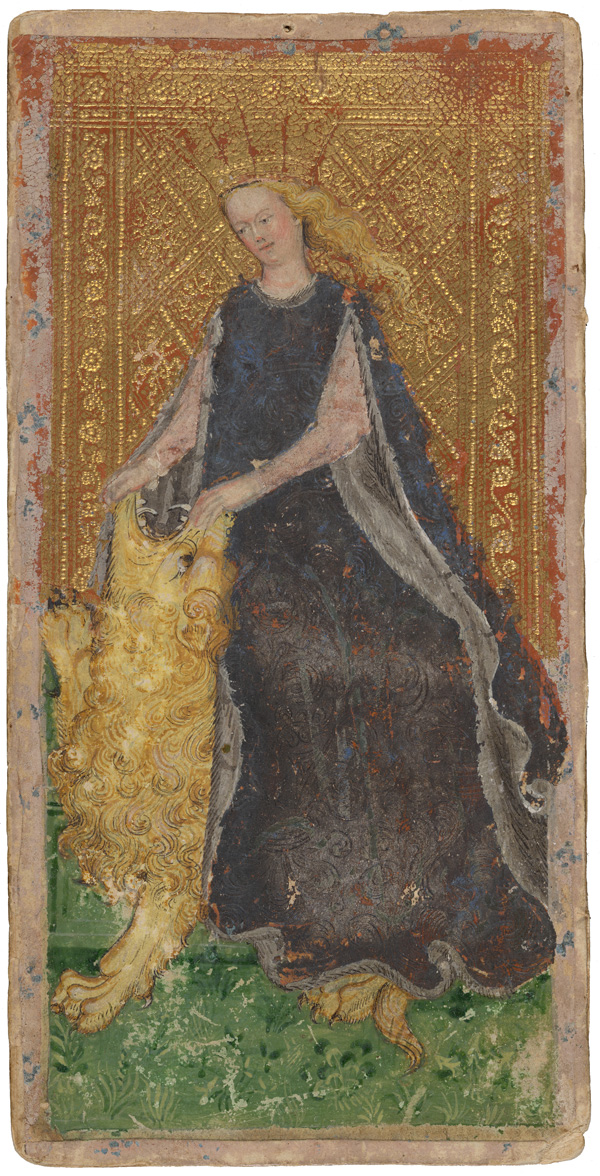
Andrea Bembo, Fortitude, from the Visconti di Modrone Tarot, ca. 1441–42, Beinecke Rare Book & Manuscript Library. Yale University.
This is perhaps the through-line of the TAROT! exhibition: even though the decks weren’t originally intended as a tool of divination, questions of belief and the unseen are perhaps not so different to the quandaries we face today. The spiritually driven ethos of Renaissance visual culture is painted right onto the cards. Milan and Medici Florence are now rightly recognized as places with a particularly robust artistic output underpinned by a massive consolidation of wealth. Divinatory practices and the mantic arts—even if at this stage, they were not yet conducted through tarot cards—were widespread and found their way into the micro and macro decisions of the court. Joshua O’Driscoll writes in the “Tarot and Divination” portion of the book, “Studying the stars was, in fact, the most widely practiced and firmly entrenched method of prognostication in the late medieval and Renaissance society. Astrology, along with its sister Astronomy, was a core component of university studies since at least the thirteenth century.”
O’Driscoll traces the winding path of tarot through a complicated maze of sources—rule books, non-card works of art, essays—toward our modern conception of the decks. The turn toward the divinatory use of tarot, in his reading, can be traced to French occultists around the onset of the French Revolution. Antoine Court de Gébelin published an influential work in 1781, arguing that tarot was “an ancient Egyptian book of magic in disguise.” This moment takes part in a long tradition of Egyptomania—which we still see permeating some current and maladapted adaptations of “New Age” thinking à la starseed believers—and rerouted the imagery of a number of cards: for example, the idea that the Chariot is actually Osiris.
“This is perhaps the through-line of the TAROT! exhibition: even though the decks weren’t originally intended as a tool of divination, questions of belief and the unseen are perhaps not so different to the quandaries we face today. The spiritually-driven ethos of Renaissance visual culture is painted right onto the cards.”
Another key moment in the history of tarot relates to members of the Hermetic Order of the Golden Dawn and the Rider-Waite deck of 1909. Most folks even vaguely familiar with tarot would recognize the imagery from Pamela Colman Smith’s extraordinary deck, commissioned by occultist Arthur Edward Waite. Her bold linework encases a palette kissed by a regal autumn sun, drenched in golds (perhaps a reference to the gold leaf on her predecessors’ handiwork), carnelian, a subtle gradient of sky blues. I was delighted to learn that she included a range of Easter eggs in her deck, including portraits of her friends. One of her idols and mentors, for example, William Terriss, served as the muse for the adventurous, stylish Fool card. I see the likeness. And what a delight to see a male muse to a female artist when historically it’s been the reverse! In her Eight of Pentacles, she adapts the blacksmith from the 1491 Sola Busca deck “to show him in the process of creating the Eight of Pentacles.” Such fun. Pieces from a printed, hand-colored Sola Busca deck are also on display in the exhibition.
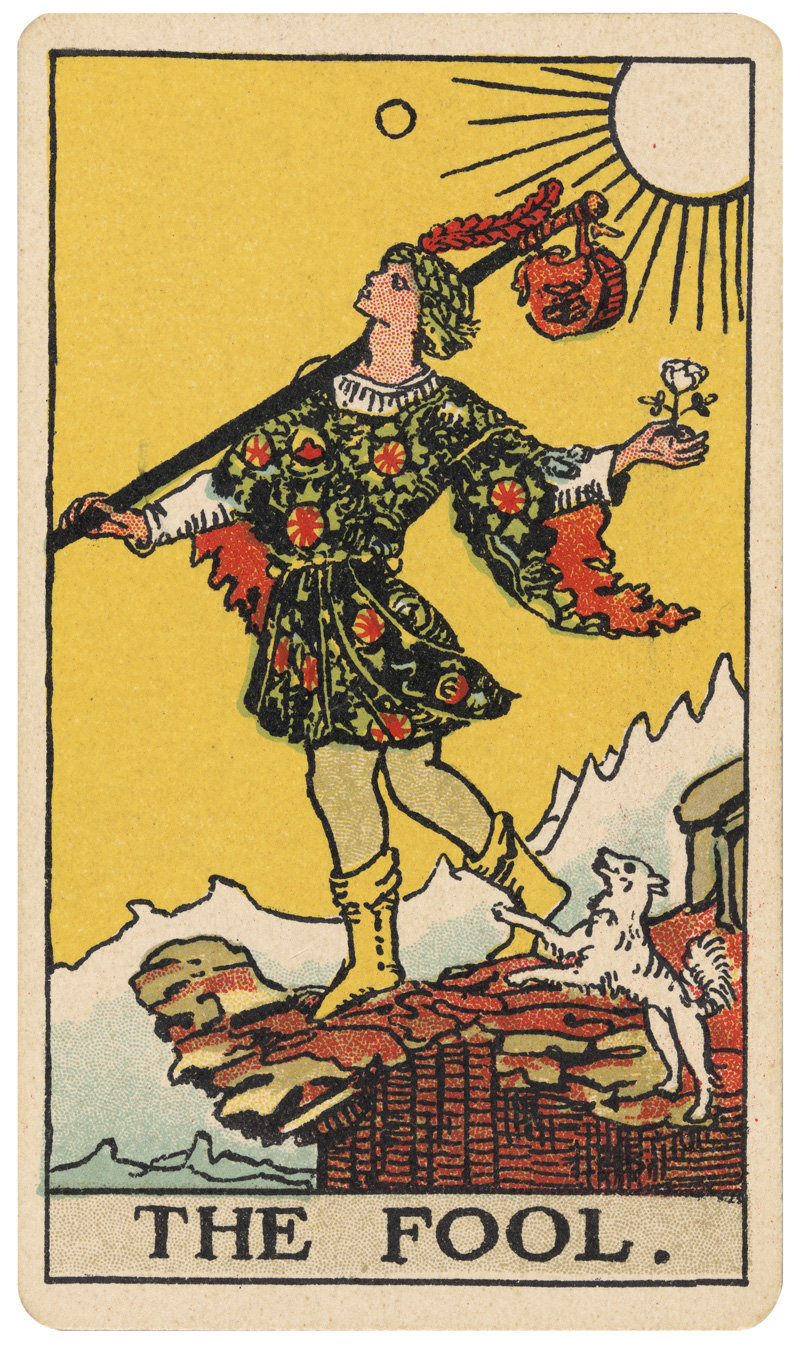
Pamela Colman Smith (1878–1951) and Arthur Edward Waite (1857–1942) The Fool, from the Rider-Waite-Smith Tarot (Deck “C”). London: William Rider & Son, ca. 1921–31 (first published in 1909). Chromolithograph. New York, The Morgan Library & Museum, PML 199373.
Smith is part of a star-studded cast of characters in Susan L. Aberth’s essay “Tarot and the Modern World,” where she outlines tarot’s transformation since the late-nineteenth century, and considers gendered language (sometimes misogynistic, sometimes gender-affirming) that prevails in tarot, specifically, and spirituality more broadly. Aberth reconnects the association between the feminine and occultism in several historical contexts, including in the Pre-Raphaelite Brotherhood of painters such as William Holman Hunt and John Everett Millais, as well as in the cosmovision of surrealist André Breton, who believed in the feminine as an “irrepressible force of nature.” While the author rejects these modes of thinking as potentially proto-bioessentialist, Aberth also notes that there’s no denying women were indeed central to late-eighteenth- and nineteenth-century Theosophy and Spiritualism in a more meaningful way: “Their voices could be heard and respected, unlike in Christianity where not only were they consistently silenced and relegated to the periphery; but considered as a whole morally weak, if not evil.”
Hence, the extraordinary array of artists that Aberth cites as working in the occult within the arts: Leonora Carrington, Remedios Varo, Helena Blavatsky, Annie Besant, Lady Frieda Harris, Mary Butts, and Ithell Colquhoun. Aberth even provides a few tart mouthfuls of art-world drama, which make tarot’s expanding universe all the more gripping and delectable.
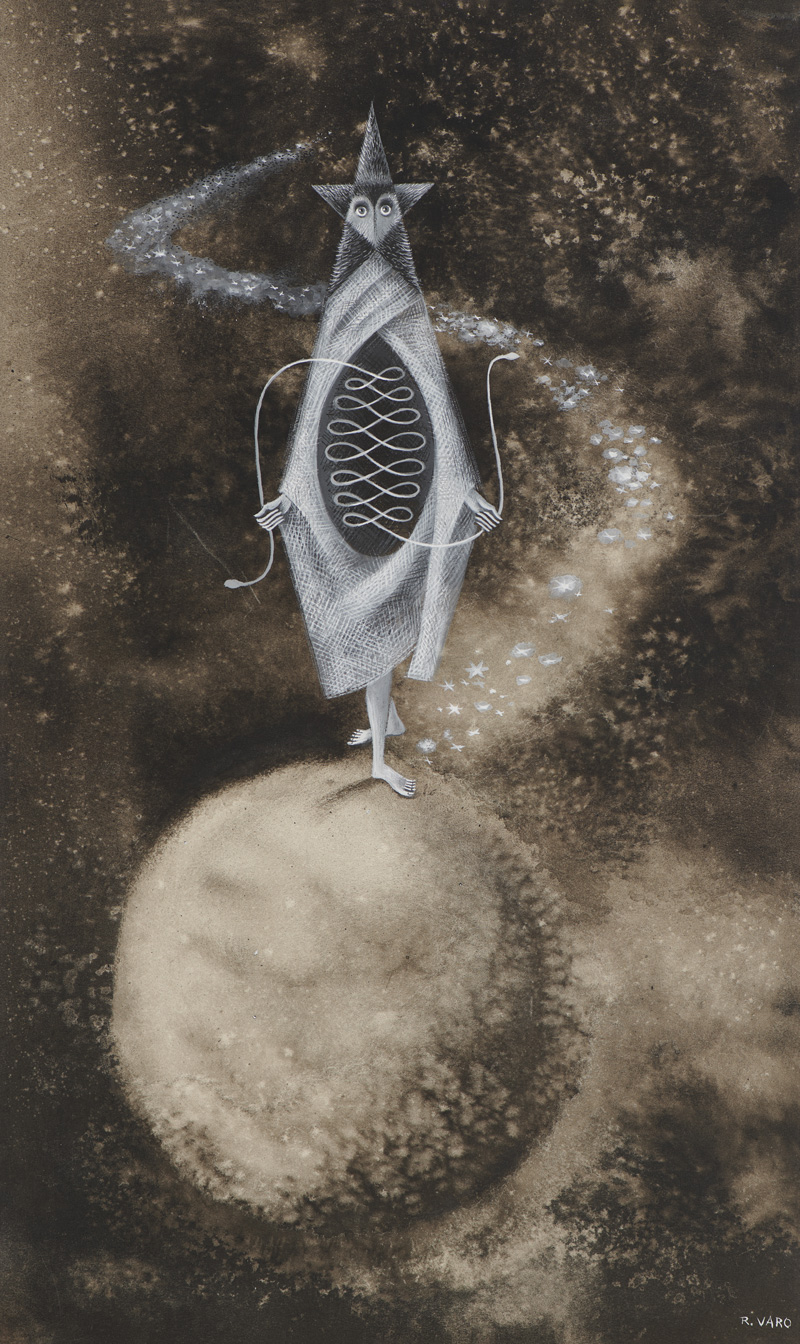
Illustration Credit: Remedios Varo (1908–1963) The Other Clock (El otro reloj), 1957. © 2026 Remedios Varo, Artists Rights Society (ARS), New York / VEGAP, Madrid. Courtesy of Wendi Norris Gallery.
Curator Claire Gilman closes out the book’s essays with her “Modern Visions” portion of the exhibition, discussing tarot in the twenty-first century. She pulls a number of artists and decks from the show and laces them together in vivid prose that veers organically into the poetic, showcasing her curatorial voice.
Of the many extraordinary artists included in the exhibition, a major highlight of the “modern” portion of the exhibition is the inclusion of three generations of Saar women, who bring a rich range of approaches and art forms into the show’s orbit: the late, singular Betye—who sadly passed away as I wrote this review—her daughter Alison, and granddaughter Sola. Betye’s illustrations for Ishmael Reed’s book of poems A Secretary of Spirits bring together the experience of being Black in America with the artist’s knowledge and interpretation of folklore, mysticism, and tarot-related imagery. Six sword suit cards by Alison are also standouts, with her signature powerful, stoic figures whose eyes pierce unseen dimensions.
Sola’s Solita Tarot has one of the most complex and rich visual lexicons on display: aquatic flora and fauna, refracted metaphysical light, vintage erotica and other ephemera, and ancient symbologies. The work exudes a mélange of freedom, intense playfulness, and poetic imagination that one finds across Sola’s oeuvre, an enchantress through and through. I’ve always felt a strong kinship to her artistic universe and got in touch with Sola to ask her to elaborate on the origins of this project. I was thrilled to learn she’s in the process of creating a second deck:
I became interested in tarot during the pandemic and began researching it more when I decided to make a deck. Composition-wise, it is heavily influenced by the Rider-Waite deck, however it also subverts its ideology…I wanted it to be colorful and connected to the natural world, so I also incorporated watercolor painting, feathers, and pressed flowers into my analog collages. My aim was to make it joyful and allow the viewer to create their own narrative from the artwork rather than a fixed interpretation.
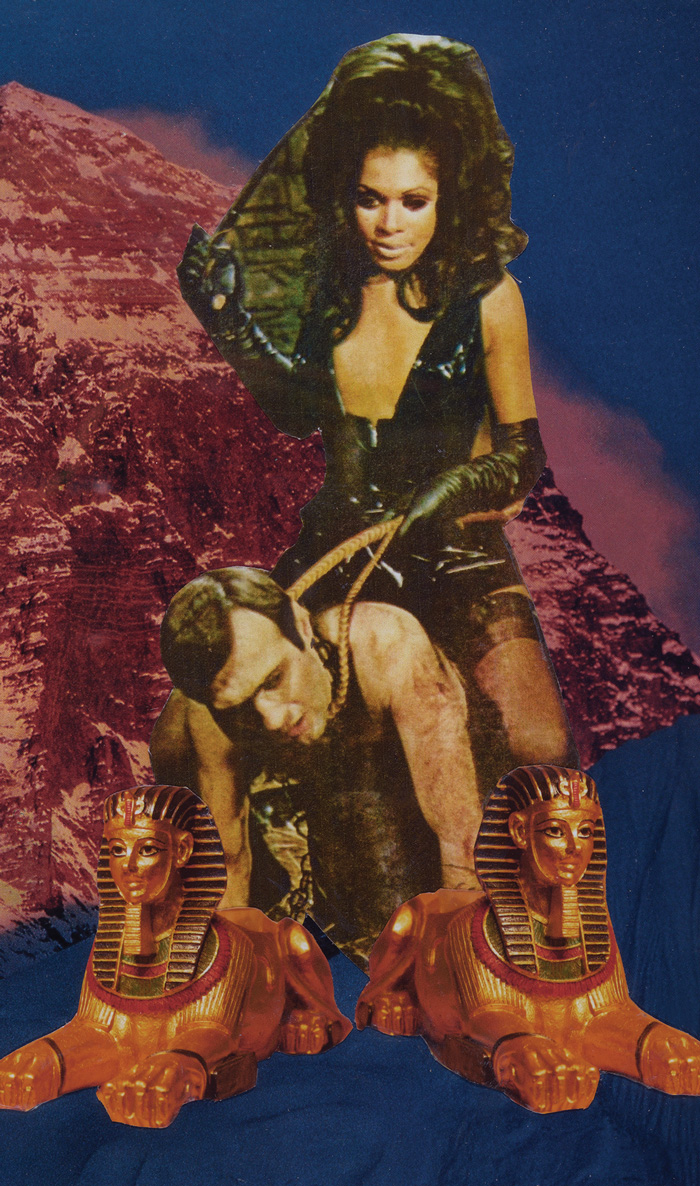
Sola Saar’s Chariot card. Supplied.
Of course, even among such extraordinary art, I feel obliged to choose a favorite work in the exhibition. The Death card of the Crowley Thoth Tarot deck, illustrated by Lady Frieda Harris and born from an intense and life-changing collaboration with Aleister Crowley, is exquisite. It’s a bona fide representation of the poetry of tarot, through which endless meaning is suggested but not prescribed. Cards become tarot when you are handed a mirror, but the reflection is liquid, a picture offering limitless realities. The dancing skeleton of Death tied to the heavens by Gurdjieffian strings, the scythe arcing across the ocean floor. And at its feet: the sign of Scorpius ruling over the water’s powerful, transformational domain. No endings in sight, really, just the resurrection of souls lacing up and up through a series of Leviathan crosses. Death is the harvester and the catalyst, the wheel, the seasons, the endless worker, neither necessarily benevolent nor evil but omnipresent. This sense of neutral inevitability is comforting. A perpetual, rhythmic shuffling of the deck.