I attended a reading once where Mary Gaitskill was asked by an eager MFA type about whether her being “famous” had any bearing on her ability to go out into the world, accruing experience to be turned into material. Gaitskill, as I recall, laughed and said something to the effect of: writers aren’t really famous; unless you’re Philip Roth, Zadie Smith, or, I don’t know, Stephen King, people don’t care. I’m not sure Rachel Cusk would agree with that position. I don’t mean for straightforward reasons of bigheadedness, but rather that what Cusk shares with the very famous is a wounded sense of having been exposed, something she continues to fold back into her work.
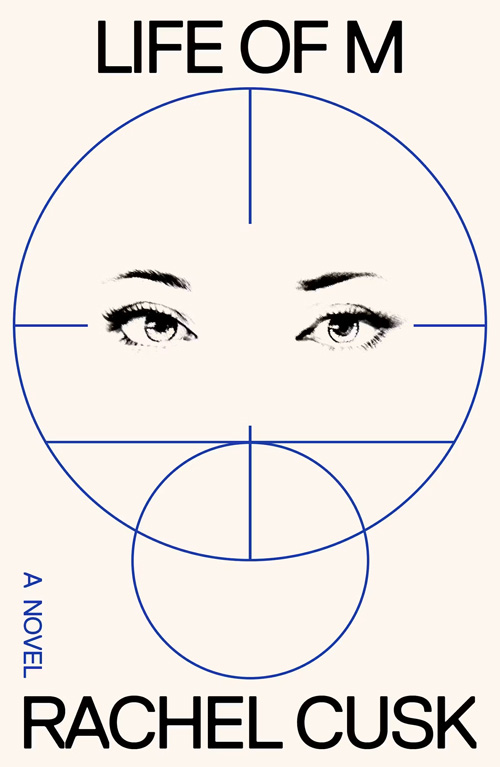
Life of M
By Rachel Cusk
Farrar, Straus and Giroux, 192pp
Cusk’s career and the evolution of her project over the last decade and a half will be familiar to many, but briefly to restate: Cusk has said that she entered a period of turmoil, even something like PTSD and an attendant “creative death,” following the publication of and hostile response to her memoir concerning the breakdown of her marriage, Aftermath (2012), which even her closest friends had counseled her not to publish. Readers, she says, took this for a “wilful exposure of self, a washing of dirty laundry in public.” Instead of engaging with the book as literature, people gleefully took sides in her private disputes and, she felt, castigated her precisely for said self-exposure, in a particularly gendered way. As she says in an interview with Guardian from 2014, “There was so much stuff in my own life that the divide [between life and the book] was completely breached, my marital arguments the subject of newspaper articles, criticisms of me in my personal life were being broadcast on Radio 4.” Her reaction to this was to inaugurate a new phase in her career beginning with her ninth novel Outline, which grew into the trilogy filled out by Transit (2016) and Kudos (2018). Where Aftermath was panned for its self-absorption––too much Cusk, and too unlikable for it––the Outline trilogy’s passive narrator Faye performs a disappearing act, renouncing agency and authority by remaining textually silent in the face of the voluble monologues she encounters. The narrating self becomes a mere recorder and presenter of the words of others. Of course the other side of this is a kind of extreme practice of extraction wherein other “characters”––Cusk might dispute this term, having said, in 2018, “I don’t think character exists anymore”––are given enough rope with which to hang themselves, revealing their capriciousness, meanness, or idiocy in almost uninterrupted monologues. Her first novel following the trilogy, Second Place (2021), was a displaced fictionalization of Mabel Dodge Luhan’s 1932 memoir Lorenzo in Taos, which concerns a chaotic and psychologically intense visit by D.H. Lawrence to an artist’s retreat in New Mexico. Cusk rewrote the real novelist as a painter called L, and changed the setting to a coastal marsh in England, likely Norfolk where she was living at the time. That novel’s female narrator, M, a writer of “minor” books, is neurotic on the page, prone to exclamation points and solecisms. She writes: “I felt myself falling out of the frame I had lived in for years, the frame of human implication in a particular set of circumstances. From that moment, I ceased to be immersed in the story of my own life and became distinct from it.” The connection is, as Cusk says in her Paris Review interview with Sheila Heti, the extent to which she would “like to make something where the imprint of identity is much less palpable. I am sort of bashing my head trying to work out how to do it.” Her latest novel, Life of M, is an inventive albeit not entirely satisfying attempt at just that bashing.
A slightly different version of the opening of Life of M appeared first in the New Yorker, accompanied by a short piece by Cusk on Muriel Spark’s story “The House of the Famous Poet.” From Spark, she writes, she “took several things… the atomizing nature of catastrophe, which yet grants a peculiar clarity of perception; the electric influence of fame; the haphazard quality of experience, which militates against narrative; and the unstructured possibilities of female association.” This novel opens with a ferocious, possessive gesture regarding the business of life writing by the unnamed narrator: “A little while ago, I told the actor M that I was thinking of writing her autobiography [my emphases added].” M, we’re informed, is a stratospherically famous movie star with whom Cusk’s narrator has become acquainted, arresting in her beauty and charm but also known for her interest in books and art. Despite feeling unimportant and ugly in proximity to her, the narrator is immediately drawn to M, but (implausibly) claims not to have known who she was when they were introduced in the unnamed city where they both live, which, incidentally, is very clearly Paris. M is game, “a good sport” about this proposed project. “Would you just make it up?” she asks, introducing the thicket of questions and ideas around authenticity and artifice, performance, writing, celebrity and selfhood that govern Cusk’s novel.
Life of M operates across three distinct modes. The first is comprised of detailed third-person observations about M’s daily and inner lives, her fame and her beauty, and so are, presumably, the substance of this imagined project the narrator is undertaking. We see M attend therapy and psychic sessions, spa days, press junkets, dinner parties, vacations, and a “literary salon” hosted by a luxury fashion brand. We see her research future roles and attend an arthouse cinema to watch her own performance in a movie from years ago, as well as, more mundanely, pick her children up from school. Across these, M emerges as somewhat needy and brittle, beset by the affliction of fame and its resultant isolation. She’s presented as having no true or meaningful relationships, a function of suspicion or guardedness on one hand and haughty self-importance on the other. More than anything else, though, she emerges as a stand-in for celebrity as a whole. (The “clues,” as enumerated by a recent UnHerd piece, add up to M being largely based on Natalie Portman, but I’m of the view that this doesn’t much matter.) These third-person sections are accompanied by passages in a second mode, a curious first person plural that address modern urban living and the built environment, wherein the “we” seems to swell to encompass not only the narrator and M or the narrator and anyone else, but all of “us” living in the “masterpieces of civilization” that are cities, with particular emphasis placed upon all the waste, dirt, shit, litter, and detritus that we produce. (Even if the sociality implied by “we” often gets undercut by a kind of exclusion—we do this, but they do that—along the lines of class.) And finally, there are the admittedly fleeting but crucial passages directly commenting on the narrator’s own life, particularly the grave illness of her partner (also unnamed and only ever referred to as such: “my partner”), including the drudgery of navigating visiting hours, the scheduling of operations, hospital food and so on. So the novel is structured by these disjunctive pronouns and what they’re able to contain or bear—She, We, I—as well as their slippage that fiction inherently enables.
M, in her capacity as a figure for fame or celebrity writ large, is presented as a sort of immovable object around which reality distorts or shifts, which in turns conjures “an awakening into an awful vigilance, a permanent state of objectivity that was perhaps the strange fruit of the experience of objectification.” She is too recognizable, too much a site of projection, to live anything resembling a normal life. Never mind selfie-seeking stans, generalized sycophancy, the intrusion of paparazzi, or, for that matter, strange novelists trying to write her autobiography, even her friends sometimes treat her “as though M’s fame were an illness or a disability,” such is the inherent “strangeness of her life.” Celebrity gets framed as a force or structure that both emerges from a fetishization of the individual and at the same time extinguishes individuality; M is in one sense only or just a very famous person. When M’s friend writes a screenplay for her to star in as a movie star, she’s offended, since “something in the friend’s manner of transforming her into an object of artistic enquiry arouses in M a violent and almost inarticulate instinct of self-protection.” This, of course, is what the narrator is also doing throughout.
Only in her personal life does M feel the need to “get herself into character.” She admits this to an acquaintance, a “clever person,” who, to her surprise, snaps back that everyone feels that way (Stars—they’re just like us!), adding that “to an extent it’s the fault of actors like you.” What Cusk seems to be saying here is that celebrity culture has precipitated a culture of performance, of imitation, of inauthenticity; “the notion of celebrity––and thus of self,” as she has it. (She likewise refers to M’s social life as her “practice” and “project” several times, as in “it is part of M’s project to befriend interesting people.”) The word celebrity invokes someone to whom we, or at least plenty of others, pay a great deal of attention when we know we probably ought not to. That is, lurking in the term is baked-in voyeurism, shame, excess, and dismissal. But criticisms of the vapidity or banality of “celebrity culture” easily become, well, vapid and banal: “What she sees is someone who has been devastated by fame. She sees the complete inversion of internal and external that fame brings about. Inside the star is now a whirling chaos, caused and claimed by ugliness.” These are among the novel’s weakest moments, when Cusk grasps for aphorisms (or platitudes) that might work, often hedged or heaped with a perhaps and attaining a flattening pithiness, such as “Perhaps this is what [M’s] desire for anonymity actually is: a wish or a need not to stop being observed but to stop observing,” or when, evoking the Tour Montparnasse (as the only glass skyscraper on Paris’s skyline), she writes, “Like the ugly tower we see everything from where we are, except ourselves. Fame is perhaps this tower, an ultimate entrapment in the self that is also a deliverance from it.” Even at this stylistic level, fame is an altogether wobbly frame for a novel because it’s so firmly entrenched in our culture that most observations about it cannot but feel trite. It’s less of a phenomenon of contemporary life and mass culture that could be vivisected than the foundational value-system that structures it—too big, as well as too obvious. (“A celebrity,” incidentally, is Sheila Heti’s narrator’s first, albeit swiftly qualified, answer to her novel’s titular question, How Should a Person Be?)
Life of M is possessed of some genuine stylistic oddness, beyond the now familiar Cuskisms of the sans-serif font and absence of quotation marks for speech. There are the many sections that begin “It is,” perhaps borrowed from the French construction “c’est”: “It is a hotel room in a foreign city,” “It is the interior of a limousine,” or “It is a boat.” First, in English at least, what is? And second, this is indicative of a placelessness or drift to which the novel otherwise doesn’t commit beyond a vague signaling towards belonging to a globalized culture. Cusk also breezes past or condenses parts of the narrative that require elaboration while describing in great detail, say, the layout of a non-descript luxury hotel suite, an olive grove, or how many commuters these days seem to be cyclists. When she discusses real or imagined books, Cusk’s deliberate generalizations or anonymizations have the effect of “the writer” (i.e. of a putatively specific book) coming to stand in metonymically for the figure of the writer as she conceives of it in toto: “the writer, forever bent on the surveillance of what is outside him, adopts a drastic policy of internal neglect,” and so on. But beyond this, what exactly is the point of not naming texts, objects, people, cities? I’ll confess I find this trying even when it’s referring to a somewhat obscure object or person. (Alright, it took me slightly longer to call to mind Francesca Woodman’s name following the description of her photograph, but to what end exactly?) But it’s even more so when it avoids naming, say, Aristotle Onassis, or the novel’s setting as Paris. It may be that it’s to induce what Cusk calls “an inversion of cause and effect––there is no effect because there is no cause––that seems to differentiate [M’s] life from the lives of other people.” It may be to flatter the worldly reader’s ego. It’s also frankly irritating.
So much of this novel has to do with authenticity and selfhood which are further scrambled by their mediation in or by art, whether in the form of the vocations of acting and stardom (“everything I did or said in [M’s] company was false. It was as if I was acting… [and] as if she was the only one good enough at acting to attain reality”) or in fiction (“a fiction writer chooses deliberately or otherwise not to see what will threaten the fiction’s representation of the world”). The narrator theorizes that an exhibition of photography is less busy than one showing paintings in the same museum because “people do not want to buy tickets and wait in queues to see reality.” But photography isn’t a straight representation of reality any more than fiction is; in the case of each medium, the relationship to the real is structured by malleability and selectivity, subject to manipulation, and inevitably leaves something, in fact almost everything, out of frame. On occasion, it’s heavily implied which side of the art/reality or celebrity/normal person divide Cusk feels closer to, like when she contrasts theater actors to movie stars: “They have turned up with the smell of the street on them. They have brought their own flasks of water; some of them have even brought food wrapped in foil or in plastic containers. They have untidy hair and imperfect faces and teeth.” M at one point meets a kind of doppelgänger of hers working in a bookstore, who resembles her in every way save for “the full hips and pair of sturdy legs that would have altered her destiny.” This is to say nothing of the dispassionate, abstracted descriptions of Paris’s homeless “men and women who live in tents beneath the stone bridges and brushed their teeth in the water fountains.” These elements may well be Cusk ventriloquizing a view held by the very rich and beautiful towards the rest of humanity, but one senses she has a little too much fun doing it.
A word that feels as if it recurs endlessly in Life of M is “cruelty.” (Having counted, it’s used seventeen times across a scant 186 pages.) Cusk has long been fascinated by cruelty, what constitutes it, and its place in fiction. There’s the Spark––a writer often called “cruel”––connection to this work, and in her introduction to the NYRB Classics edition of Olivia Manning’s Balkan Trilogy, Cusk praises Manning’s “extruded subjectivity” and her setting out of “indifference, injustice, cruelty, hatred, neglect… [as] the constituents both of personal memory and of social reality, of private unhappiness and of public violence.” In Life of M’s narrator’s complex identification with M, criticism of M’s performances by critics or colleagues are cast as cruel in the same way, one imagines, that Cusk sees criticism of her own work. Films, in general, are cruel for how they “distract” us from life; cruelty is also connoted by the way tourists move around cities, or, bizarrely, a man’s gap tooth. “The transformation of cruelty into possession,” likewise, is “the way in which… M chose her fate.” What isn’t framed as cruel, ironically, is anything that the narrator says or does, whether at the larger scale of the project imposing upon and writing M’s life, or the smaller one of her icily astringent descriptions of those who people it.
Conceptually, cruelty provides a kind of hinge for the novel, as the tone shifts towards its end. The prose grows urgent, imperative: “It is time for us to work. It is time for us to forget about other people and other things. One day we will be forgotten ourselves.” There’s a kind of frenetic (cruel) burst of energy, maybe even an admission that the long descriptions of M in spas and olive groves, and musings about celebrity, have been slightly wasteful, now dismissed as “simply the collision of another character with our own. We do not operate any longer through character.” The narrator doubles down: “No suffering, no cruelty. No cruelty, no book.” Well, indeed. When the narrator finally shows M what she had been calling “our project,” M is displeased and calls for a meeting: “I don’t like the way you portray me, she said. Actually, it’s hurtful… You’ve made it seem like I lack humanity… You’ve made it seem like I’m unable to love.” The narrator responds: “It isn’t you… you’re just playing a character… The character was invented by me. So if what you say is true, then it’s me that it’s true of.” The narrator all along has participated in this idea that a public image or persona is public property, a kind of fair use approach to human relationships. She hadn’t even googled her, she protests, only watched her films. M’s whole character––her loneliness, neediness, inability properly to attach to people, her look-at-me-don’t-look-at-me brittleness––is mere projection. It becomes clear that all of the M sections were invented out of whole cloth, after the narrator had seen a close-up of M on television in the crowd at a tennis match. The narrator and M, who we believed to be locked together like Magdeburg hemispheres, have actually had very little to do with one another. And it’s here that the full scope of what we’ve been reading comes into relief, as the narrator explains that the project was entirely a response to the aforementioned near-death of her partner, a compensation in the form of “living inside someone else”:
The process had felt like a surrender to my own ugliness. It was the same ugliness in proximity to M that I had noted at the beginning, the ugliness of experience. I had dealt with that ugliness in the past by trying to pay attention to myself. But it seemed that the project had caused me to lose the ability to do that. It was this abandonment of myself that had helped me… Using an actor had allowed me to relinquish my experience.
“Cusk’s weird individualism is always (differently) deconstructing itself. In the attempt to represent a kind of pure interiority in starkly lucid prose, Cusk ends up demonstrating, by omission, the sociality of the self. In the end, Cusk in Life of M reveals more about herself than she perhaps meant to, which, it turns out, is also what she meant to do.”
M ambivalently tells the narrator that “[o]bviously… you can do what you want,” before a spectacularly peculiar final line to the novel that needs some elaboration. M says there’s something she’s been meaning to ask the narrator: “What is it? I said…. This might sound stupid, she said, but I’ve been wondering. Are you a guy or a girl?”
Is this a distasteful joke about the narrator’s “ugliness in proximity to M”? A reconstitution of the whole represented project into an altogether creepier endeavor, that is, a sexual fascination authored by a “guy”? A red herring? Avant-garde alienation, TERF nonsense, or a combination both? (Andrea Long Chu, after all, famously accuses Cusk in her previous novel, Parade, of developing an “inscrutable private language that has allowed her flatly essentialist views about gender to pass for the feminist avant-garde.”) The fact that the “real” as opposed to invented M asks this makes all of these feel a little unlikely in different ways. It’s more that Cusk’s evacuation of the authorial persona, her wish to hide or to think no longer only of herself, has gone still further and led to this presentation of a kind of idealized spectral, genderless subjectivity. She has broken “the rules of representation and the rules of reality,” as she calls it throughout this novel, but couched that within the very domain of the personal from which she’s trying to flee.
In the Manning introduction I quoted from earlier, Cusk, writes that “[t]he ‘truth’ of a writer’s experiences is difficult to unravel, but in these novels the striking impassivity of the point of view is the place to look for it.” She knows that the “imprint of identity” turns out to be impossible entirely to scrub, even if you take mega-stardom as your subject or try to remove gender from the equation. The supposedly disappeared self keeps the self central; a renunciation of identity is also, paradoxically, a bolstering or reinforcement of it. And Cusk’s weird individualism is always (differently) deconstructing itself. In the attempt to represent a kind of pure interiority in starkly lucid prose, Cusk ends up demonstrating, by omission, the sociality of the self. In the end, Cusk in Life of M reveals more about herself than she perhaps meant to, which, it turns out, is also what she meant to do.