A new kind of writing has emerged in the last few decades. The prose is sparse, the chapters are short. At their best, the sentences are sensual; erotically and intellectually charged. The plot is barely there—a woman is under the influence, or meanders the streets of a metropolis. She has affairs, picks up or puts down lovers; she gets married or falls apart. More often than not, it’s not the story but the prose that pulls the reader forward. Where there is a plot, where the writing is what we call fiction, it is still almost always filtered through intimate experience. Inside, the book intersperses personal experience with the theorizing of said experience, melding poetic observation with something like a story. The themes are usually feminine—men don’t seem to be such masters of their own emotions—and concern love, marriage, divorce, pregnancy, death. It’s written mostly in English. Take, for example, Maggie Nelson’s The Argonauts, Motherhood by Sheila Heti, half of The Möbius Book by Catherine Lacey, Ghost Stories by Siri Hustvedt, I Love Dick by Chris Krauss. If you’ll allow it—and at the same time allow me to reclaim a term that has been used against us women—you could call this kind of writing Broadernism.
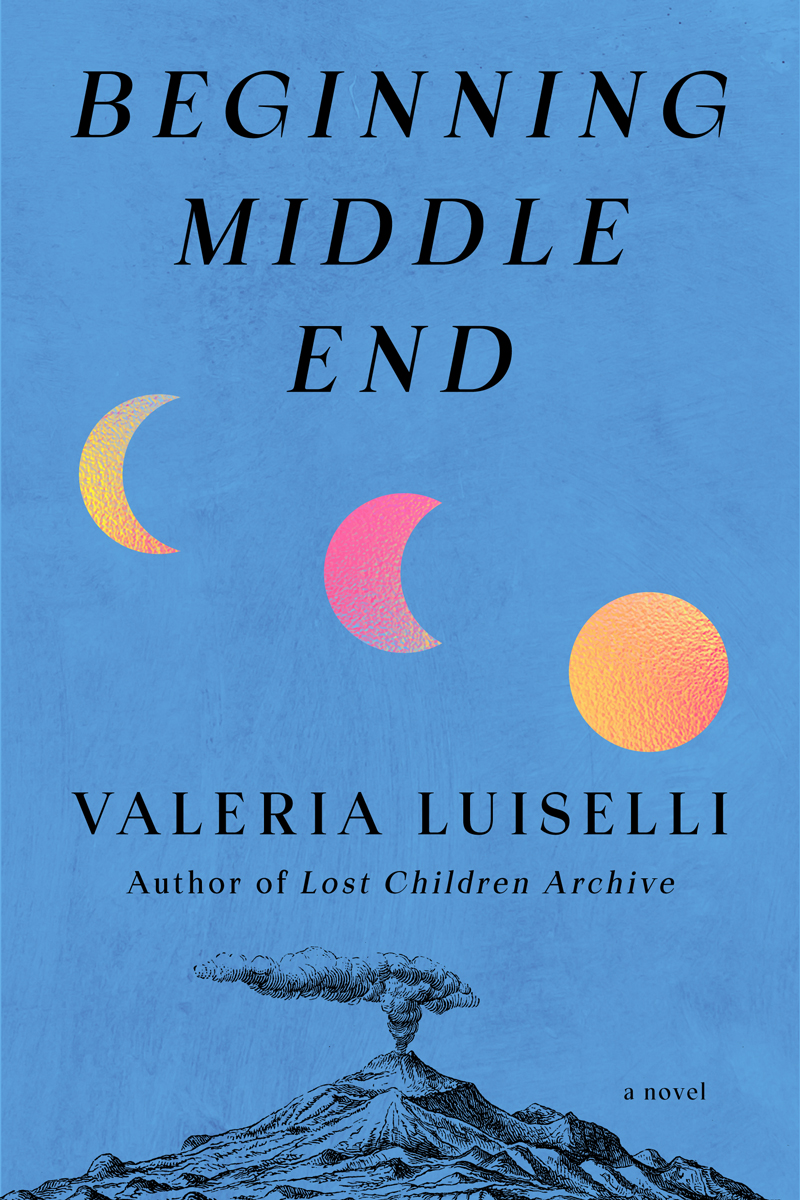
Beginning Middle End
by Valeria Luiselli
Knopf, 368pp
Valeria Luiselli, the brilliant author of Faces in The Crowd and Story of My Teeth, is a master of this genre. Her latest book, Beginning Middle End, is in many ways an investigation into this form of writing, which she undertook in English and Spanish simultaneously. The book’s premise is simple: Ella, a writer whose story resembles Luiselli’s closely, escapes New York City with her daughter Manuela after a troubled divorce. (Luiselli, a writer from Mexico City living in New York, recently split from the novelist Álvaro Enrigue, whose Now I Surrender echoes Luiselli’s first divorce novel, Lost Children Archive.) Manuela and Ella, whose names echo the feminine pronoun “ella” in Spanish (though they are not revealed until the end), bounce around from New York to Barcelona to Catania to Philosophiana in Sicily, and have minimal, intimate adventures. They walk around these cities aimlessly, staying in an empty apartment in Barcelona lent to them by Ella’s lover while he is out of town. When he returns and the dynamic turns sour, they flee and steal several volumes of his Loeb Classics. They ultimately decide to return an ancient mosaic that Ella’s grandmother, a Sicilian immigrant, had stolen before leaving her motherland behind. The mosaic depicts Proteus, an early Greek god of rivers and bodies of water, whose mythology holds an important place in both Sicily and Ella’s family history. While these plot points meander onward, mother and daughter receive intermittent messages from a boomer grandmother in Baja California, also named Manuela, who offers astrological prophecies while claiming to be part of an eco-guerrilla movement. Beginning Middle End loosely follows the structure of the Odyssey (24 chapters, with small sub-chapters in between) and is peppered with learned references to ancient Greek and Roman mythology, which mother and daughter read jointly for most of the book.
As the title suggests, the novel seeks to discredit the traditional storytelling mode where a narrative moves chronologically, linearly, from the introduction (beginning) to a central problem (middle) to a resolution (end). “In the beginning,” the novel opens, “was a mother and a daughter. Later, somewhere closer to the middle, there were other mothers and daughters, there were men, there were other people in general. But for now, it is only she and I, and a ray of sunlight enters the bedroom…then disperses into her face, and she is sleeping, and I put my hand on her forehead and gently wake her up.” Life, Luiselli tells us, stands at odds with the simple narrative rules that we inherited from the ancients. We no longer are born, get old, get married, have children and die; instead, there are many beginnings and many ends to our lives. The genealogy of these three women follows this idea—while Ella is in the middle of her life, her divorce grants her a new beginning, a reawakening. Manuela, the daughter, is at the beginning, but her innocent wisdom makes her oftentimes sharper than her mother, more resolute. Manuela, the grandmother, in her dotage and already losing her memory, nonetheless joins a guerrilla movement, a decision usually made during the flower of one’s youth.
There is a clever piece of scaffolding supporting the novel’s structure—mother and daughter are always reading either Pliny the Elder or Pliny the Younger. In the same way, the book cycles from Ella to Manuela, the daughter (or Manuela the Younger) and then to Manuela, the grandmother (the Elder), placing all of them in a kind of circular timeline. In this sense, one of the theses of the book is that, in Luiselli’s words, “parents think of their relationship to their children way too teleologically,” passing on their wisdom and letting them grow. Instead, as the interactions with Manuela, the daughter, remind us, “while we think we are simply reading and writing the world for them, our children are always, also, reading and writing us.” In this way, time itself becomes disjointed, and the three (or four, including the grave-robbing great-grandmother) women are set in a permanent continuum, outside the tyrannical cycles created by Luiselli’s men:
Most of our lives, we run between space and time, between beginnings and endings, trying to figure out where: where in the story are we now, what is the beginning and where is the end. But maybe there are no beginnings, and no endings, either. Maybe all there is, is the middle, bending, sinuous, constantly flowing back into itself.
• • •
Writing a novel can be oddly similar to having a crush—everything in your life, everything you read, hear, taste or smell is relatable to your beloved, forcing you to think about them constantly. The world becomes a sponge of experiences that redirect you to your sweetheart or, if you are a writer, to your book. This Broadernist genre of fragmentary, elliptical writing lends itself to this: a clever writer like Luiselli can redirect every experience (the purchase of a Polaroid camera, the voice of the GPS in the car, a dead fish in the kitchen) to the central experiences of the character’s life. And so, everything in her world becomes a symbol for what is being told—the Polaroid camera expresses Manuela the Younger’s longing for a family that has been ruptured by time, the voice of a GPS becomes “the lady who knows where to go” at a time when both mother and daughter seem particularly lost, the dead fish starts to stink up the apartment the way guests, after a couple of days, usually do. This form of writing is particularly fertile because everything you do or see can be integrated into it: every experience is doubled in meaning, and a seemingly quotidian event can be turned into a powerful omen.
“Writing a novel can be oddly similar to having a crush—everything in your life, everything you read, hear, taste or smell is relatable to your beloved, forcing you to think about them constantly. The world becomes a sponge of experiences that redirect you to your sweetheart or, if you are a writer, to your book. This Broadernist genre of fragmentary, elliptical writing lends itself to this: a clever writer like Luiselli can redirect every experience (the purchase of a Polaroid camera, the voice of the GPS in the car, a dead fish in the kitchen) to the central experiences of the character’s life. And so, everything in her world becomes a symbol for what is being told.”
In interviews, Luiselli has jokingly said that around “27%” of what happens in her book is true. The broader story (a mother and a daughter, a divorce, a great-grandmother coming from Sicily, Mexicans in New York and then in Italy) is certainly hers, and readers who are hungry for gossip might try to discern how much of this book relates to Luiselli’s own experience of her somewhat public divorce. That’s perhaps why Manuela the Younger is constantly asking questions about Ella’s divorce—questions which go unanswered in this fiction, as in Luiselli’s real, public life. But the parallels between Ella and Luiselli become blurred, and the experiences that are woven into the narrative help fictionalize the plot while also underscoring the resemblance to real life. At some point, the narrator admits: “I have, of course, used slivers of my own life, shades of moments, pluckings from a family lexicon to write fiction.” Manuela the Younger herself, she tells us, “is convinced that she almost drowned in a swimming pool in the shape of an electric guitar…like the girl in one of [her] books almost did.”
In an earlier and more artful moment, in which we see Manuela the Younger truly undermine her mother’s intelligence, Ella is confronted by a young journalist in Amsterdam about the autofictional or perhaps autobiographical nature of her books. Rather defensively, she states that neither is true. She tries to explain the fictional nature of her writing, but Manuela interrupts and starts reciting a monologue taken directly from the character of a girl, a daughter, who appears in Lost Children Archive, Luiselli’s previous novel. “It was a flawless delivery,” Ella says, “she had mastered the tone and spirit of the character, the talented little impostor.” The journalist looks at her triumphantly, and Ella gives in: “How was I to explain to him that my daughter was in fact impersonating the character, that she had learned the lines—that she was imitating me; and not me, her? How was I to say all this and not have both of us, mother and daughter, sound concerning?” This story, Luiselli has revealed in interviews, is part of the 27% of truth.
• • •
Manuela the Younger is wise, outsmarting her mother on more than one occasion. Manuela the Elder might not be as sharp, but she sends charmingly Boomer text messages that her granddaughter and daughter delight in decoding. The only character that seems to be destabilized is Ella, the single figure in the middle, who is trying to make herself anew while connecting and reconnecting with her daughter. The great-grandmother, although distant, is a kind of luminous presence whose rebel spirit (stealing an ancient mosaic, running away to the Americas) guides her progeny throughout the book. Returning to Sicily—which Luiselli regards as a border between Europe and Africa, both culturally and geographically—is an attempt to reclaim that lineage. The male side of the family, aside from scattered references to the father and ex-husband, is left relatively untouched. In this way, Ella is making and claiming a genealogy of her own.
To do so, Beginning Middle End combines high and low culture, experience and thought, personal and public, political and artistic utterances. Pliny and Virgil and Homer coexist with astrology, tourism and digital navigation. There are plenty of literary theory games, such as the Sebaldian inclusion of Polaroid pictures towards the end, the reworking of classical literature in modern and feminist terms, and the contemporary reading of Ulysses as a “human trafficker.” There is some customary liberal posturing—take, for example, the inclusion of fascist propaganda on the streets of Palermo, a series of fires engulfing Italy as synecdoche for global warming, and the sanctifying mention of Las Tesis, a Chilean feminist collective, as analogous to Seneca’s Trojan Women. In this way, the narrative moves in concentric circles, and the genre’s conventions allow Luiselli to extrapolate a series of political concerns and literary and intellectual interests from a simple story about a mother and a daughter. But such is the genre that Luiselli inhabits: a cannibalistic form of writing that encompasses the high and the low, the political and the literary, the artistic and the academic.
Beginning Middle End is at its weakest when Luiselli is too eager to exhibit her academic pedigree and her unerring politics to the reader, and at its best when the obsession with the relationship between mother and daughter is at the fore. After twenty-three chapters where the mother’s intelligence is routinely surpassed by her daughter, Ella finally gives up: the last hundred pages are reserved for Manuela the Younger, who re-narrates the adventures from her wise and simultaneously innocent perspective. Here’s where the conventions of the genre reveal themselves as easy, almost forgiving. Broadernist books—which devour experience (both real and intellectual) and only partially reorganize it—are both pleasant and inconclusive, addictive to read while never fully constitutive of original or definitive meaning. We are led to believe that Manuela the Younger’s soliloquy, which is this book’s ending, is in fact nothing of the sort: it is just another intervention, the latest in what will be an uninterrupted chain of women, through which knowledge passes but doesn’t ever quite settle. Beginning Middle End succeeds in its aim of revising traditional narratives but, while offering many openings, it finds no closure. The challenge for writing to come, for Broadernists looking to expand the genre, will be to inherit all its ambition and none of its capriciousness.