
The Pope is American. Dimes Square is full of Trad Caths, or at least it was a few years ago. What better time to turn away from the tacky exultations of Justin Bieber megachurches and towards the eternal might of Rome? Stained glass, flying buttresses, and thousands of years of history make the perfect bulwark to defend Western Civilization from the invading hordes. Never mind that many of the invaders—including most of Latin America—are Catholic, too, or that the Pope In Question says we should be nice to immigrants. Faith, famously, does not care about facts.
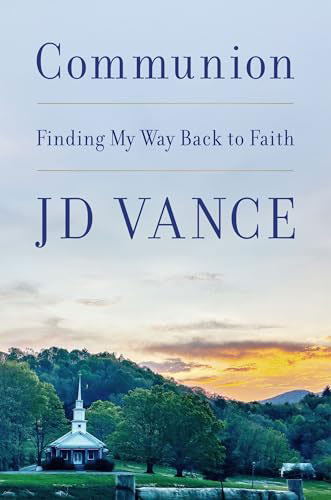
Communion: Finding My Way Back to Faith
by JD Vance
Harper, 304pp
Such is the fevered backdrop for a new book by America’s dauphin, Trump hater-turned-ally JD Vance. Our President-in-Waiting has stepped off the mount to offer us Communion, a suspiciously timed elegy for his atheist past and rapturous paean to his Jesus-come-lately Catholicism. Rubio may be Trump’s current favorite to take the throne, but we all know Little Marco is an empty suit. Vance, on the other hand, is the ideological heir to the MAGA movement. He is a symbol, too, of its contradictions—the immigration hawk with the Indian wife, the hillbilly elitist, the moon-faced champion of male virility. Just as the cross-in-the-cleavage blondes who stalk the White House halls decry feminism while girlbossing their own careers, so too can Vance mourn the loss of a Rockwellian America while hastening its decline via private equity, sobbing “Ay Dios Mío!” over the grave of every church demolished for a data center.
But it’s too easy to call out Vance for hypocrisy. He is a politician, after all. So pretend that someone else wrote this book. Pretend that it was written by a professor of Compassionate Capitalism at the University of Toronto, an airport book, with pull quotes from The Atlantic on its jacket. Feign this, and the book becomes surprisingly tepid, almost middle-of-the-road liberal, full of Ezra Klein-approved profundities.
Here is Vance describing his visit to Munich in 2024:
It is one of the most beautiful places in the world… I was struck by how much Munich seemed to be designed to make human life more enjoyable. The people who laid out the city, who designed and built its structures, seemed to have engineered it on a warm, humanizing scale.
American Experiences Walkable City for the First Time: Immediately Becomes Leftoid Urbanist. It’s a tale as old as low-cost airlines. He continues his rapture: “there’s something uniquely invigorating about places where everything is beautiful.” This is sort of like saying “nice things are good,” but we can let the redundancy slide, considering he’s in the midst of an ecstatic communion with the gods of high-density urban planning. Reflecting on America’s architectural failings, he gets explicitly anti-suburban:
Even rural Ohio counties have, as their county seat, ornate courthouses constructed in the nineteenth century. But for some reason we have chosen to govern ourselves, marry each other and shop for junk in increasingly soulless public squares and repeating commercial strips. This says something about us, although I’m not sure what.
“I’m not sure what” is a bit of aw-shucks gaslighting, a way to avoid telegraphing his obvious disdain for suburban America, a constituency he will need to elevate him to the presidency. He’s quite sure what it means. The car-centric sprawl he hates is a symbol of our vapid consumerism, the desiccated landscape of a people who’d rather buy straightening irons at Target than discuss religion with other intellectuals at a café table. Godless Americans who prefer the Quiznos drive-thru to sampling Red Leicester at the cheesemonger. And he’s right!
After finishing college in Columbus: “For many recent graduates, the dream neighborhood was the Short North Arts District—hip and walkable, with modern apartments and trendy coffee shops.” When he moves to Cincinnati, he brags that their historic home was only “a few minutes walk from downtown.” These adorable communities seem at odds with the America Vance actually inhabits: Trump’s America, where Melania is driven around Mar-a-Lago in her Chevy Tahoe, or perhaps his mentor Peter Thiel’s America, where an autonomous vehicle ferries you through 100-degree heat from startup office to an air-conditioned Pickleball complex. There are no “public squares” in these Americas, soulless or otherwise.
Such is the confusing fight for Vance’s soul, less between Rome and mainline Protestantism, or even atheism, as it is between warring aesthetics. On the one hand, he’s a trad-revivalist who wants period details. Cornices! Porcelain knobs! Crown moulding! You can hear him chiding the realtor, “WE WANT HISTORIC CHARM! YET ALSO CLOSE TO SHOPS AND RESTAURANTS!” And on the other, he’s drawn to an aesthetic that goes unmentioned in this book—the cold luxury of the new tech right. The Bezos-Zuckerberg-Musk-Kardashian nouveau riche tableau of indoor-outdoor living, pools with walls that become television screens, red-chip art, and NFTs.
“It’s too easy to call out Vance for hypocrisy. He is a politician, after all. So pretend that someone else wrote this book. Pretend that it was written by a professor of Compassionate Capitalism at the University of Toronto, an airport book, with pull quotes from The Atlantic on its jacket. Feign this, and the book becomes surprisingly tepid, almost middle-of-the-road liberal, full of Ezra Klein-approved profundities.”
Vance’s first book, Hillbilly Elegy, was poetic if overwrought, a bestseller-turned-Netflix schlock. Like many other politicians whose first memoir delights (Barack Obama), Vance’s sophomore outing is a more cynical cash grab, a plodding campaign platform disguised as thoughtful introspection. You might’ve heard of the minor scandal surrounding the book’s cover, a photograph of a white clapboard church, somewhere in the rolling hills of Appalachia. The church is actually Methodist, not Catholic, the image selected as a legible shorthand for small-town America, not the specific mysteries of the One True Faith. This, again, makes Vance a hypocrite. Big deal. More interesting to me is that the sunset is very orange, the trees are very green. You can tell they really upped the saturation, giving it a sort of elder-millennial-who-posts-to-Instagram-once-every-few-months vibe. Vance is a study in obfuscation, but what he can’t hide is how much of a cringe millennial he is. On discussing why men should do more housework: “In the immortal words of TLC, ‘a scrub is a guy who talks about what he wants and just sits on his broke a**.’” (Yes, he put in those asterisks. God doesn’t like swearing). On hearing a Church choir who miraculously sang the same song as a choir he’d heard previously, which, to Vance, proved the existence of God: “But to quote Samuel L. Jackson from Pulp Fiction: ‘You don’t judge sh*t like this based on merit.’” On facing child-rearing criticism from online commenters: “to parent an infant in the age of the internet is a punishment befitting the fallen nature of man.” Hrmmmm, methinks thou soundeth like a funko-pop liberal, m’lord!
And he knows it. Vance’s greatest struggle is renouncing his elitism while still signalling, through winks and nods, that he is smarter than the gold-plated chud in the Oval Office. Vance name checks David Brooks, Ross Douthat, even Christopher Hitchens, respectable never-Trumpers of the moderate intelligentsia, while simultaneously railing against striver culture, and its blind desire to acquire traditional talismans of success—a Supreme Court Clerkship, the nice house in the right neighborhood—those favored by the coterie of Yale and Washington. All of this handwringing screams New York Times reader, the kind who’d be appalled by the UFC fortress sloppily installed on the White House lawn. Occasionally, his biblical struggle becomes comic: “During conferences and speaking gigs, I enjoyed posing a subversive question. ‘Would you,’ I said, ‘rather have dinner with a former coal miner from East Virginia or a management consultant from Paris or London?’” It is telling how often his fantasies drift towards Europe.
Vance experiences his come-to-Jesus moment in a French cathedral. “I was working remotely,” he explains, “so we landed in Nice, rented a car, and spent a month driving around the country.” Spoken like a digital nomad in a $65 trucker hat from the SSENSE sale, the Vances’ French holiday is mostly a chance to discover art and architecture. In Burgundy, which he insists is “arguably the most famous wine-growing region in the world,” he finally finds God:
The setting sun shone through those giant stained-glass windows in such a way that you could actually see the rays of light in the dust floating in the air. I couldn’t stop thinking about the emptiness of the cathedral and what that said about Europe’s cultural decline and Christianity’s slow evaporation from the continent…
In that moment I felt a strange sense of possession. This church, in a foreign country, empty but for me and my family, felt like it was mine. I owed something to it, and it owed something to me.
Listen, I get it. It’s nice to have the place to yourself. Who hasn’t been moved by some gorgeous stonework? Who can’t get misty-eyed imagining the majesty an illiterate peasant must’ve felt marching into Sunday service? The peasant was lucky, too, because he wasn’t possessed by the godless desires of nabbing a Supreme Court clerkship or a penthouse in Dupont Circle. No phone to scroll, no likes to monitor. All he had to do was please God (and the clergy who were scraping a solid 10% of his annual grain output).
Usha, who lately seems possessed by the same demonic forces as Melania, with her ever-glassier Stepfordian stare, is presented as the other catalyst to Vance’s conversion, despite being Hindu. Various feminine modifiers surround her every motion— “pure,” “delicate”—Vance’s own Indian Mary, an incorruptible mother. In one of the book’s most New York Times moments, she lends him her copy of Joan Didion’s The Year of Magical Thinking. He tears through it in a single day.
His economic arguments are varyingly populist, self-righteous, anti-imperial, borderline left wing; at times he sounds like Henry David Thoreau. He likes the library. He hates Black Friday, not just for its feral acquisitiveness, but for the employees forced to work over Thanksgiving. He was turned off by America’s response to 9/11: “People back home were more interested in shopping, as George W. Bush encouraged them to do.” I remember those ads! I was 14 years old, looking at a full-page spread in the newspaper exhorting us to “go out and spend $20 on something you love: America.” I’m touched that my fellow libtard JD Vance was just as disgusted as I was by our grotesque patriotic consumerism. Capitalism has gone too far, he argues—nannies to raise our kids, delivery drivers to bring us dinner, nursing home attendants to care for our aging parents—not coincidentally, jobs often done by non-white immigrants.
He’s not wrong, per se. Life is more meaningful when we cook our own dinner. A community is richer when its residents aren’t siphoning cash to San Francisco for every sandwich they were too lazy to make. He wonders aloud if a country’s success can really be measured by “false prophets” i.e., conventional economists: “Domestic labor, if unpaid, is uncounted in a measure like GDP,” he writes, feministly. “We care about GDP in the Trump administration but we also care about wages, and how many people are dying of drug overdoses. If that means the GDP is a fraction of a percent lower, then so be it.” I’m sorry, is this the Republican Vice President or a radical French de-growther? Next he’ll want to measure Gross National Happiness, like Finland or Bhutan.
I was unmoved by his attempts to sell Christian Nationalism as the solution to the conflicts at Europe’s door. While his armchair psychoanalysis of NATO leaders as “mourning the unraveling” of the liberal order is perceptive, his assertion that their mistakes represent a “crisis of faith” is too pat. A more Catholic Europe, would have… what? Invaded Russia first? If only we could return to the peaceful days of the Holy Roman Empire! As if the Catholic Habsburgs and Bourbons didn’t wage endless wars over religion and territory and familial rivalries, all wrapped in the cloak of divine right.
Obviously, the specter of Islam haunts him, despite his hopes to be president of the United States, where the majority of new immigrants are Christian, and relatively few are Muslim. Yet we are beset by social divisions. To justify Vance’ cynical pivot, God is the only solution: “Apart from the military, no institution of American life successfully brought rich and poor, black and white, working class and college-educated together. Except the church.”
I can think of three more, actually, off the top of my head: football, gambling, Grindr. How many straw man arguments must we endure on the road to conversion? Vance’s theology is circular, although as an atheist, I’m inclined to feel that way towards most justifications for the existence of an Old Man In the Sky. Any doubt you might have, he argues, becomes further proof that your faith is being tested. Which of course proves that faith is real. On the church’s centuries of child sexual abuse, Vance concludes: “The Bible isn’t a fairy tale. It makes two claims very much in tension: that God is real and works divinely through His People, but that those people continue to fail and fail again.”
In other words: God is messy. God is a flawed female protagonist finally getting her Hollywood dues, thanks to daring projects like Fleabag. Every inconsistency, every unbelievable twist of fate, must be treated as further evidence of God’s divine truth. Because the truth isn’t perfect. It’s real. Vance wants America to have faith in him. To trust that despite all his contradictions, he believes everything he says. Does he really? God only knows.