Robert Dadd’s murder was announced to subscribers of the Kentish Independent in the summer of 1843 with two portraits—one of the victim and one of the killer, his son Richard. Both portraits were drawn by the younger Dadd, once a leading young talent at the Royal Academy of Arts. At the bottom of the page, the editors also included an unattributed etching of a quaint, leafy corner of Cobham Park, which sits uncomfortably above its label: “Scene of the Murder.”
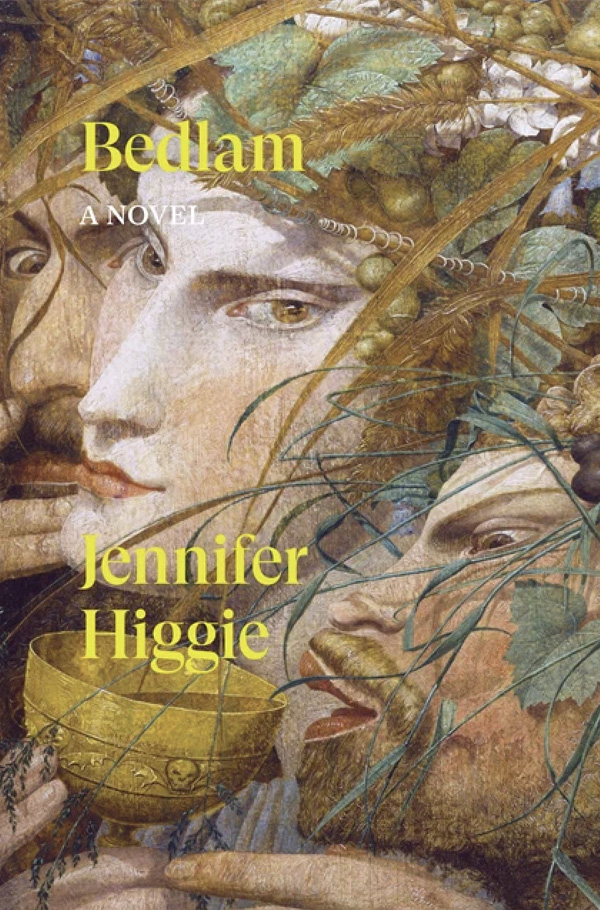
Bedlam
by Jennifer Higgie
Verso Books, 240pp
Bedlam, Australian writer Jennifer Higgie’s first book and only novel, is an account of a year in Richard Dadd’s life, leading up to the murder and continuing into his subsequent internment at Bedlam psychiatric hospital. In 1842, Dadd accompanied businessman and former politician Sir Thomas Phillips on a Grand Tour of Europe and the Middle East, acting as his draftsman. He sketched and painted the scenes, people, and landscapes they encountered while Sir Thomas footed the bill. Dadd got to travel and diversify the subjects of his works, and his patron got a trove of impressive mementos to show off back home in England.
But, seemingly overcome by the sensory overload of his travels and the intense heat of the desert, Dadd suffered a mental breakdown. Far from displaying the symptoms of ordinary sunstroke (Sir Thomas’ proposed diagnosis), he came to believe he was an instrument of the ancient Egyptian god Osiris, grew paranoid and withdrawn, and inferred sinister double meanings in every word and glance. Returning to England, his delusion culminated in catastrophe when he murdered his father, whom he deeply loved, convinced the man was a demonic impostor. Were he alive today, Richard Dadd would quite possibly be diagnosed with paranoid schizophrenia.
Bedlam’s author Jennifer Higgie is best known as an art critic and curator. She has written at length about spirituality, mysticism, and the divine in art, with a focus on female artists, and has curated exhibitions and written books featuring the likes of Hilma af Klimt, Georgiana Houghton, and Ithell Colquhoun. In my copy of the A-Z of Contemporary Art, the only entry for which she is the sole author sits under W—for “women”—focusing on the raw, erotic art of Carol Rama. So how did she come to write the story of Richard Dadd, told as if from within his own head? It’s not that her extensive background as an art critic—including years editing the contemporary art magazine frieze—shaped her understanding of Dadd and his story, but quite the opposite. Dadd shaped her.
In her 2023 book The Other Side, Higgie traces her career back to her initial encounters with Dadd. As an art student on a fellowship in London, she wandered out of an exhibition of young British artists a little dissatisfied; the work “sizzled with life but was too big and brash for my state of mind; it was like being shouted at in a pub.” On her way out, she noticed a sign for a side exhibition on Victorian fairy painting. In 19th-century Britain, the obsession with hyper-detailed fairy glens and supernatural folklore served as an apparent outlet for artists suffocating under industrialization, scientific upheaval, and repressed anxieties. There’s evidence that many fairy painters experimented with drugs to enhance their scenes and subjects, but Dadd didn’t need hallucinogens to perceive what others could not. His paintings draw on myth and literature, but also include curious creatures of his own making: winged dames and squat goblins, hazelnut-hedgehogs and daisies the size of human heads.
“Part of the joy of reading Bedlam, despite its uncomfortable material, is that it was born from the author’s genuine love and curiosity—it comes from an open-minded critic’s impulse to truly understand the artist and his art.”
Rather than treating Victorian fairy painting as mere nostalgic kitsch, fever dream, or escapism, Higgie dug deeper. “[B]roke, unemployed, and doubting [her] artistic abilities,” Higgie sold a painting and used the money to go to a Greek island. There, in the sweltering heat, she tried to imagine what Richard Dadd was feeling as he made his way across Europe in the company of a pompous former mayor. In one letter, Dadd had written to a friend: “I have lain down at night with my imagination so full of vagaries that I have really and truly doubted of my own sanity.”
Out of her mental wrestling came her first book, Bedlam, a stream-of-consciousness novel that struggled to find a publisher and sold very little when it was eventually taken up by Sternberg Press in 2006. This reissue by Verso, twenty years later, is a welcome second chance to introduce readers to both a fascinating 19th-century artist and an extraordinary art critic. In many ways, Bedlam is exactly what a first novel ought to be—puckish, bold, and unrestrained, an experiment in free-writing that few authors allow themselves. One prospective publisher’s reason for turning down the novel was that it was “too French.” One can easily imagine how a traditional editor would be at a loss on how to prune Bedlam and unable to fathom publishing it “as is” in a decade whose palate for unconventionality was not as pronounced as today’s.
Part of the joy of reading Bedlam, despite its uncomfortable material, is that it was born from the author’s genuine love and curiosity—it comes from an open-minded critic’s impulse to truly understand the artist and his art. I was surprised to discover that my favorite of Dadd’s pieces, a scene from A Midsummer Night’s Dream, was painted in 1841—a year before his sojourn across Europe and descent (or is it ascent?) into madness. Titania Sleeping is framed by outstretched bats and an oversized, blooming hedge bindweed (whose vernacular names include heavenly trumpets, white witch’s hat, and even wedlock—for its gown-like flowers and binding quality). The bindweed curls into an inner arch over the naked Titania and her pearly-skinned attendants, whose heads are graced with dewdrop crowns. Miniature goblins with cherubic proportions but sinister expressions perch on the leaves—some watching attentively, others playing botanic instruments—while a group of dancers appear to be frolicking out of the frame and into another world. The whole composition rests on a Fibonacci spiral that draws our eye not just to Titania, but deeper into the shadows to discover the barely visible Oberon lurking behind her. How can we reconcile the artist’s sensitivity and attention to beauty with the horror of patricide? Higgie attempts to find the answer in his brushwork: “His pictures make his state of mind clear,” she writes in The Other Side. “Surfaces are unstable, leaves tremble with energy, the sky blazes with portents; a hazelnut is as sinister as a child is malevolent; a game of chess a prelude to violence.”
On one hand, the book belongs to a long lineage of biographical novels about artists—classic psychological portraits like Irving Stone’s Lust for Life (on Vincent Van Gogh) or The Agony and the Ecstasy (on Michaelangelo)—and is certainly as thoroughly researched. Both Stone and Higgie used their subjects’ letters as their primary source material, as a way of getting in step with the artists’ tone and tempo. Yet there’s something far freer in Higgie’s writing that dodges the category’s tendency toward sweeping period-dramaesque chronologies. Though a painter herself, she’s seemingly uninterested in long descriptions of tools or technique. Her version of Dadd wastes no time ruminating on the details of his craft—both artist and writer are busy seeing.
In his paintings, the comfortingly pastoral and the deeply unsettling are constantly intertwined—and, most importantly, imagination is always more real than anything else. Higgie wants to know what it’s like inside Dadd’s head, how he performed his unique magic, translating the world as he saw it into extraordinary, accomplished paintings. She imagines how he thinks, how he moves, how he dreams:
I feel the slyness beneath my lids, how my eyes might look closed to one who didn’t know how to look. This is what I see. A small soft feather escapes and drifts away, a white thread curls in the cold night breeze. The miniature feet of tiny German mice whisper and tip toe around me. (Every living thing born.) The wood floor creaks. The suggestion of trees against the far wall, undeceived by my heavy lids, waving and bowing like old friends.
When visiting the Colosseum, Dadd finds himself “glutted on ruins,” and yet discovers it is like “a different place every time.” He cannot stomach the amphitheater’s history of suffering and spectacle, but soothes himself with the “certain peace” that taking up a drawing pencil offers:
History is more and more unclear to me. It is easier to draw, to look at the curve of rock or stone or brick and to try and fathom how it interacts with the sky and the earth than it is to contemplate the mechanics of the mind of the man who ordered that this violent architecture be placed so perfectly.
He’s thinking of Emperor Hadrian, of course, but he’s also beginning to unravel his thoughts about God and religion. His sleeplessness and agitation increase as they venture further south, and the rigid clarity of his Anglican upbringing completely disintegrates. He begins to wander the streets at night, watching the locals and visitors at the shoreline with a mixture of artistic fascination and moral panic:
I have seen women laughing as they lick the juice from the sailors’ unshaven chins, and seen a tongue covered with fish juice enter a painted mouth. These are scenes from Dante or Bosch. How I wish I were a Shakespeare to give them the descriptions, the moral context and the narrative they demand. But I am not. […] As a writer my observations are impotent. But as an artist, they are simply waiting for my interrogation.
His attention to aesthetics remains hyper-sharp from the time of his departure through Western Europe, the Alps, and the Mediterranean, even as his paranoia grows. He admires the light on the sea and the “sloping lines of its low horizon”; he notices how violently the “marble breathes […] in its death throes” in Athens. Yet, the physical world begins to morph and merge with his internal landscape. He sees “green hills” in shifting mounds of desert sand and envisions “scorpions the size of men haunting ruins.” Higgie’s prose mirrors Dadd’s art: she works with words in layers, like paint, lingering on the light on a particular tableau or acknowledging a darker energy vibrating beneath seemingly banal landscapes. She pushes the biographical novel into a state of radical interiority, operating as the artist in work of extended ekphrasis. In doing so, she distances herself from the likes of Irving Stone to find a place among more contemporary, form-breaking works, like Ali Smith’s How to Be Both and Max Porter’s The Death of Francis Bacon (though I insist that Bedlam is far more “readable,” awful as that word is, perhaps because Higgie was already developing the critic’s desire to take that ineffable quality about what moves us and make it legible to everyone else).
Higgie’s Dadd finds solace only in the perspicuity of nature, particularly the night and the ocean, which offer him a break from all the visual noise: “The sea front offers me some respite,” he reflects, “gay as it is with light and the sloping lines of its low horizon.” He clings to the water as an escape hatch: “[W]hatever the vagaries of my imagination, and however unsettled the place may have made me, there is always the ocean and the leave-taking it offers.” Whether this leave-taking implies a homeward-bound ship or more final exit is open to interpretation. Sir Thomas, increasingly alarmed by these bizarre outbursts, can do little but shield the young painter from the sun and encourage his fluid intake. He fails to see that Dadd is responding to a profound, terrifying spiritual shift—an oversight that makes Dadd deeply suspicious. He is preoccupied with Osiris and theories about the sun that have little to do with heatstroke (“Struck by the sun. Such an idea, a fist of heat. […] A blade of light, softened with mezzotint”). Ancient myth and history begin to hold more weight for Dadd than the world around him, until finally he buckles and returns home, nearly unrecognizable, soon to follow a near-spiritual impulse to patricide.
When Higgie reflects decades later on writing Bedlam, she continues to ask questions about his experience and what it means for ours: “How do religions die? At what point do they move from relevance to fiction and madness?” For Dadd, the ancient gods never died; they merely waited in the ruins for a crack to appear. Higgie’s radical approach to telling Dadd’s story suits her subject matter and brings to mind an essay by another frieze alumnus, Charlie Fox. “[A]n experimental spirit might be the canniest way to proceed with the critic’s task,” he wrote, “because what serious thinking about art really involves is throwing yourself into the stuff that’s frequently mute, tricky, dream-like and dragged from the jungle of somebody else’s consciousness to haunt your own.” Higgie paints a picture of an artist who “distrusted the surfaces of the world,” who felt overwhelming compassion and sought out beauty, but who also committed real-world horrors. Twenty years after its quiet debut, this novel stands as a testament to the kind of stories that are made possible when we blur our critical and artistic boundaries.