
America is in a time of God. America has always been in a time of God. Lost somewhere between eternity and Jetztzeit, Americans are haunted by imminent eschatons and questionable grace: a millenarian romance that promises redemption, a cleansing of a national conscience in the hopes that destiny will someday manifest. Take to the road, especially in “flyover country,” and you’ll become aware of the strained mysticism that thrives like kudzu along the embankments. Among the 1-800-U-HURT? billboards and fast-food alleys and jerry-rigged amusement parks (I’m thinking of a particular drive in Pigeon Forge, Tennessee, near the kinetic cathedral known as Dollywood) are thousands of churches, roadside crosses, even a few dormant revival tents. Turn on the radio and the airwaves are a susurrus of Godtalk: raspy stentors competing with the fragility of AM frequencies and the faithful’s attentions, hectoring and soothing as they issue final warnings to America’s sinners. These last vatic poets are everywhere, like the drone of tornado warnings across the Great Plains. Slow down near the estate sales and foreclosures (“LORD BE MY PROTECTOR” sprayed on the boarded windows), and the inevitable wash of radio static will begin to sound like the cries of the damned. Almost every soul in America is within reach of these sound waves; a storm indeed blows from Paradise.
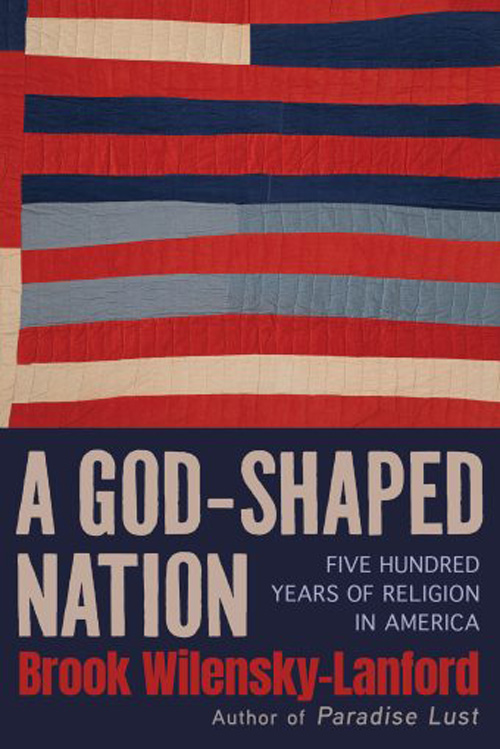
A God-Shaped Nation: Five Hundred Years of Religion in America
by Brook Wilensky-Lanford
Atlantic Monthly Press, 672pp
Though A God-Shaped Nation doesn’t touch on these “stations of the cross,” Brook Wilensky-Lanford’s history provides an exhaustive backdrop to America’s peculiar status as an OECD country in which the vast majority of adults believe in angels. This history, like modernity itself, is a narrative of uneven development, requiring multiple lifetimes and many libraries to tell in full. Despite this task’s magnitude, A God-Shaped Nation renders America’s religious odyssey with dazzling, kaleidoscopic breadth: a half-millennium of prophecy, heresy, hierarchs, shamans, demons, holy men, idolaters, preachers, revelators, and much, much bloodshed. It’s a convulsive history in which each generation believed they were the ones who finally saw the light. And while a book like this could tend toward the merely “interesting” or the grotesque, Wilensky-Lanford’s approach to her material is as broad church as it is sharp. Beginning with the conquistadors’ campaigns against the Taíno, justified by the Catholic doctrine of conversion and the imperial logic of the Spanish Crown, and ending in the present with the resurgence of Christian fundamentalism, the book moves through Wovoka’s Ghost Dance, Pentecostal egalitarianism, and the Black Church’s role in the Civil Rights Movement. We are provided with a two-sided approach: religion as repression and resistance; the battle cry of the oppressor and sigh of the oppressed; the language of the dominator and the vernacular of the street. Politics in America, just as life in America, has rarely not been religious.
Let’s begin, where else, with the Puritans. Their arrival at Plymouth Rock in 1620, hailed in school histories as the inauguration of American “religious freedom,” signaled the start of a theocracy based on original sin and a covenant of grace. Escaping persecution in England, the Pilgrims established a religious Bantustan on an already populated spit of Massachusetts to be closer to Heaven and farther from the Church of England. Soon, however, the escapees of despotism became despots in their turn. Enslavement and religious persecution served as the plinth to their Biblical monument. We may, as inheritors of their impulse, sneer at the Puritans’ hypocrisy, but Wilensky-Lanford reminds us: “To the Puritans, ‘religious freedom’ was the freedom to practice their own religion, and only their religion, as they saw fit.” And in the Puritan religion, everyone was automatically bound for damnation due to original sin; God’s grace alone saved the poor wretch from hellfire. This created a state, both civil and spiritual, where one could never be sure who was Elect and who wasn’t. Their time of God, living the truth of predestination, was thus a paranoid hunt for heavenly signals. Was Prester John rich because he was Chosen? Was a miscarriage, an illness, a sign of God’s disfavor? We are no strangers to this cruel interpretive impulse. Neither, alas, were the Puritans. To become a proper church member “required [publicly] narrating how the events of one’s life seemed to point to God’s favor—the birth of a healthy child, an abundant harvest, an answered prayer.”
The Plymouth Pilgrims were too hardcore, even for other Puritans. In 1629, a non-Separatist colony was established in Massachusetts Bay. Then, on the basis of yet more accusations of intolerance, a Baptist outpost was set up in Providence, Rhode Island. The Baptists represented a great leap forward in American religiosity, establishing patterns still discernible today. Allowing for bracketed dissent, the Baptists embraced a devolved hierarchy of churches, often using adherents’ homes for worship. Stressing, like their Puritan siblings, a direct relationship with God, they held less to the draconian restrictions of Predestination and more to Arminianism, which taught faith and good actions could lead to sinlessness on earth. While John Winthrop’s “City upon a Hill” was built by captive hands, Roger Williams’s Providence refused to be a house of bondage (for a time, at least), positing instead a “ship of state” where civil and religious laws remained separate. No longer could one be seditious to a state of grace. Instead, the foundations were laid for a defining feature of American society: disestablishment. Later, this would be constitutionally enshrined as the “separation of church and state.”
“America is in a time of God. America has always been in a time of God. Lost somewhere between eternity and Jetztzeit, Americans are haunted by imminent eschatons and questionable grace: a millenarian romance that promises redemption, a cleansing of a national conscience in the hopes that destiny will someday manifest. In A God-Shaped Nation, Brook Wilensky-Lanford’s provides an exhaustive backdrop to America’s peculiar status as an OECD country in which the vast majority of adults believe in angels.”
Disestablishment landed strangely. Rather than leading to “enlightened” secularism—say, Jeffersonian Deism—the opposite happened. The realm of politics became supercharged with religiousness, and religion with politics. The first decades of the American republic were an algae-bloom of funky new sects, each painted a brighter shade than the last. So-called “energetic” Christianity invoked the intoxicating now-time of Imminent Arrival, requiring preparations for the Judgement. In the mouth of a Methodist circuit-rider in the revivalist Blue Ridge, Jesus’ injunction “abandon thy father and thy mother” must have sounded quite radical. A little later, the Sermon on the Mount’s “Be thou perfect” was interpreted literally by Pentecostals, who experienced collective rapture in sweaty tents and spoke the tongue of angels. Partially because there was no official state religion to control aberrations, republican America became a petri dish of spiritual furies. And because so many of these furies claimed to live truth, bringing God’s time into man’s, the order of the day was not interpreting signs but calls to action—to purify the body and soul. This could result in mass fire sales of personal belongings, as many did in preparation of a prophecy by one William Miller, who calculated the exact date of the Second Coming as October 22, 1844. This could also result in John Brown’s great sacrifice at Harper’s Ferry, which he claimed to have done “in behalf of [God’s] despised poor,” quoting the passage from the Old Testament: “Remember them that are in bonds, as bound with them.” It seems that, since then, the options for American radicals have not changed much: either join a doomsday cult or become a martyred abolitionist.
After the purification ritual of the Civil War, Wilensky-Lanford argues that “civic religion” was applied as a salve to national wounds. “America’s original sin of slavery had been redeemed and the nation reborn as one.” While Lincoln’s assassination allowed for an obvious Christological narrative—his martyrdom for America’s redemption—more medievally strange was the alternate civic religion of the Lost Cause, “its adherents calling Reconstruction the sin and themselves the redeemers.” Among other things, it held an ossuary for Robert E. Lee’s horse’s remains on the Washington and Lee campus in Virginia, right next to the general’s own crypt, and required teams of armed missionaries known as the Ku Klux Klan. A doldrum in A God-Shaped Nation, the post-Reconstruction era is a story defined by populism and fundamentalism (conflated in the figure of William Jennings Bryan) and the rising sun of middle-class morality (which stood hard on Prohibition but flagged on anti-lynching laws). Its ineluctable sense of progress was always mottled with bloody atavisms. For example, when the transcontinental railroad was completed on May 10, 1869, a Congregationalist minister called it, in his benediction, “a highway for our God.” Wilensky-Lanford reminds us that this came, as ever, at the expense of other people’s land, other people’s gods.
Each generation thought they saw the light, but the medium of the light changed. In addition to disestablishment and mass death, techno-spiritualism is a defining feature of American society. Samuel Morse’s first telegraph message was “What hath God wrought.” Electricity was seen as evidence of the Holy Spirit. After World War II, the atom bomb and the radio conspired to form a new religiosity in American life, which included adding the subclause “under God” to the Pledge of Allegiance and a new “media crusade” to capture postwar youths not for consumerism but for Christ. Billy Graham is Wilensky-Lanford’s Napoleon of this postwar techno-revival. Though doughty figures like Father Coughlin existed before Graham, his ability to use the rhetoric and technologies of war—radio and television; crusades and Atomic Armageddon—made him a hugely important figurehead in American religion. Graham captured the quiet desperation of Levittown America, promoting a faith-based salvation that, in keeping with Pentecostalism and his own Southern Baptist faith, required enthusiastic declarations of submission: “Give your life over to JE-SUS!” Graham’s popularity soon translated into political cachet when, in 1953, he started the National Prayer Breakfast. If the state didn’t really watch over religion, a newly technically endowed religion certainly began to watch over the state. The televangelist and his megachurch became one of the cornerstones of modern American politics, melding media-populism with market fundamentalism: Reagan its saint, Trump its terminal moraine.
Malcom X once said that noon on Sunday is the most segregated hour in American life. A God-Shaped Nation demonstrates this in detail. While the Moral Majority’s revanche de Dieu continued apace, the moral minority worked in the dusty corridors and clapboard churches of America’s dispossessed. Wilensky-Lanford provides a more or less careworn narrative of Martin Luther King Jr. and the Southern Christian Leadership Conference, emphasizing the importance of the Black Church to the Civil Rights Movement, and closes the good Reverend’s hagiography with his moving Pisgah sight in Memphis. After the passage of the 1964 Civil Rights Act, however, the white evangelical bloc mobilized to use “religious freedoms” in favor of anti-integrationist schools and policies. Next came the anti-abortion movement. At this point, American history begins to resemble not a parabola bending toward justice, but a spiral curling in slant rhyme.
A God-Shaped Nation ends with a headshake of heavenly woe. The “Puritan idea of religious freedom” has returned; principalities of evil reign over an ever-closer union of church and state. A God-Shaped Nation forms a mosaic sketch of American religions, particularly revelatory on the twin forces of disestablishment and techno-spiritualism. While no book covering 500 years can do everything, the lacunae in cultural and existential matters in A God-Shaped is indicative of the limits of its approach and (left-liberal) politics. Where’s the music? Where’s the metaphysics? Here, the need for religion’s enchantment goes largely unexamined. A different book might start with the Spanish conquest and end with Keto’s strange atonement. Or the lucrative appearance of Toast Christ. Or the fact that the most popular comment on Facebook is reportedly “Amen.” André Malraux once said that the twenty-first century will be religious or it will not be. These, I suppose, are questions for us to figure out for ourselves, driving down the highway, listening to the radio—attempting to live a true life in a false world.