July 1959: Paul Celan and his family are vacationing in the Swiss Alps. They’re in Sils Maria, where the poet’s beloved Nietzsche sent Zarathustra up into the mountains—where he is to meet Theodor W. Adorno. Celan incorrectly assumed that the philosopher’s oft-cited statement, published eight years earlier, “After Auschwitz, to write a poem is barbaric,” was made in reference to “Death Fugue” (1948), then and now Celan’s most famous poem, a ghastly Holocaust collage which the poet himself would later renounce as too stylized. The meeting never happens; Celan returns home to Paris early. But some months later, he imagines what it might have been like in his only work of prose fiction, “Conversation in the Mountains” (1960).
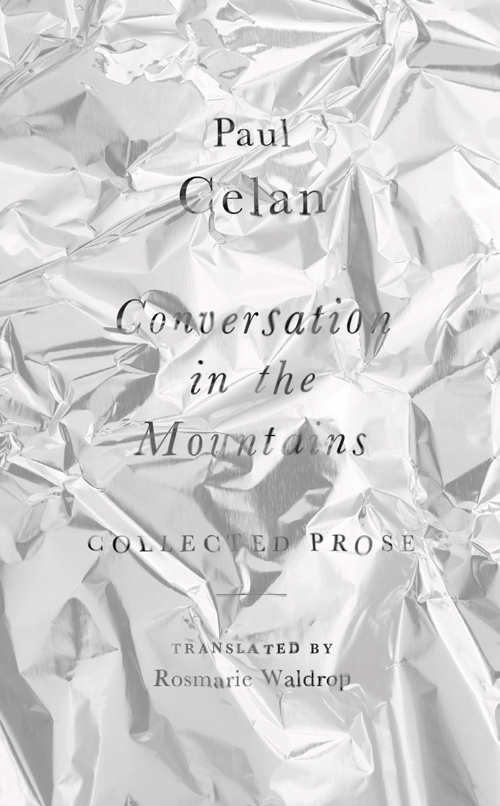
Conversations in the Mountains
by Paul Celan
Translated from the German by Rosmarie Waldrop
New Directions, 80pp
Celan fashions himself a solitary traveler, his prose invoking Georg Büchner’s Lenz (1839), Franz Kafka’s “Excursion into the Mountains” (1913), and Zarathustra in one fell swoop, as he writes, in the poet Rosmarie Waldrop’s translation:
“One evening, when the sun had set and not only the sun, the Jew—Jew and son of a Jew—went off, left his house and went off, and with him his name, his unpronounceable name, went and came, came trotting along, made himself heard, came with a stick, came over stones, do you hear me, you do, it’s me, me, me, and whom do you hear, whom do you think you hear, me and the other …”
The sentence goes on until the story doesn’t so much conclude as end, in a manner reminiscent of Beckett’s short prose. “Conversation in the Mountains” is the centerpiece around which Waldrop organized her 1986 translation of Celan’s collected prose, now republished by New Directions. The book compiles all the prose published in his lifetime (a scant 80 pages in this edition, which is to say, not a lot). Forty years ago, little of Celan’s output had been translated into English. What might have been reticence or balking on the part of translators at the “impossible” task of conveying the poet’s expansive wordplay and obscure allusions has been allayed by the prodigious output of his works available in English in the years since. In 1989, George Steiner, writing in the New Yorker, posited that “much that we cannot grasp in Celan’s poems may one day be cleared up.” That elusive day is perhaps yet to come; happily we return to the weeds. Waldrop’s original introduction articulates a paradox at the root of his prose: “For Celan, whose poems moved ever closer to silence, prose was too noisy a medium.” And yet, as this collection traces, occasions arose in which Celan was commissioned to write in prose, to give a speech, or introduce an artist or writer. These invitations grew infrequent as his later poetry became denser, more reticent—in the last nine years of his life, he published three poetry collections, yet only three short prose texts—but the collection does succeed in “defining the place from which Celan writes,” as Waldrop notes.
Much has been written about Celan’s trouble with his native German language. He was born Paul Antschel in 1920 in Czernowitz, present-day Ukraine, then part of Romania, to a Jewish family with Orthodox and Hasidic backgrounds. While at home, the family spoke High German interwoven with Yiddish: In the area around Czernowitz, Yiddish was commonly spoken in addition to Romanian and Ukrainian. His Zionist father sent the young Celan to the local Hebrew school, but shortly after his bar mitzvah, Celan abandoned his Hebrew studies and his father’s ideology, instead attending local communist youth groups and involving himself in antifascist activities. He would go on to receive a classical German education at the behest of his mother, who had a particular affinity for the language and its literature. Celan studied medicine in France in 1938 and was pursuing a degree in literature back home when the Soviets invaded in 1940. A year later, when the Romanians retook their city, they began deporting the Jewish population at the behest of their Nazi allies. His parents—who had refused their son’s pleas to lie low—were deported one night in 1942 while Celan was hiding out with a friend. Celan soon received news of their deaths, his mother’s from a wound to the throat. He would never shake the feeling that their fate was his responsibility. That same year, Celan was sent to a labor camp run by the Romanian army in Tăbărăști. He managed to survive, and by 1948, he had relocated to Paris where he lived for the rest of his life. Once, when asked why he wrote in German, he replied: “Only in the mother tongue can one speak one’s own truth. In a foreign tongue the poet lies.”
Despite this imperative, Celan’s “Conversation in the Mountains” engages Adorno’s aphorism, by wondering how either could use their mother tongue after Auschwitz. When the two at last meet in the story, the poet of the “Death Fugue” writes: “And who do you think came to meet him? His cousin came to meet him, … came, tall, came to meet the other, Gross approached Klein, and Klein, the Jew, silenced his stick before the stick of the Jew Gross. The stones, too, were silent.” The humor, the wordplay, disarms us. Celan continues: “It was quiet, quiet up there in the mountains. But it was not quiet for long, because when a Jew comes along and meets another, silence cannot last, even in the mountains.” A few paragraphs later, Celan ironically describes these two as Geschwätzigen, translated by Waldrop as “windbags.”
The German word takes its root in schwätzen, which in English approximates as “to idly chat.” Celan’s interlocutors’ speech is hollowed out. And yet, when Klein and Gross at last converse, the latter asks the former: “The stones—to whom do they talk?” To which Klein responds: “To whom should they talk, cousin? They do not talk, they speak, and who speaks does not talk to anyone, cousin, he speaks because nobody hears him, nobody and Nobody.” Here, Celan makes an important distinction, between redet and spricht, well translated by Waldrop as “talk” and “speak,” the former more redolent of schwätzen and the latter laden with meaning as the language of poetry, Celan defining a space for it within their shared mother tongue while answering the earlier assertion of his “cousin.”
One of the benefits of this volume is that the majority of its texts were written during a narrow period from 1958 to 1961—aligning with the height of Celan’s recognition and the composition of his 1963 collection The No-One’s Rose. This makes it tempting to consider the collection something of a lodestar. We’re invited to hear resonances across these texts, attended to and guided by Waldrop’s translation, and the opacities and allusiveness that add to the complexity of a speech like “The Meridian,” given by Celan in 1960 on the occasion of his winning the Georg Büchner Prize, are elsewhere clarified in other texts.
Take, for instance, the first of his two responses to questionnaires by the Flinker Bookstore in Paris. Published in the shop’s annual Almanach in 1958, Celan’s response contains a directness that borders on ironic. Speaking of German poetry vis-à-vis French poetry, Celan is both vulnerable (“No matter how alive its traditions, with most sinister events in its memory, most questionable developments around it, it can no longer speak the language which many willing ears seem to expect”) and cutting (“This language, notwithstanding its inalienable complexity of expression, is concerned with precision. It does not transfigure or render ‘poetical’; it names, it posits, it tries to measure the area of the given and the possible”). Here, Celan not only establishes the historical conditions with which his poetry must contend, but also how he himself considers his mother tongue to have been transformed by the Holocaust. Importantly, these texts show how Celan, as a Jewish person reclaiming the language of the perpetrators, used the German language in his poems.
The collection also facilitates a reading that these statements come from a writer striving to reclaim a sense of political agency. In an aside in “The Meridian,” unusual in its direct reference to political theorists, Celan tells the audience that he “grew up on the writings of [the early anarchist writers] Peter Kropotkin and Gustav Landauer,” after referring to poetry as “an act of freedom.” A year later, however, in his second response to the Flinker questionnaire, which builds on his claim that bilingual poetry is impossible, he writes that “Double-talk, yes, this you may find among our various contemporary arts and acrobatics of the word, especially those which manage to establish themselves in blissful harmony with each fashion of consumer culture.” The scathing tone contrasts with the staid, occasionally funny, sometimes romantic one found elsewhere, and serves to further underscore the poet’s long-held political commitments alluded to in “The Meridian” as being an aspect of his poetics.
One of the benefits of Conversation in the Mountains is that the majority of its texts were written during a narrow period from 1958 to 1961—aligning with the height of Celan’s recognition and the composition of his 1963 collection The No-One’s Rose. This makes it tempting to consider the collection something of a lodestar.
Waldrop’s introduction refers to the “groping complexity” of “The Meridian.” The adjective reveals her own relationship to the difficult writer, whose entire poetics could be described as a reaching for—as opposed, say, to actually grasping—meaning. In a speech given two years prior, when receiving the Bremen Literature Prize, Celan articulated how after the Holocaust, he wrote poems “to orient myself, to find out where I was, where I was going, to chart my reality.” This is echoed in “The Meridian,” where he writes: “I am looking for all this with my imprecise, because nervous, finger on a map—a child’s map, I must admit.”
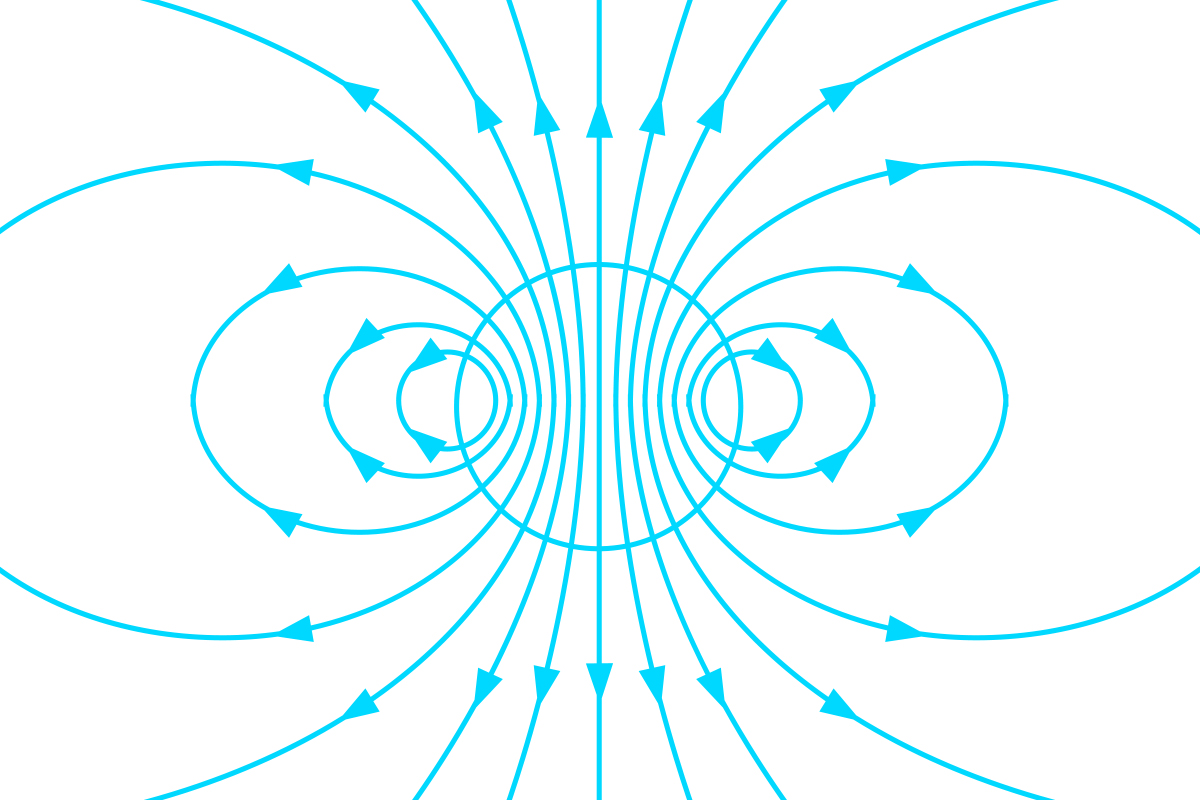
Celan’s charting, his maps, the “u-topian” project (the hyphen finds its way from the original “Meridian” to the translation, holding open the gap of that impossible location): all these suggest that the movement of his poems is not that of a vector, but a magnetic field. It’s in that same gap—between the topos and its realization—that his politics and poetics meet. Such resonances also play out in Waldrop’s work, whose poetry mapped the revelations of twentieth-century physics: matter dissolving into forces and vectors and what happens between them, a world no longer of substances and actions, but of occurrences. Just one year after the initial English publication of Celan’s book, Waldrop would publish the first volume of her trilogy Curves to the Apple, which takes the tension between the organic and the electromagnetic as its framework. Her own quantum mind is at work when, in “The Meridian,” she renders Celan’s Toposforschung—literally “topos research” or the study of recurrent motifs—as “topological research,” referring to a geometric object whose integrity is preserved under continuous deformation. Her topology not only serves as a metaphor for her own act of translating Celan, but also for the pressures under which Celan places himself and his own language, the bulwark he can write against in order to recover his mother tongue.
By 1960, Celan held no illusions about his utopian project: “The absolute poem—no, it certainly does not, cannot exist.” And yet, he groped, to borrow Waldrop’s term. His late work, which would go the way of the magnetic field, words breaking apart, the reader left to garden the gaps of his atomic structures, nevertheless contains a kernel of that early ethos, found in that in-between of his margins, the field of his language. “The poem holds its ground, if you will permit me yet another extreme formulation, the poem holds its ground on its own margin. In order to endure, it constantly calls and pulls itself back from an ‘already no-more’ into a ‘still-here.’” We too embark upon Celan’s impossible project—one that, like the poem, holds its own margin.