
“You are not God, though in God you are drowned.”
As a child, nothing infuriated me more than my father’s inability to give me a straight answer. A question about the city of his birth would digress into a story about the magi, those Zoroastrian intellectuals trained in astronomy and spiritual worship. Hadn’t I learned of the Three Wise Men from the east in the Bible? Those were Persians! And if I needed to know the name of his primary care physician for an insurance document: Ibn Sina’s five-volume journal of medicine taught the European doctors everything they know about anatomy. The definitive pedagogical text in Greek and Italian universities for 600 years!
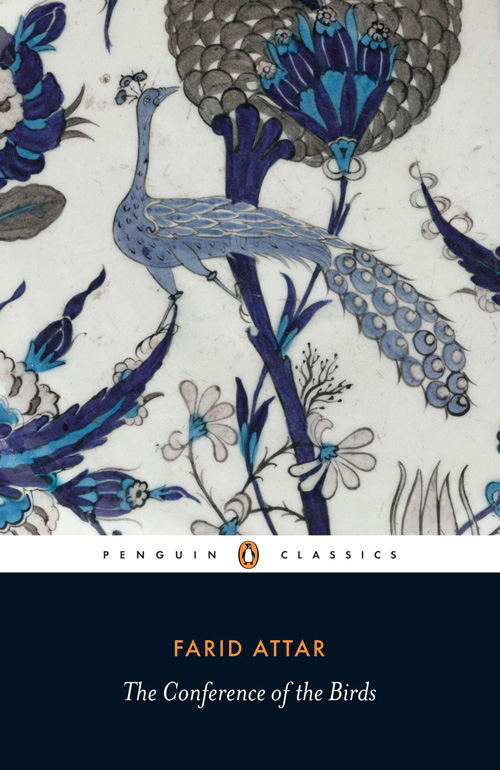
The Conference of the Birds
By Farid ud-Din Attar
Translated from the Persian by Afkham Darbandi and Dick Davis
Penguin Classics, pp. 240
There are things you know, things you don’t know, and things you don’t know you don’t know, to bastardize the words of an infamous bastard, former US Secretary of Defense, Donald Rumsfeld. I was all of ten years old, translating for my father with this insurance representative on the phone, with no clear sense of what I was meant to deduce.
“Act as a lover and renounce your soul.”
It’s no surprise that The Conference of the Birds is one of my father’s favorite texts, and Farid Ud-Din Attar among his favored poets. What’s curious about the translation of the title is that manteq, here accepted to mean conference, is also the Farsi word for logic, as in, The Logic of the Birds, suggesting that complex cognitive reasoning is an endemic psychosocial feature of birdlife, rather than what humans may simply project onto them.
The book was first composed in the 12th century and it’s gay as fuck. Gay doesn’t even begin to scratch the surface of its repeated, and almost hypnotic, overtures to the profundity of homosexual desire. A full page on the exhilarating beauty of a boy, followed by a comical brevity of lyric to acknowledge that the girl who burgled that boy’s attention away from the King’s lustful cloister perhaps, just maybe, had a nice smile or something.
Attar chronicles the quest of the world’s birds as they search for their one true leader while, one by one, the wise hoopoe poetically lambasts each bird for their doubt, their vanity, their partiality to comfort, etc. Interspersed are additional vignettes in verse—some linked, some not— that correspond to real historical figures. Attar recounts these vignettes in the Sufi tradition, flipping the traditional hierarchy of social class, such that the lords and constables are shown to be fussing over nothing, while dervishes and beggars practice true enlightenment through a dignified detachment from the distractions of the material realm.
Attar, and my father for that matter, understood the anecdote to be an allegorical and pedagogical form and, though this scholarly-poetic concern for archetypal representation is commonly associated with Carl Jung, Attar predated Jung by an order of centuries.
More than simple asceticism, the vision here is to dispense with ego, idolatry, and selfhood, and to sublimate that liberated psychic energy into a devotion to God, by using all the technologies of divinity at your disposal: wine, passionate sex, and submission.
Could I adopt the wise logic of the plebeian birds for a week? With Attar as my guide, I’d try.
Day One
“How long will you persist in blasphemy?
Escape your self-hood’s vicious tyranny –
This exercise in spiritual living coincided with the launch of my debut novel, No God but Us, which demanded that I get creative with the assignment. How to transcend the vicious tyranny of selfhood, when the author must now shoulder the responsibility for marketing their own book? No social media break for the wicked, or however that idiom goes.
I’ve been guerilla marketing for weeks. The short swamp toad on Grindr— whose previous dozen or so messages I’d ignored— finally gets his wish for a nude granted, but only if he’ll follow the link and buy my book. Unfortunately, a gooning homosexual will say just about anything to narrow the proximity to his desire. Proof of purchase or the deal’s off.
Whether I self-promote the book or not, I’m doomed from the start. There’s nothing more egoistic than publishing a novel. Long before artificial intelligence began undercutting whole industries, it was the control-freak God-complex of the novelist that did away with the collaborative trappings of theater and performance, or the anonymity of epic poetry, to bravely face what was once described as “the Culture” and roar: “Not We, I.”
I type another reminder about the launch event into the ionized glass of my digital interface and share it across several platforms. I do not evade the self. I do not ascend.
Day Two
“But you must empty this first glass; the wine
That follows it is love’s devoted sign.
If petty problems keep you back— or none—
How will you seek the treasures of the sun?
In drops you lose yourselves, yet you must dive
The launch venue I’ve chosen is large, very large, large enough to have warranted multiple gentle check-ins from friends about whether it is not, in fact, too late to consider downsizing to a more modest bookstore instead. Alas, it is too late. My hubris gnaws at me.
Thankfully, there is wine, the term I’ll use as the atavistic stand-in for my preferred substances, which induce a similar albeit more pronounced experience of sexual disinhibition, or what Attar might call love’s devoted sign. One glass, two glasses, three. Hours vanish this way. I dive through untold fathoms of flesh, alive despite my best efforts.
With non-fiction, you can hide behind the premise of the journalist or the scholar; there are certain conventions of the form that constrain the author’s full creative possibility. No such safeguard exists in fiction. Didn’t I once counsel my own students that for every rule of creative writing, I could show them a novel breaking that rule, exquisitely. Did I take the right risks? When my mind is adjudicated by the world, will I have imagined enough?
I try to cover my face with the back of my palm, but the truth will not stay hidden. A single teardrop turns to two, three, and then many more. There’s no way to continue with sex. I allow myself to be comforted. Everything is going to be okay, Q says. I ask him to repeat it.
Day Three
I wake up immersed in a newfound tranquility. I have singlehandedly navigated the sailboat back from the shores of the underworld. Once you have cried during sex—not a lone tear traveling down your cheek or the subtle moistening of a pillow, I mean really bawling—how bad could a book launch really be? The novel will have the journey meant for it. Already, it has taught me patience, discipline, humility. What it does for anyone else now is a gift.
Day Four
“Love ambushed me and at its sudden stroke
One of Attar’s more harrowing vignettes follows an effort by Sheikh San’an to court a Christian girl. In pursuit of her love, the Sheikh abandons his faith, his custodianship of the ka’aba, his community, his dervish cloak, and his freedom, travelling all the way to Rome and agreeing, at the girl’s insistence, to labor in the filth among the dogs for a year before she’ll even consider his bid. At the conclusion of the year, she renounces him for his impoverishment, demanding that he bring her gold and silver he doesn’t possess.
It’s the morning after the launch and the last of my guests just departed. In an extremely diverse place like Brooklyn, New York, with an enormous number of gorgeous gay people of color, it is a choice to fuck white people instead. I rub my nose. The options are slim this late and my faculties are weak. I walk over to a neighbor’s apartment and a second gay man I wasn’t told about is also there. I guess the pair were expecting to ambush me into a surprise threesome by baiting me with the more attractive one. Fucking tweakers. This is not the first time this has happened, but it is the first time that I have had the wherewithal to promptly remove myself and retire to my chambers. Not today, Christian girl.
My beloved friend M, who is an English professor, informs me that, at roughly the same historical moment Attar was writing in present-day Iran about the folly of interracial love, analogous stories were circulating in medieval European literature about the cruel figure of a Muslim man, who preyed on the faithfulness of a Christian girl to trick her into devotion.
“I wake up immersed in a newfound tranquility. I have singlehandedly navigated the sailboat back from the shores of the underworld. Once you have cried during sex—not a lone tear traveling down your cheek or the subtle moistening of a pillow, I mean really bawling—how bad could a book launch really be?”
Day Five
“Harvest your longing for it is the cure
I arrive in Atlanta, a city I once considered relocating to, partly for an old lover, and partly because M lives there now, in the same gorgeous home where, one winter several years ago, while cat-sitting her aging orange tabby, I almost lost my mind. It’s gray and gloomy. The city announces a flash flood warning, directing residents to seek shelter right when my launch event is set to begin, and it draws up the bitter taste of failure from the last time I was here, back when I first realized that the lofty pillow-talk of said lover was all guff.
These endless hyper-policed highways. The lit-up billboards feebly responding to the city’s surging HIV crisis. M and I discuss that fateful trip. She says, at least I know for certain now, and she’s right. I let the river run its course. If I hadn’t, perhaps I’d still be wondering.
Day Six
“Detachment is a flame, a living flash,
That will reduce a hundred worlds to ash;
Its valley makes creation disappear,
On our drive south for the book tour, M and I stop at some natural springs in the Florida aquifer system. There’s a large statue of Osceola, a native Seminole leader whose rousing oratory in 1834 persuaded the council of tribes to join forces, fight the Americans, and refuse the forced removal of indigenous people from the area, leading to the Great Seminole War of 1835-42. The Americans suffered many more casualties than the Seminoles, and they navigated the terrain with great difficulty. Many accounts suggest Osceola was winning until the Americans captured him through deception and killed him.
The psychedelics are starting to hit. My vision infuses with squiggles of cartoon heat waves. A hawk circles overhead and plummets to the grass to snatch an unsuspecting snake in its talons. There is no such thing as my book. There are only the infinite echoes of the sun.
Day Seven
“I lose myself within myself; I seek
For strength in being poor, despised and weak.
When poverty’s bright sun shines over me,
My father was never one to derive meaning from his objects. I could postulate that it was a consequence of losing so much to the refugee experience— a homeland, proximity to his family, his name, whatever didn’t fit inside a suitcase—but I’d be putting words into his mouth. He drinks his Johnnie Walker neat. He nurtures a fig tree sapling into adolescence. Once a week, he practices his harmonium in the corner. Back when he was a child in Herat, what did he dream of his life becoming? I couldn’t tell you. He’s the happiest man I know.