The Four Agreements: A Practical Guide to Personal Freedom, by Don Miguel Ruiz, is a self-help book that was a true publishing phenomenon: more than 15 million copies were sold, and the book spent over ten years on the New York Times bestseller list, having received enthusiastic endorsements from Oprah Winfrey and Deepak Chopra.
In the email from Kismet asking if I’d like to read the book and spend a week trying to live by its precepts, there was one sentence that ended up convincing me: “The idea is to have fun with it. And that hopefully you learn something along the way? But it’s OK if you don’t.” The obligation to learn something would have been paralyzing, but once I knew that becoming a better person wasn’t compulsory, I felt relaxed enough to give it a go.
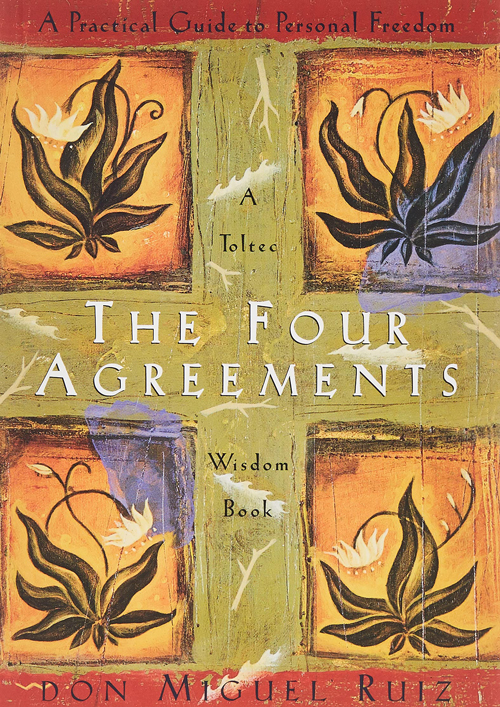
The Four Agreements: A Practical Guide to Personal Freedom
By Don Miguel Ruiz
Tarcher, 160pp
Reading the book wasn’t as easy as it seemed. Besides the author’s style, which consists of examples and repetitive phrases to define the “four agreements” of the title, my personal history and hangups were constantly getting in the way of my reading. Don Miguel Ruiz claims that this is a “book of Toltec wisdom,” and that’s where I came across my first obstacle.
When I was a child, my father got me involved in a New Age group that also considered itself a descendant of Toltec culture. They were all readers of Carlos Castaneda who had developed a series of practices based on their reading of his works. My childhood and early adolescence were heavily influenced by this group, and I spent the following years denying their influence on my life. During that time, I realized that the word “Toltec,” in New Age circles, didn’t refer to any one indigenous Mexican culture specifically. The Toltecs were a militaristic civilization from the Post-Classic period—predating the Aztecs—from the central region of Mexico. What we do know is that they were polytheistic, and they dabbled in human sacrifice, but it would be impossible to derive a “philosophy of life” applicable to the modern world from a culture that disappeared over 800 years ago. That’s what makes them the perfect blank canvas for projecting any sort of associations one might want. Miguel Ruiz attributes several terms and ideas to the Toltecs that in actual fact come from the Spanish language, in his efforts to bulk up his method with some ancient spirits and thousand-year-old wisdom. The heavy co-opting of indigenous history by the New Age movement bothers me for political reasons, and to get through The Four Agreements I had to make a big effort to switch off the part of my brain that engages in critical reading, to concentrate instead on the rest of the book.
But what exactly fills the rest of the book? It’s the four agreements, of course, which are explained succinctly on the back of the book: “1. Be impeccable with your word. 2. Don’t take anything personally. 3. Don’t make assumptions. 4. Always do your best.” After reading these agreements, and their descriptions, I couldn’t help but think that they include a fair amount of common sense, and that just maybe, they could help me avoid or at least delay my anxiety for a week. Here are the results.
Monday – Tuesday
I had planned to start the Kismet Spiritual Digest on Monday, May 11, but I completely forgot about it. That would have been a great day to get started. In the morning I had a video call with an old friend, a film director, who’s interested in adapting one of my short stories for his next feature film. After the call I read for a bit, then I went for a walk around Mexico City, and wrote a bit more of the novel I’m currently working on. But it wasn’t until about 6 p.m. that I remembered that I was supposed to be doing the Kismet Spiritual Digest, which is to say: strictly following the four agreements as laid down by Don Miguel Ruiz. Could I honestly consider today as part of the Digest, if I was not conscious of today being part of the Digest? If someone lives their whole life in a Christian manner, but has never heard about the word of Christ, would we call them a Christian? I decided that the answer was no: to follow Miguel Ruiz’s agreements I had to have them front of mind, to think of them actively, to foist some kind of intentionality on my life.
I had to fast on Tuesday, so I could get a blood test at a public hospital about ten miles south of where I live. My appointment was at 10.30 a.m., so I had dinner late on Monday, at about 10 p.m. Skipping food wasn’t as much of a problem as skipping coffee. I tried working for a bit in the morning before going to my appointment, but I felt drowsy and slow, so instead of writing I re-read the four agreements from the book.
The waiting room of a public hospital in Mexico offers up a pretty depressing panorama. Little old men with colostomy bags or oxygen tanks, people in wheelchairs, long lines and a complex bureaucratic system involving ticketed turns, waiting for large stretches while listening carefully for your name to be called. But every time I get frustrated by this system, I remember that I’m getting world-class medical attention and free medication for a chronic-degenerative condition that would ruin me economically if I lived in the United States. The nurse who took my blood sample was quite rude and didn’t even respond to my greetings or questions, but I decided not to take it personally: I was following Don Miguel’s second agreement.
That same day, in the evening, I had a psychoanalysis session. It was hard not to speak ill of myself or to take things personally, which is what I usually get up to in therapy, so I ended up telling my therapist that I was trying to live by the principles of The Four Agreements and that’s why I was feeling so optimistic. He seemed concerned.
Wednesday
On Wednesday I had to go back to the hospital, this time for a medical appointment and to pick up my medication. The doctor took a look at the results from my tests the day before and confirmed what I already suspected: I have a new autoimmune disease, Sjögren’s syndrome. The most annoying symptom is that it gives me an insatiable thirst. No matter how much water I drink, my mouth always feels dry. I remember from Canto XXX of Dante’s Inferno that there’s a counterfeiter who suffers the same punishment. I thought that perhaps because I’d faked something too—the false calm I attributed to one of my characters, perhaps—I was now suffering the same torment. Then I recalled The Four Agreements and abandoned such an exaggerated theory (after all, that’s what it’s all about, abandoning theories) and I walked to a bookstore to sit down with a coffee to read Ricardo Piglia’s book Formas breves. I was doing the very best I could, and in truth it seemed to be working: the world was more open and kinder to me.
In the afternoon I went and got a haircut. My barber and I always talk about sex, and this time was no exception: he told me about going to the town where his boyfriend’s family was from to meet them all, and how difficult it had been for them to fuck with so many people around, not to mention how hot it was during the day. He seemed happy to have taken a few steps forward in terms of the intimacy in his relationship, but he missed the animal passion of the early days.
Thursday
My water bill arrived in the morning and it was huge: ten times more than normal. I thought we’d fixed the leak two months ago, but apparently not. Maybe my chronic thirst was the cause? I went down into the basement and couldn’t help yelling: it had flooded again. For months now, the basement has repeatedly flooded and no one has been able to explain why.
The third agreement says I shouldn’t make assumptions, but in these circumstances, my anxiety took over and I couldn’t help myself: what if this flooding was actually Lake Tenochtitlán, repressed for centuries but not bubbling forth to wash away my sanity. I thought that perhaps the spirits of the Toltecs were angry at how their culture had been abused and had sent Tlaloc (God of the rains) to flood my house. I remembered something from Gaston Bachelard’s The Poetics of Space about the relationship between basements and the subconscious. Perhaps my basement had flooded because I lied in my psychoanalysis session. I was thirsty, so I drank a glass of water. But nothing changed. What did I think was going to change?
I spent all day fighting with bureaucrats from the water company and trying not to make assumptions, but by 8 p.m., I was exhausted. I realised that the only way to shut down the whirring engine of anxiety would be to take a tiny dose of clonazepam. What would Don Miguel Ruiz have to say about that? Following his methodology would be much easier if I was medicated, but something tells me that would be considered cheating.
Friday
I wrote two sentences in my notebook: “It’s hard not to have anxiety. It’s hard not to use my own words against myself.”
The doctor had told me, two days ago, that I’m incapable of producing tears in my left eye, and that I produce very few in my right eye. For pretty much my entire life I’ve identified as someone who cries a lot. But I suppose I’ll just have to adapt to these changes.
In the evening I went to La Americana, my friend Cata’s bookstore. We spent two hours chatting about short stories, contemporary art, Buenos Aires, psychoanalysis, DMT, and the desert. Cata told me about the time she smoked a toad in the Sonora Desert, somewhere near Caborca.
I told Cata that I was spending a week living according the principles of The Four Agreements. Inevitably, I ended up talking about my childhood, about my time living in the “Toltec-inspired” New Age compound where one night, they buried me alive. Chatting with my friend, I realised that these were vastly different experiences. It was one thing to “avoid making assumptions,” to “always do my best,” according to Don Miguel Ruiz’s thinking, and another thing entirely to constantly fast, to spend days at a time blindfolded, and to be buried for 8 hours, which is what happened to me when I was fourteen years old. One was a household variety of spirituality, something perfectly adaptable to life under capitalism. The other was a more radical proposition. It wasn’t fair of me to compare them, just because they both leaned on the word “Toltec” for philosophical heft.
“Did I learn anything along the way? I don’t know. My theory is that The Four Agreements is completely lacking in substance. The four agreements themselves—which are printed on the back of the book—are all you need to read. And even then, they’re vague enough that you’re free to interpret them as you please. If there’s any useful wisdom in there, it’s that it is possible to feel at peace with yourself, in order to feel at peace with yourself. Which is to say: you can just enter into a loop of positivity that is completely detached from the material and historical conditions of the moment you’re living. And what did I discover this week about my material and historical conditions? That I can’t cry. But that doesn’t automatically mean I’m a happy person.”
Saturday
The next week I had a trip to Schenectady, New York, with my wife Catherine to look forward to. We were going for our friends’ wedding, which more or less lined up with our anniversary. So, I decided to spend the weekend at home, faffing about, reading Proust and working on my novel.
The contemplative life allowed me to go deeper with The Four Agreements. What’s more, Proust’s great roman-fleuve was the perfect accompaniment to this spiritual exercise. His prose submerged me in a hypnotic trance, which also, for a time, dispatched all my assumptions. Reading Proust means giving yourself over to the most impeccable use of language conceivable. Reading Proust is doing your best.
For years, my idea of “doing my best” was linked to Deleuze’s take on Nietzsche’s eternal return. “Live every moment as if it’s going to be repeated forever” seemed to me like a great moral maxim, because it implies matching the everyday with every day. Here’s what Kierkegaard had to say about it: “True repetition, supposing that’s possible, makes a man happy, while recollection makes him unhappy.”
I asked myself if I’d be prepared to continue The Four Agreements experiment for the rest of eternity. I decided I probably could. In Don Miguel Ruiz’s book, the idea of silencing what in Mexico we call el mitote, all of life’s noise, is treated with almost comical levity. And the advice to not take yourself too seriously, which underpins all four agreements, is also comical.
But sometimes it’s easier to make fun of yourself retrospectively: it’s only because he’s writing many years later that Proust can depict the young Marcel with the tender foolishness he’s known for.
Sunday
Did I learn anything along the way? I don’t know. My theory is that The Four Agreements is completely lacking in substance. The four agreements themselves—which are printed on the back of the book—are all you need to read. And even then, they’re vague enough that you’re free to interpret them as you please. If there’s any useful wisdom in there, it’s that it is possible to feel at peace with yourself, in order to feel at peace with yourself. Which is to say: you can just enter into a loop of positivity that is completely detached from the material and historical conditions of the moment you’re living. And what did I discover this week about my material and historical conditions? That I can’t cry. But that doesn’t automatically mean I’m a happy person.