
The incident involves an old pink and silver ribbon that has gone missing. In The Confessions, this is Rousseau’s central admission of shame. Instead of owning up to his crime at the time, he accuses the young cook, Marion, because he “was only afraid of disgrace.” This episode makes for the book’s painful heart, and for the French philosopher Frédéric Gros, the residual power of Rousseau’s story lies in the sublimity of the shame that the narrator professes to fearing, which “prevailed over everything.” Referring to this episode in A Philosophy of Shame (Verso, 2025), Gros writes, “in my own life, I reckon I have experienced shame more often than guilt, and in taking decisions have been more swayed more by the diktats of the former than the injunctions of the latter.” And as to his interpretation of the episode, Gros remains confident in Rousseau’s sincerity. He considers this to be the culminating point of the book: the terror of shame testifies to the “remarkable obstinacy” that the emotion is uniquely capable of instilling.
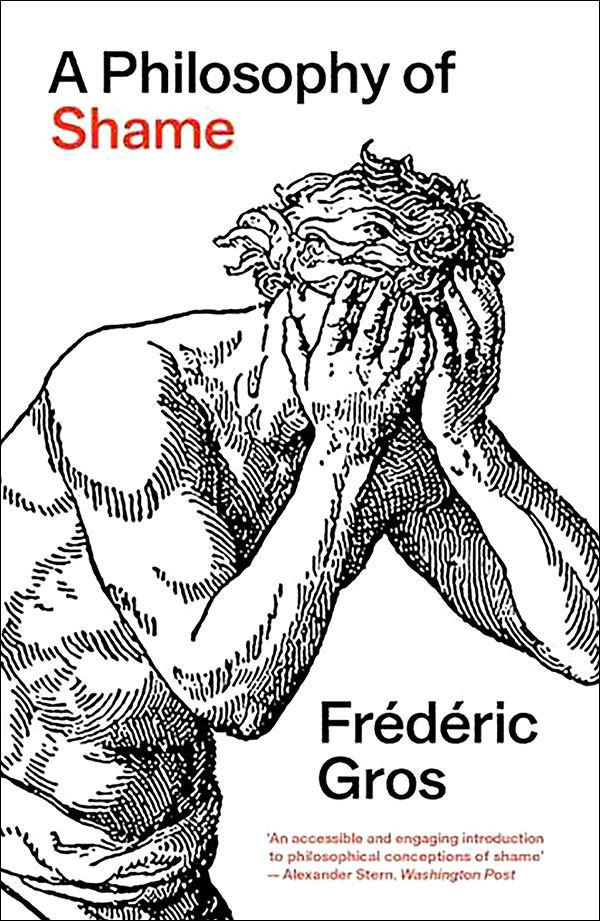
A Philosophy of Shame
by Frédéric Gros
translated from the French by Andrew James Bliss
Verso Books, 176pp
For commentators, ranging from David Hume to Paul de Man, Rousseau’s tiresome self-laceration reveals the extent of his own self-deceit. Immediately following the false accusation, Rousseau goes on to say that Marion’s name only slipped out because of their friendship. Further masking the memory, Rousseau claims that his lie had virtuous beginnings—he had been planning to gift the ribbon to her. In Gros’s view, the shame that Rousseau describes has less moral depth than the other way around. “We recall humiliating scenes with great precision,” he writes. “They cut clear, sharply delineated shapes within us.” Here and throughout A Philosophy of Shame, Gros describes shame as a mutilating force. The pain and the lucidity are presented as its most distinct attributes. Shame is the price to pay to be able to tell the right story.
Originally published in France in 2021 and now translated into English by Andrew James Bliss, the latest entry in Gros’s oeuvre builds a dizzying large claim. At the outset, he describes shame as having been “caught in a dual political destiny.” On the one hand, it is the instrument of far-right campaigns such as those of French politician Éric Zemmour, who opens with an appeal, “vous avez honte,” you are ashamed. On the other hand, it has also become—and as Gros intends it to become—a rallying cry for the Left. “One of the great motifs in art and thought is a certain ‘shame of being a man,’” said Deleuze in an interview with Claire Parnet in 1996. The phrase is Primo Levi’s, from The Drowned and the Saved, and A Philosophy of Shame can be partially read as the continuation of Deleuze’s motif.
Throughout the course of the book, Gros surveys a range of disturbing, contemporary case studies, such as the infamous cancelling of Justine Sacco, the rape trials of Anne Tonglet and Araceli Castellano and the incest trial of Éva Thomas, and the psychology of the spree killer Jean-Claude Romand. Accompanied by literary and theoretical readings, the heterogeneity of our social reality is schematized into a search for the “systematic superimposition” of shame. Rather than following a dialectical story of progress, Gros describes shame as “[merging] in a dizzying spiral.” What ties the episodes together is Gros’s persistent belief that we have patterned ourselves in such a way, that only through “reappropriating” shame, can we “delineate” and “hive off” our sense of the distinct community that can be constituted.
One might ask: isn’t the very idea of modernity predicated on an exodus story of shame? In popular anthropological accounts, shame is one of those central values that define an honor-based society. At its most basic version, shame is an experience of being seen as inappropriate, by the wrong people at the wrong time. At its most extreme version, it is the shame of thinking one cannot live, and cannot look others in the eyes if one did certain things. In Civilization and Its Discontents, recall that it is our sense of guilt, along with its undertones of Christian morality, that Freud took to be the “most important problem in the evolution of our culture” and the touchstone of his theory of self-understanding. Shame is often seen as an emotion that has become regulated, almost evacuated. Gros’s argument, instead, begins with the claim that shame remains the fundamental emotion that gives grip to our current image of normalcy and conformity. Gros wants to go far: shame is the “emotional marker” of our acceptance of raw power. The vertiginous multitude of what we take to be “shameful” behavior reveals what passes for honorable in honor-less societies. Defining normality, and not honor, is the starting point of the book. Its true end, however, is aimed toward describing a shame that is revolutionary.
Much of Gros’s oeuvre draws on a resolutely Foucauldian framework. Trained at the École normale supérieure in Paris, Gros first discovered Foucault’s work in 1986, just after the latter’s death and in his own first year at university. He is the Gallimard and Pléiade editor for much of Foucault’s work, and also recently assembled the final volume of the History of Sexuality (Pantheon, 2021). A Philosophy of Shame extends a project that he has taken up since The Security Principle (Verso, 2019), Disobey (Verso, 2020), A Philosophy of War (Verso, 2026), and most famously, A Philosophy of Walking (Verso, 2014). In Le Monde, when describing The Security Principle, Gros insists that his own method differs from Foucault’s because his goal “is not to write a history or do an archaeology, but to show how these notions are in fact closely related.” The distinction he makes is unclear to me. Compared to his previous work, the internal tensions of shame he demonstrates are quite irrelevant to the logic of the state, and he seems to have offered a portrayal of shame that is distinctly social. When he says that the Left should reclaim “shame” as a rallying cry, he means that social movements should “reactivate”— a verb he uses from the same interview— and renew an idea that is a part of the transhistorical horizon of moral imperatives and cultural values, but he does not adjudicate, nor speculate on the causality that leads one from “archaic shame” to “intersectional shame.” Throughout the book, we encounter half a dozen typologies of shame like these, and even the ultimate, “intersectional” plea—which forces us to “reflect on the mechanisms of injustice, detect hypocrisy, anticipate danger and play a calculating game”—is not enough. It is a stand-in value, signaling a deeper need to be sufficiently and permanently inflamed.
The nub of Gros’s position—and where he abandons the diagnostic gaze—is that shame holds a prophetic potential and can forge “a fiery and luminous path that transfigures us and fuels collective anger” in favor of social change. “The major emotion of our time” needs to become a “signifier of new struggles.”
Since the beginning of his career, Gros has been a proponent of the slippery genre of the philosophical essay, and it is perhaps along a literary, not analytic, axis that one can best appreciate what Gros means in writing that we need to “work” and “elaborate,” “finesse” and “sublimate” on our experiences. The language is loose but never florid, riotous and just unsound enough in Andrew James Bliss’s translation. The book returns us to striking stories that lie at the basis of a Western cultural foundation, from Lucretia to Maupassant’s Boule de Suif. A humanist sensibility also emerges as an ideal. Shame can be revolutionary only when it’s aided by the imagination, and at least the emotion does seem uniquely suitable to Gros’s characteristic argumentative strategy, namely the lack of ontological grounding. Whether we choose to partake in “intersectional shame” or “patriotic shame,” we are, as Gros contends, imagining the fundamental task of stepping outside ourselves and expanding our horizons, even though it might be unclear what kind of person we are becoming.
The nub of Gros’s position—and where he abandons the diagnostic gaze—is that shame holds a prophetic potential and can forge “a fiery and luminous path that transfigures us and fuels collective anger” in favor of social change. “The major emotion of our time” needs to become a “signifier of new struggles.” Curiously, Annie Ernaux, Primo Levi, and Virginie Despentes are the heroes of this book, even though these are authors who themselves would question how their works might move us toward any such destiny. Gros writes that memory, as Ernaux demonstrates, is “shame’s special gift.” Compare his position to the lucid opening of Ernaux’s Shame (Seven Stories, 1999), and one cannot help but feel slightly baffled by whether the chorus of authors only destabilize Gros’s story. There, shame is the emotion of self-protection, and Ernaux is characteristically tight-lipped and skittery about what writing can possibility achieve. “My father tried to kill my mother one Sunday in June, in the early afternoon,” so she begins. Immediately her recollection is lit up by a flash of fear that comes not necessarily from the memory, but from a dimness and a loosening, caused by the act of writing:
In fact, now that I have finally committed it to paper, I feel that it is an ordinary incident, far more common among families than I had originally thought. It may be that narrative, any kind of narrative, lends normality to people’s deeds, including the most dramatic ones. But because this scene has remained frozen inside me, an image empty of speech—except for the sentence I told my lovers—the words which I have used to describe it seem strange, almost incongruous. It has become a scene destined for other people.
Gros might be tempted to tie a ribbon around the scene, but should he? The worst thing about shame, according to Ernaux, is that we imagine we are the only ones to experience it—the failure, to her as well, is that of imagination. Ernaux writes her experience of shame not because it is morally valent, nor because it makes out a cultural value to her identity. The Sunday story about her parents stands between her present writing self and her younger self, because she recognizes that she has instrumentalized it in recounting it to her lovers specifically. She chooses to conclude Shame with a cathartic high note, but it describes an altogether different sort of learning. Not until two years later would she experience her first orgasm, which, ultimately, is the moment when her “sense of identity and coherence is at its highest.”
Surely it will come, the anger and the rage.