
I began by trying to accept a principle I claim to believe but find difficult to trust: that it’s easier to work when there’s a lot going on. Unlike writers who rise first thing and begin with a clear head, I like to poke around, fill my head with nonsense, read some book reviews that infuriate me, and finally—hopefully—start writing when a bout of livid ambition hauls me out of bed around noon. When I was planning the Digest for Zen and Ghibli, I thought it would be fun to watch a bunch of Ghibli films with my girlfriend, Ellie, so I decided to do it the one week of the summer when we’d have a lot of time together: during a three-part August trip up the East Coast from the Hudson Valley to Martha’s Vineyard to Newport. I figured we’d watch Princess Mononoke Monday night, The Wind Rises Tuesday night, and then maybe some deeper cuts like The Red Turtle or The Tale of Princess Kaguya.
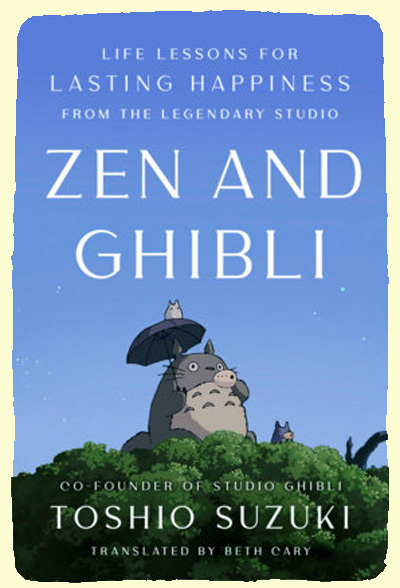
Zen and Ghibli: Life Lessons for Lasting Happiness from the Legendary Studio
By Toshio Suzuki
Translated from the Japanese by Beth Cary
G.P. Putnam’s Sons, 256pp
I started reading Zen and Ghibli on Monday morning in a house in the Hudson Valley where we were visiting some friends of Ellie’s. The book is a series of conversations between Studio Ghibli producer and co-founder Toshio Suzuki, who’s worked alongside director Hayao Miyazaki for forty years, and three Buddhist monks from whom Suzuki wishes to learn about Zen. While Suzuki is learning about Zen, the monks generally comment on how Ghibli films express important Zen principles. It’s not a book that makes any efforts to “teach you how to read it,” as we used to say in fiction school, and for the first third I was baffled by the presumption that anyone could be interested in these reported conversations, which are kind of a circle-jerk about who’s the most enlightened. The book finally comes alive when one of the priests says people who work in anime frighten him and he wouldn’t mind if Ghibli didn’t exist. Luckily Suzuki goes in for that kind of bluntness. He reports that he met Miyazaki when he requested an interview with him on behalf of a magazine and Miyazaki said it would be “beneath him” to participate. Maybe I should use that line on the next person who sends me an oily publicity email. I could use a lifelong collaborator.
What ended up happening is that every night I was so exhausted from swimming and running my mouth that Ellie watched Princess Mononoke in hourlong increments while I slept through it. I thought that was okay, since I’ve watched Princess Mononoke about once a year for the last decade.
MONDAY
We’re staying among a big group at a gracious, buttery country house—our friend Isabel’s place—designed at every turn toward simple pleasures and what used to be called “diversions.” I’m reminded of a line from White Out, Michael Clune’s dazzling memoir of his addiction to heroin: “Two happy little 7UP cans sat on the floor with us.” The coffee stains on the counters and the big sheet pans from last night’s dinner have an air of exhausted satisfaction. Everything is so big that the house seems to say, gently and sternly, “You can’t do it alone, you know.” Outside, I’m drinking a cup of the foamy stuff that comes out of Nespresso machines and reading, on my phone, a 2009 interview with the poet Frederick Seidel that I got from the Paris Review listserv this morning. Behind me, Ellie and Emma play metronomic ping-pong. Inflatable loungers drift sleepily along the edge of the pool. In summertime the weekend dies hard.
I slather myself in sunscreen and shield my eyes with my copy of Zen and Ghibli. The book opens with a conversation between Suzuki and the Buddhist priest Shinsuke Hosokawa. Hosokawa claims he has plenty to learn from Suzuki, who has “gained a lot of experience from producing animation films and working in advertising.” It doesn’t seem like either Suzuki or Hosokawa really know why they’re having this conversation. Right away the book smacks of the sort of pamphlet that a publicist strings together to milk a fanbase, rather than a book that lived in a man’s heart and caused him anguish and raptures. They talk about how important it is to “focus on the present.” They discuss Hakuin Ekaku’s paintings, which Suzuki is fond of copying, and the fact that Hakuin’s works were at one time considered advertisements for Zen teachings. Suzuki is the one who draws the taglines for Miyazaki films, and he waxes on about the line for The Wind Rises (“You must live”):
Suzuki: “I happened to write it with a brush, and the advertising producer said, ‘Let’s go with that.’ Simply put, it means: ‘There may be many hardships in life, but you must live regardless.’ Everyone is facing difficulties in society, and we can offer encouragement. But I always tell myself that I can’t get caught up in how many people the film reaches. Of course, I’m happy if many people see a film, but really, I just hope that the message gets through to those who understand it.”
There’s an obvious problem here—if you talk about advertising as if it’s noble, in the most banal way, I’m not going to trust much of what you say next. Then again, the real problem likely has more to do with my choice of “spiritual text.” Why did I choose a book about the lessons a body of artwork can impart? I believe in lessons (I think) and I believe in art, but lessons hustled into art make my hackles go up. Meanwhile, here’s Seidel, who God put in my inbox this morning:
“I write about going fast. I write about wanting things and liking things. I stare and stare and go blind—that’s me writing, and writing about writing. I’ll leave out love and lust as preoccupations. And the wish to believe. And the near impossibility of faith. I suppose I think that art itself is the supreme theme of art. And I don’t know whether that’s a cause for despair. Probably it is. Art can’t do anything. ‘I don’t believe in anything, I do believe in you.’ I wrote that.”
God, how I resent Suzuki’s simpering, and how I love Seidel’s nihilistic ego!
TUESDAY
I wake with the flutter of imminent packing. I can’t say I’m feeling especially focused on the present. I’m more focused on how we’re going to make our ferry from New Bedford. According to Hosokawa, I shouldn’t be thinking about making the ferry, I should be trying to live more like a baby. That’s the closest thing to Zen enlightenment. “A baby isn’t thinking ‘What shall I do tomorrow,’ nor does it think about what happened yesterday. It laughs when it wants to and cries when it wants to. Wouldn’t it be wonderful to live this way?”
It’s a little bit of a disappointment, after spending thirty-two years thinking that growing up was the be-all and end-all, to think I’ve been going about it all wrong. Then again, so far it seems to me that the more you grow up, the clearer it is that you’re never grown; you just keep discovering you were wrong about things and starting over. I like babyhood when it bursts out of an adult. I like that Ellie claps her hands when she sees a square of chocolate. I like that when I stroke her head I see the emotion rustle from her mouth down through her shoulders and her torso, like a bead falling down a string.
WEDNESDAY
I’ve spent all summer trying to begin a new novel and feeling thwarted and miserable about it. And it’s not lost on me that I felt exactly this way for the first three years that I was “working” on my last novel—which didn’t feel like working on a novel at all, but like repeatedly failing at writing a single page. I’m afraid of “my new novel” the way I’d be afraid of returning to a house where I was hunted down with a knife, except I shouldn’t act like such a victim about it, since I was the one holding the knife and jerkily trying to outrun my own hand. But that doesn’t make the blade look any less sharp. Suzuki says that what he and Miyazaki have in common is that they forget everything about the films they’ve made each time they start a new project. He even considers Princess Mononoke, one of Miyazaki’s masterpieces, to have the flavor of a film by a first-time director, because when Miyazaki was making it he abandoned all the techniques he’d been developing in his previous films. This is a man who has famously announced his retirement again and again—with earnest conviction—and then, to Suzuki’s chagrin and the delight of the world, gone back on his word. Apparently, he “presents like a baby who has been turned into an adult,” Hosokawa’s Zen enlightenment ideal.
Do babies consider doing interviews for magazines “beneath” them? Then again, there is something delightfully infantile and raw about the way Miyazaki behaves in all of Suzuki’s stories, like the way he shows vicious jealousy about drawings done by other Ghibli staff, including Suzuki (whose gifts are, apparently, caricature and sanctified forgery—nice work if you can get it).
My friend Phoebe once embroidered on the tuck flap of two pillowcases a phrase that my friend Khash and I used to repeat to each other in moments of writing crisis, as a reminder that we’d done it all before, we had ways and means: Remember your training. I’m squeamish about the beginner’s mind. My friends josh me for being ungenerous toward naïve people and books that show too much naïveté, but they seem to me to betray such a sneaking narcissism, as if things only become meaningful when they happen to you. It’s like a neon sign declaring that when you watched your friends go through every variety of heartbreak and revelation you just thought: no reason I should learn anything from that. My mother spent a lot of time when I was a child describing the horrors that await naïve women. In a way I suppose looking to other people to tell you about your own experience is what the book I just wrote is about, except in the book it doesn’t help the girl at all, it just pisses her off. Maybe I should take a lesson from my own unconscious. I’d love to write a novel that feels like it was made by a baby turned into an adult.
THURSDAY
I’ve started to fall into a rhythm with Zen and Ghibli. It begins to populate with specificity. Or maybe I’m just starting to respect its gentle language, which at first I experienced as received. Hosokawa tells Suzuki that individuality is totally unnecessary in the practice of Zen. The language is supposed to be received. Something unique about Japanese heroes, Suzuki remarks, is that they’re often passive. He says that the children’s books and manga when he was growing up often counseled that “in order to win, you must discard yourself.” But his concept of passivity is sort of confused; he thinks of himself as passive, but it’s more like he’s responsive. He responds all the time to Miyazaki’s vision, to the demands of the Ghibli studio. And he describes himself as a relentless if well-meaning busybody, forever playing matchmaker with his acquaintances. Another priest he speaks with, Master Sōkyū Gen’yū, talks a big game about how important it is to be passive, but then he admits that he’s writing a novel, and that “a writer can’t be passive.”
Seidel, in the Art of Poetry interview I’ve been returning to all week: “The moment comes, if it ever comes, when you have enough strength to give way, to give in to being who you are, to give in to your themes. Giving in to your obsessions, giving in to the things that you will be writing about over and over. And sometimes the things you’ll be writing about over and over are things that some people don’t find very nice.”
I wonder if discarding yourself and giving in to your own themes aren’t so different. One seems to have the sheen of self-annihilation and the other of self-indulgence, but, as Seidel puts it, the second thing requires you to “give way.” Two languages for surrender.
FRIDAY
I’m in a needy, inconsolable mood. It involves a lot of exaggerated frowns. In this mood, I say, “I wish I had a purpose,” and Ellie says, “Yes, you’d be so great with a purpose,” and then we go on teasing like that for a while. I’m probably moody because I’m trying to make “my new novel” surrender to me, like a king, instead of approaching it like a baby turned into an adult. What would that mean? Writing with crayons? I’m hopeless at being a baby. I’m too in love with being an adult. Suzuki says he’s relieved when Miyazaki is in a bad mood because it shows his “duality” (an important virtue). Does Ellie like it when I’m in a bad mood?
In other news of surrender, she turned to me just last night, as we walked back from the beach through the woods, and said with bewildered gratitude, “I love my new life.” Her new life is an office job she started two months ago, which felt, at the time, like a painful renunciation of her adventurer’s life as a bartender, in which she seemed to live beyond the frontier of authority and routine. But there are romps on this side of the frontier, too.
SATURDAY
We go to a sushi restaurant in Newport before Ellie’s friends’ wedding, and I read her bits from Zen and Ghibli. I read her this nice part I like about kochū, jar-worlds, in which Hosokawa remarks that Ghibli films like Spirited Away and My Neighbor Totoro contain hidden paradises from which children leave having matured, just like in a Zen expression about the world inside a jar. And I read her the part I hate about “focusing on the present,” the nobility of advertising and the instrumentalization of art.
Ellie laughs at my disgust. She’s had plenty of encounters with Buddhism and everything in the book is familiar and inoffensive to her. She says in Zen culture, everything is elevated to the same significance: advertising is as important as tea-making is as important as flower-arranging is as important as calligraphy is as important as filmmaking. Apparently what I call “banality” is really a Zen principle of repeating the same thing in painstakingly similar ways so that eventually, it will stick. I can’t help dissociating during this disquisition until she says the word “koan.” What an unusual and beautiful sound!
It’s not that I don’t understand that there’s a relationship between simplicity and depth. I think basically Ellie and Suzuki are telling me that you can get to another layer of anything. That’s easy to accept. I guess I just don’t know if I really believe boring yourself is the way there. This is very unpopular, I know, these days we’re all supposed to resent being entertained and find being bored so challenging and necessary! Eh. Maybe everybody was entertained too much when they were children. They had sports leagues and tutors and stuff like that—Ellie had chess camp. The memory of being devastatingly bored as a child bleats in my head like a lone sheep that won’t die. It was so, so boring, and then I learned to read. You’re trying to tell me that now that I’m an adult, with a bed I’m allowed to lie in all day, I should just close my eyes and breathe rather than read?
“Ellie laughs at my disgust. She’s had plenty of encounters with Buddhism and everything in the book is familiar and inoffensive to her. She says in Zen culture, everything is elevated to the same significance: advertising is as important as tea-making is as important as flower-arranging is as important as calligraphy is as important as filmmaking. Apparently what I call ‘banality’ is really a Zen principle of repeating the same thing in painstakingly similar ways so that eventually, it will stick. I can’t help dissociating during this disquisition until she says the word ‘koan.’ What an unusual and beautiful sound!”
SUNDAY
Ellie and I have a lie-in in a clinging, nervous atmosphere. The wedding, throughout which we had all the fun that a lavish evening on Castle Hill among gracious, good-natured people can afford—quite a lot of gin-scented fun—left something sinister in its wake. “I think that was the first time we’ve ever been somewhere where I really felt it was whack to be gay,” Ellie says. I suppose that might be what’s bothering me, too, but I think that’s a bit too pat. It’s more that a wedding is like a novel, full of histories and families, and authored by a particular and coherent vision of the world. This wedding was itself reminiscent of one of my favorite novels, The Age of Innocence, situated as it was on a peninsula in Newport and drenched in the florals and goodwill of a lucky society which knows, approves of, and celebrates itself, a descendant of the very society in which Newland Archer swam, teeming still with people who are essentially named Newland Archer. A world like this, just like this sort of novel, floods me with yearning. I have a sense of belonging to no place, no people, no tradition but the defiant, wise rejection of tradition. Rejection is a tradition in itself, too. But it’s long felt to me like a sort of awkward penmanship with which to write novels, letters, even grocery lists.
The only weather that disturbed the ceremony was the threatening whine of two drones overhead. The flower girls, toddlers in skirts encrusted with pearls, stumblingly searched their baskets for flower petals at the mouth of the aisle. Then they looked around and realized we enjoyed laughing at their routine. A tiny brunette with a punishing, coquettish look finally raised a fistful of petals and stood there watching us. I’m actually plenty baby, I’m just like that flower girl. When I really get started there’s a merciless edge to it, like I want to make people watch while I hurl fistfuls of petals on the ground. But just let me do the hurling in style! Let me do it in pearls.