
One Christmas, the writer and critic Emily LaBarge was vacationing on a coral island in the Atlantic when six masked men with guns and machetes broke into her home. They ransacked the rental property and held LaBarge and her family hostage for hours, while the 1993 comedy Mrs. Doubtfire blasted on the living room television. Eventually the men left; the family survived; the event was over. Although, as LaBarge would discover upon her return to London, it also wasn’t over.
“Everything was sucked into the event and the telling of the event and the writing of the event,” LeBarge writes in Dog Days, a work of memoir, literary analysis, and psychoanalytic theory. First the police required a “schedule of loss,” a list of the tangible items taken from the rental home. Later, friends and family wanted an account as well, although mainly they were wanted to know “if there was Rape, the Worst Thing they can imagine, and which holds within it all the other Worst Things that have no clear designation.”
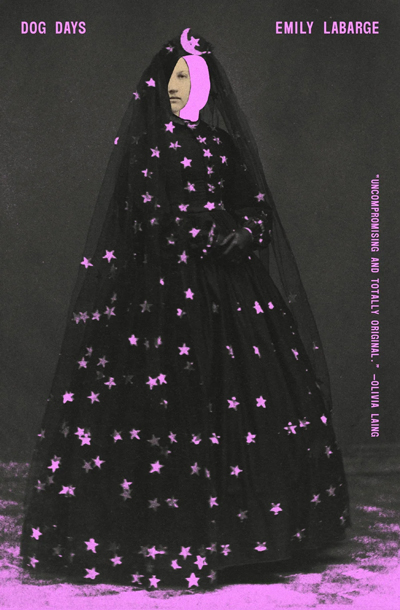
Dog Days
by Emily LaBarge
Transit Books, 280pp.
What most people were looking for, LeBarge began to understand, was a “good story,” a way of narrating what happened with “just enough details to perturb, to hint at but never say what cannot actually be turned into a story with any serviceable point other than randomness, cruelty, and utterly speechless fear.” But the more LeBarge told this story, the more she bristled at its inadequacy. In the event’s aftermath, LaBarge felt “this will last forever and this will happen again anytime and anywhere.” The good story promised coherence, and what LeBarge in fact experienced had nothing to do with the before and after of narrative.Freud suggests that the difference between mourning, a fine period of grief, and melancholia, a more abstract, diffuse, and persistent state, is that in the later, the loss remains mysterious. In melancholia, the person knows, “who he has lost, but not what it is he has lost in them.” The “good story” certainly has something to tell us about “who” has been lost— the person who has died, the boundary that has been crossed, the violence that has been endured. But it doesn’t quite manage to contain the “what,” the particular way we bind things up, the language and images we knock together, the bits we can’t let go of, the gaps in memory we can’t recover, and what, in light of all this, the event begins to mean to us. In Dog Days, LaBarge goes seeking for the “what,” and discovers it might not be found in a story at all.
To locate a current of pain, loss, and culpability that plot can’t quite contain, Lebarge turns to the language of others. She begins collecting writing by Joy Williams, Alice Munro, Julie Hayden, Amy Hempel, and Lorrie Moore, writers of stories in which “it seems as though something undefinable is missing, has been lost, in which there is some shapeless hole to be filled.”
In these stories, which LaBarge quotes extensively, tragedy may or may not befall the narrator; maybe someone has left or died, or maybe it is just a cloudy morning and a young girl is walking to school. Regardless, these narrators share a sense of doom and a confusion over who or what might be responsible. In Williams’s Honored Guest, a woman dying of cancer recalls a moment at a department store when a stranger stared at her: “she was looking through me, through me, and she began talking to someone, resuming some conversation with whoever was with her, and all the while she was staring at me to show how insignificant I was, how utterly insignificant.” In light of the woman’s illness, this story assumes a haunting significance: “I felt as though she’d cursed me.” It’s not quite clear, however, whether the bad thing is caused or merely recognized by the stranger, whether the gaze makes the dying woman insignificant, or instead makes her insignificance suddenly legible. This very question—is the bad thing out there or in me?—goads characters to go fishing for the omen, the memory, the missing person, or the fatal flaw which ties all their troubles together, and which, of course, cannot be found.
Much like these characters, Dog Days goes on a journey of associations. The sources LaBarge cites are vast and ultimately bewildering; Bashō, Donald Barthelme, Tennessee Williams, Jenni Diski, Melanie Klein, Joan Didion, Bessel van der Kolk, Susan Sontag, Sylvia Plath, and many more. They tell us about sleeplessness, the moon, trauma theory, the constellations, time, the 1982 Lebanon war, grief, deep sea diving, fairy tales, and the scene in Mulholland Drive where two men encounter a nightmarish apparition in the alley behind a diner. LaBarge is a masterful guide, although she is often overpowered by her erudite and madcap chorus. As she escorts us across time and media, her voice vacillates from contained and critical to one that, seemingly at random, unspools into splintered syntax, wordplay, repetition, and, most unnervingly, borrowed language. She weaves in so many quotes and references that it becomes difficult to separate one voice from another.
In her own life, LaBarge writes of experiencing “pareidolia,” which she defines as “the tendency to perceive specific, often meaningful images or patterns in random or amorphous data.” In her journals, she attempts to carefully dislocate those connections she suspects do not hold up, such as, “the broken tree branch does not mean the ground beneath our house is rotting,” or “the pain in my hip is not a sign of impending death, or some creature trying to burrow into my bones.”
Trauma is often described as an experience that breaks the present apart. Amidst this breakage, LaBarge seems to be saying, the elements of one’s life and learning attempt to recombine, often in odd configurations. Dog Days conjures the anxiety and thrill of this dizzy process of disintegration and reintegration.
Fifteen years after the home invasion, LaBarge admits that the questions she had in its immediate aftermath—why did it happen, does it matter, who cares?— remain the same. What has changed, of course, is that she has managed to write about it. That means something, even if she chooses to frame it in the negative. “It matters that I didn’t not survive,” she writes, “I didn’t not find a way to use language.”
“Trauma is often described as an experience that breaks the present apart. Amidst this breakage, LaBarge seems to be saying, the elements of one’s life and learning attempt to recombine, often in odd configurations. Dog Days conjures the anxiety and thrill of this dizzy process of disintegration and reintegration.”
One critique of trauma theory asks how it influences literature; if we believe that we are products of the things that have happened to us, decipherable primarily by the roadmap of our past, how does this affect how we write novels or tell stories? In “The Case Against the Trauma Plot,” literary critic Parul Sehgal suggests that a certain understanding of trauma, “presents us with locks and keys,” rendering personality “the pencil rubbing of personal history.” This tidy story, Sehgal argues, cannot fulfill literature’s ambition to render capacious characters, or conjure imagination and aliveness in its readers. Crucially, Sehgal doesn’t suggest we forgo writing about trauma altogether; in a recent essay, she praises Gisèle Pelicot’s memoir for its subtlety and self-interrogation, and encourages its readers “to look at the memoir of sexual violence more attentively, to regard its aesthetic and stylistic choices as meaningful.”
Language, as Sehgal and LaBarge both suggest, is not incidental to a trauma story but the hinge on which it might accomplish something for the self and for its readers. When language is too familiar and expected, it traps us in a story whose ending we know. Perhaps the alternative has as much do with the words we choose as the way we find them. The writer Adam Phillips has described psychoanalysis as a “ritualized improvisation,” a treatment primarily engaged with how we manage a conversation, what we evade and unwittingly reveal. The point, Phillips suggests, is not merely to find a cure, in the sense of erasing the bad thing, but to take interest in the way we put the blocks of a story into place and what those arrangements make possible. In place of a tidy and “medical” solution, we have the chance to surprise ourselves with finding something alive in our most tenaciously stuck stories.
Stories, Labarge writes, should be tasked with just this, “creating possibilities that don’t yet exist, that evade or refuse the conventional, hackneyed, easily recognizable,” such that we don’t get trapped in the “endless metonymy” of mourning and melancholia. If an element of trauma is repetition—the way everything, under its levelling gaze, starts to look exactly the same—it is the job of the writer to clarify that situation, to complicate the pattern, to write into what we typically eschew, and, in doing so, change our relationship to the story and to storytelling itself.