
My grandmother grew up in a settlement at the end of a flat, unlovely coastal road on Newfoundland’s western edge. The large families who lived there had more barns and boathouses than bedrooms. The children who survived long enough were schooled all together when they weren’t working—the boys at the quarry or on the boats, and the girls doing everything else. On Sundays, they stood beside their mothers and sang hymns in the old Methodist log church. I know the settlement well, though by my time its residents were all elderly or had emigrated; I played make-believe alone between the drooping sheds, gates still locked after half a century. Mostly, I trawled the beach for sand dollars—dried urchin skeletons the size of a large coin, with scalloped edges and a five-petalled flower at the top, like an engraving. Sand dollars are hollow and have a hole in their underbelly just wide enough to fit a sewing needle. I’d hold them up to my ear and give them a gentle shake, listening for the sound of something loose within. There’s an angel inside! my grandmother would say. I was always trying to get the angel out without breaking the sand dollar. It never worked.
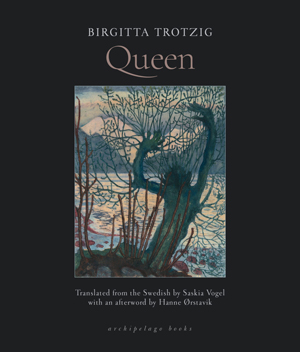
Queen
By Birgitta Trotzig
Translated from the Swedish by Saskia Vogel
Archipelago Books, 168pp.
Birgitta Trotzig must have known what I learned as a child but since forgot: that you can’t free the angel without shattering its shell. Translated by Saskia Vogel, the 1964 novella Queen is Trotzig’s first full-length work to be published in English. The protagonist Judit Lindgren was born in the late nineteenth century onto a once-prosperous, now-ailing farm on Sweden’s southeast coast. In the difficult winters of his own childhood, Judit’s father Johan witnessed the village farms “barred up like fortresses as defense against all the beggars.” Repulsed long ago by his own father’s callousness and disdain for suffering, Johan admits the beggars he once saw turned away and feeds them at their table. “In the face of the poor, we find God,” he says, but adds that “Judit did not see it this way.” The second-born, Albert, is his sister’s opposite—sensitive, compliant, and prone to headaches and ridicule. Their mother never fully recovers from the traumatic birth of the third and final child, so young Judit is left to raise baby Viktor as her own. She grows up into the head of the family, reigning over her brothers after their parents’ deaths, transformed into something “dark strict and hard”—something both she and others call “Queen.” “Now I have in my stone body a stone heart,” she thinks. “The Queen has me, I am queen of myself, in the land of twilight I am left to eat stone.”
The hard-hearted Queen is born of Judit’s success at maintaining order and dignity amid poverty, illness, and emotional neglect. The Queen is her shell and her protection, though it keeps her in a state of perpetual self-abnegation. Her brother Albert is aware of the old Judit’s existence, having shared a childhood together:
The Queen had locked away the good Judit. In a pit the good Judit lay wounded, he could not stop believing in her even if his entire life so passed without him ever glimpsing her again, he could not abandon her.
Yet when the Queen looks at Albert, she feels “disgust for this obedient personage, as for a body without bones, weak, gristly.” She vows her youngest brother will be different: “[S]he raised him hard and strict and mercilessly stalked all that seemed weak and frail in him, Viktor was not permitted any weaknesses.”
Viktor grows into a restless and volatile man. He sires an unknown number of illegitimate children and begins to rebel against his sister’s rule. And like in my grandmother’s village, those without a reason to stay always found a ship ready to leave. At the tail end of an emigration wave that saw roughly a quarter of the Swedish population living in the United States, Viktor arrives in New York City. There, he ekes out a pitiful existence before his merciless, arbitrary death in the “dark mass of the unemployed,” smothered by the Great Depression. His death and the separation that preceded it are at the heart of Judit’s struggle, both with and against the Queen. But before she can begin to reflect, she must reckon with the unexpected arrival of his widow—like a beggar at her gate.
The only thing that brings Judit any joy are the lilies in her garden: “two beds full of the large white kind—what a vision it was when they were in bloom.” Aside from her well-tended flower beds, the Lindgren family’s environment is bleak and weather-beaten. The lowlands of Österlen dominate Queen and many of the author’s other stories. As with John Steinbeck and the Salinas Valley, some of her native admirers find it difficult to say whether the landscape feels “essentially Trotzig” or vice versa. Every season in her world is captured on the same gray paint swatch: “Spring’s smudged gray-warm twilight” casts itself over the fields; summer brings “the gray heat-hazed August sky”; in fall, “the wetland shone greenish gray […] as if the earth had its own glow.” Only winter breaks the mold, violently monochrome, alternating between darkness and “blinding ice-light” over the “naked gray country.” The author is generous with her descriptions, but she keeps her palate spare. There are no lapis-lazulis or indigos when a simple modifier on ‘blue’ will suffice:
[…] the sea lay open and blindingly blue-black, the swans glided snow-white across the dark blue but not a single ice floe remained. The sedge stood pale yellow and dead, its tinder-dry rustle in the soft sunny breeze the day after the storm, the swells heaved still and icy in the blue. The juniper and hawthorn shone red along the sea road which after the snowmelt was but a mud-dark bottomless wheel-track.
It’s a distinct pleasure, reading a remarkable writer, largely untranslated into the English language, when there’s a robust back catalogue and new volumes waiting in the wings. For the anglophone reader, Birgitta Trotzig’s life story has yet to fossilize into a series of accepted facts and anecdotes, in the manner, say, of Tove Ditlevsen or Ingeborg Bachmann, who have both enjoyed a recent resurgence in readership. Born in Gothenburg in 1929, Trotzig completed her education in art and literary history (or didn’t complete an education in psychology, depending on the source), and became a frequent contributor to the newspaper Aftonbladet and Bonniers litterära magasin. In photographs, she looks like the mirror image of her Queen:
a young woman who in her way was beautiful with her large sharp pale face under a dark crown of hair, her deep-set eyes seemed dark too but were in fact gray – eye-stones the clarity of which is revealed as firelight falls through them, clear as the sea.
The author married artist Ulf Trotzig and the couple moved to Paris in 1954, 1955, or the early 1960s, depending on which source you read. Biographical snippets insist that it was in France that she developed her interests in spirituality, neo-Catholicism, and Jewish mysticism. She’s been (lovingly) labelled “a converted yet contrarian Catholic”: it may be devoid of pomp and priests, but Queen is rich with French existentialism and a more mystical divinity. Her characters do not find their maker in the search for benevolence or grace: “[W]as there more than a soft echoing emptiness,” Albert wonders, “how was God’s voice so distant that it only reached him as wrath and absence?” One study of Trotzig’s work was given the bold title Job mitt ibland oss, or “Job among us.”
In The Art of the Novel, Milan Kundera argues that “the complexity of existence in the modern world demands a technique of ellipsis, of condensation.” Condensation is really a poet’s art, and, in Queen, Trotzig lets slip a handful of infidelities to prose, dipping a toe into the water of white space, controlling the reader towards a semibreve rest after surviving long lines on luftpausen. The most poetic passages, however, often begin with an image that could easily stand alone. But, in putting the initial tableau to paper, something is set in motion, a train of iterations of the same words, glimpses, and shades, repeating like the “endless gray waves” of the Baltic—at least until the writer turns her attention elsewhere.
Through the darkness swept the beam. Capturing – releasing: capturing – releasing. So deep the darkness when the night released its grip, like falling down through a well, darkness, no end; again the sleepers were struck by the light as if by a knife; again darkness, all the while they were on their way into darkness downward and downward, whirling, falling. Without pause the lighthouse beam swept across ever-new light-unstruck never-seen waves.
This proliferation might seem like the opposite of condensation, but it feels economical, reusing the same handful of words. To the translator’s credit, not one syllable feels superfluous. Emerson wrote that “the maker of a sentence […] launches out into the infinite and builds a road into Chaos and Old Night.” Reading Trotzig for the first time made me really feel this way; I was blissfully happy to follow her into the dark:
In the summer the doors are for the most part left open and one can look right through the barn, as if it were a massive gateway, upon the pastures and the sea – the still gray sea beneath the white sky gives off a light like nothing else in this world; mild, sick; a misty white light, as mute as the blind milk of membrane around an extinguished eye; in this silent white light rest meadows so green, and the sound of steps or hoofbeats vanish without echo in the soft greensward, there reigns the silence, the birds, the scent of grass, the scent of broom, and between the people too a membrane-like silence: the white soft light upon the meadows, between the buildings, inside the buildings – words drown, the fate of the word is to drown, is it not?
What can I say about this sentence, or the many others like it, when it solicits my uncritical admiration? The cadence of “mute” and “silent” and “silence,” of “misty white light” (disigt vitt ljus), “silent white light” (det tysta vita ljuset), and “white soft light” (det vita mjuka ljuset), are curiously sensual for a disembodied narrator. The shushing and lulling sounds more opiate in English, uninterrupted by the spiky k’s and double-t’s of the original Swedish. Translator Saskia Vogel pulls an s like a loose hair through the entire image: “in the soft greensward, there reigns the silence, the birds, the scent of grass, the scent of broom”—a whisper beside that primal letter m (mild, milk, membrane, meadows). And, of course, there are the hints of Kristeva, two decades before she popularized abjection in critical theory with Powers of Horror.
“Condensation is really a poet’s art, and, in Queen, Trotzig lets slip a handful of infidelities to prose, dipping a toe into the water of white space. The most poetic passages, however, often begin with an image that could easily stand alone.”
Trotzig thought deeply about language, poetry, and silence. In the preface to her essay collection Jaget och världen (“The Self and the World”, here in Brad Harmon’s translation), she wrote:
When it comes to what really happens to me in life, I’m struck into silence. Silence! Stop sign—zone border! […] The real-life event hits me—massively burdensome, complicated, overwhelmingly intangible—and transforms all speech, any form of direct articulation, into a surreal rustle of leaves.
Queen summarizes this neatly: “in wintertime the sea speaks, what does a person have to add to that?” We keep speaking and writing all the same, and we know that the characters’ stoney silence contributes enormously to the poverty of meaning in their life, and some turn to the Bible to hear the word of God instead. “Ordinary speech,” Trotzig argues, is never sufficient to the task at hand, nevertheless the words want to go there “like a moth to the light.” Perhaps her repetition is just that—an inexhaustible moth, trying and failing and trying again to reach the bright filament inside the bulb.
While it comes as a shock that Trotzig hasn’t been widely translated before, the present does feel particularly ripe to receive her. As if writing a kind of fable, Trotzig never lingers on the specific socio-economic conditions in a way that would incline us to blame them for her characters’ misery, but they leave their mark on the psyche as pride or pity, disgust or desire. It’s been nearly a hundred years since these characters were crushed by the onslaught of capitalism or defeated by their own walls. They never learn that rejecting the vulnerable Other in the name of safety or prosperity is a false promise. Queen’s existential themes ought to provoke us, if not to action, then at least to gently, thoughtfully, turn over a few stones and face what’s underneath.