“Complying is what we do when desiring seems too dangerous or too difficult,” the British psychoanalyst Adam Phillips writes near the end of his new book of essays, The Life You Want.
I wanted to start this column on a Friday by writing, “The life I want begins on the weekend, so I’m starting this now, after work and before a drink, before friends, before the night, in the space of time when what I want or claim to want—the pleasures of good company and chemicals; the forty-eight hours of relief and possibility that interleave the weekdays I spend performing manual labor at a museum and attempting, in the evenings, to be a writer—is within my grasp but still wanted, not yet had, not yet found inadequate or regretted as foolish and wasted,” but that would have meant disobeying the commandments of this young column. It’s meant to commence on Monday and end on Sunday, and I fear the lawgiver, my editor, who is like God and my father, and thus also the object of my sick devotion. He kills my darlings; he fucks my prose; he’s married. I pray to him in emails: Just one more day and I’ll submit and it will be good. And God so loved Paul…
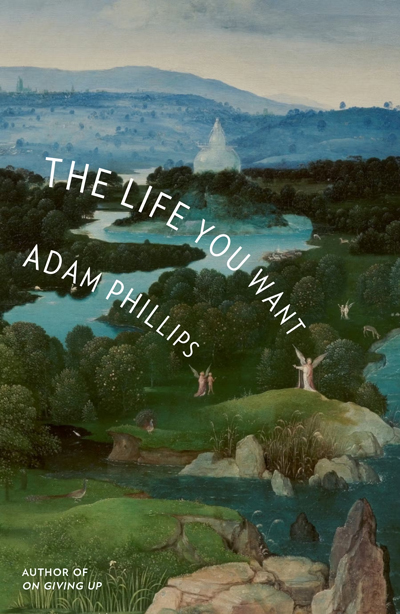
The Life You Want
By Adam Phillips
Farrar, Straus, Giroux, 160pp
Phillips has no trouble filing—this is his 29th book. In it, he asks what the philosopher Richard Rorty’s American pragmatism and the psychoanalytic traditions of Freud, Winnicott, Ferenczi, Lacan, Jung, and others might, together and separately, through the tangle of their distinctions and confluences, be able to tell us about what we want and how we can secure it. I crowded his margins with notes about my affinity for silence and my fear of language (of making my mark, of “coming out” with anything) and thought meanwhile, over a busy week: who has the time to want a life while living like this?
God said, “I am that I am”; we say, “I want that I want.” Or is it I am that I want?
Monday
I don’t want to think; I want the life that lacks the capacity to examine itself. This isn’t true, but I act as if it were: I look at phone; I stuff myself with screen; I avoid writing. I want not to want the bright rectangle; I want to want to write; I want to want to struggle toward becoming other than I am. But I’m tired! Today I have the spiritually emaciated feeling that comes after a weekend bender: there is nothing, but nothing, inside me, and I cannot believe there ever will be again.
Reading The Life You Want, I want to attempt an intentional misreading: I want “to use the text to realize and enhance and enliven one’s own purpose,” meaning my own, as Phillips says Rorty argues we should. But what if my purpose sucks? Today my purpose is to layer blankets and Tyvek on folding tables at a museum, to cart packing materials from a storage area to a staging area, to tape c-bins together and gather A-frames, and to sneak away to read Fire Island Art, a book I’m reviewing.
I work for eight hours on my feet—closer to six factoring in breaks licit and not—and then go to Trader Joe’s, carry groceries home, unpack them, fold laundry, clean my apartment for two-plus hours, eat, talk to my boyfriend, Jamie, on the phone, sit down to read Fire Island Art, and fail to peruse the first issue of the New York Review of Finance, a new print-only broadsheet I’m to profile. Tonight I wanted to be a good boy who does the right things and gets the gold star. How’d I do?
• • •
“I don’t want to think; I want the life that lacks the capacity to examine itself. This isn’t true, but I act as if it were: I look at phone; I stuff myself with screen; I avoid writing. I want not to want the bright rectangle; I want to want to write; I want to want to struggle toward becoming other than I am. But I’m tired!”
• • •
Tuesday
The Romanian philosopher Emil Cioran, quoted by Phillips: “We dread the future…only when we are not sure we can kill ourselves when we want to.”
The dawn chorus: I want to die, fucking kill me, I’m gonna fucking kill myself. These things I say on the way to work, or when I remember some semi-embarrassing thing I did or said that I refuse to interrogate for even the few seconds required for me to assess it as acceptable and commonplace and my terror as self-important.
I walk around the museum like a shell: meatless. I try not to be where I am, in other words, and regret what this attempt does to my relations with my coworkers and thus to my reality. It impoverishes it, i.e., the “saving grace” of this art handling job ought to be the conversations I have with Pap, Ilie, Addison, Michaela, with artists and writers of talent and charm, and too often instead what I give to them, and thus to myself, is cold silence. But sometimes I want to be a bitch.
Phillips: “For the pragmatist, unlike the psychoanalyst, the risk is that we avoid becoming what we want to be, what we might be, what we could be, by telling ourselves what we really are.”
I’ve always had a fear of making my mark, of “coming out” with anything: speech, writing, action, language in one form or another that could (irrevocably) change my present circumstances. (Yes, I discovered this in sessions with a psychoanalyst; yes, it has much to do with being gay and with my dad.) So the life I want is the life I lead, if “want” here indicates that I strive toward stasis or that I strive toward failing to satisfactorily strive and thus toward failing, glowering all the while at my failure. Woe is me.
Phillips: “Unless, of course, there is something you want more than the life you want.”
But how I rejoice at my successes, especially those I regret in advance because of what they disclose of me, like an essay I published last year about love in the time of penis enlargement. I am a silly machine, gorging on shame and then expelling it in works of varying quality.
Today I was almost late for work again. Today I sat in the 3rd floor conference room in a chair a few feet from a behemothic wooden table; today I moved crates, tables, tool carts, packing materials, art carts; today I deinstalled books and broke a plexiglass vitrine topper; today I drove a scissor lift, removed piggies from the lighting track and detached them from cables running to lighting fixtures, yanked cords through ceiling panels and onto the floor; today I deinstalled metal sculptures affixed to velvet pillows.
The style of Adam Phillips: the plain wordiness of his sentences, which seek in the snaking of their mundane verbiage to be accurate, to continue a thought past its obvious end point and toward a complicating and unresolving conclusion; his use of incomplete sentences and dependent clauses, especially following semicolons.
At night I have drinks with Carlos in Bushwick and recount an ongoing dispute with another friend, feeling meanwhile like I should be elsewhere, shouldn’t be drinking, should be reading or writing for one of my assignments or pitching something. Afterwards, I help Jamie plan his birthday party. I want him to have what he wants; I want him to know that I want this.
Wednesday
At the museum we are packing the art of Vaginal Davis. I like her work but have no aesthetic grip on the work while at work. Between tasks I send emails—to an editor, about a job opening at her magazine, to the NYRF editors, about the profile. I think desultorily about the Fire Island Art write-up I’m drafting this week. We remove a big-cocked bread sculpture of Justin Timberlake from a wall and it crumbles onto the floor. Inside we see mold that’s black. Is it black mold? No one cares. It’s trash.
Puttering between galleries, I hover my finger over the “complete purchase” button for a ski helmet for Jamie. I am frenzied: will he think me unthoughtful or wasteful for buying it? Will he deem it inadequate? Will he love it, me? Why do I worry? Because I’m self-obsessed? Because I care? Stop: pay. At night I help him edit the deck he’s submitting for a major photography job.
Phillips: “People always do things for good reasons, even though often they do not know what these reasons are.”
From the margins: terrible to see someone’s terrible piece (of prose, of shit) fêted online by people who fancy themselves tastemakers (or taste-havers) but a blessing to have one’s own middling work talked up by the same people.
Sitting in bed under the blankets in our apartment on the top floor of a decrepit brownstone while Jamie writes “Yappy Hour” on fifty matchboxes; —his birthday party is tomorrow. I’m fence-sitting, half my person frantic, fearful of misspending my time and so failing to complete my assignments, the other half resolved that I’ll manage, almost at peace.
“To enjoy thresholds you have to enjoy bearing contradictions rather than trying to resolve them.”
Thursday
I’m on my lunch break at the museum, leaning against a soiled cushion on a broken part of the red breakroom couch; around me other installers and registrars are reading, looking at their phones, sketching, talking.
I used to account for the emotional remove with which I confront so much of experience as owing to a belief that I had an idea of how the various ready-made storylines available to me to complete a scenario could go. Later I associated it with a terror of coming out (or being forced out) and being expelled from society; now I seem to have little idea of what is happening to me. I scurry like a mouse from task to task, screen to screen. I’m nibbling life. At a nearby table, a handler scratches at something in his sketchbook. He’s making something of his time.
The Trader Joe’s salad I eat every day: another thing not to taste, not to believe is real, to cram into me with as little resistance as possible and hopefully then to forget about and thus to render, after a fashion, non-existent.
Tonight is Jamie’s party; that will be real.
Friday
I am hungover. Thursday night recap: worry and setup, then a major turnout. Jamie’s beaming. I slept little and use two sick hours to go into work late. The life I want, being unknowable in my present condition, is all the same known not to revolve around whining too much publicly about my circumstances, which some would call charmed. I want dignity; I want to whine the right amount; I want to elaborate a fake essay about the dignity of whining.
“We resist the wish to survive and flourish and be gratified.”
Saturday
Thinking is difficult. Mucus coats the back of my throat; my body aches. I have a slight fever, I am sick after all. I want the life that ibuprofen provides. I take it.
“Famous,” “famously,” and “infamously” together appear twenty-six times across the Phillips’ book’s 146 pages, almost always when the author is introducing a quotation from an analyst or philosopher, sometimes twice on the same page, and, in several cases, in nearly identical formulations.
Page 61: “Rebels, Sartre once famously remarked, keep the world the same so that they can go on rebelling against it; revolutionaries change the world.”
Page 86: “Rebels keep the world the same so they can go on rebelling against it, Sartre famously remarked; revolutionaries change the world.”
Page 96: “‘To solve the problem you see in life,’ Wittgenstein famously wrote, ‘you must live in a way that makes the problem disappear.’”
Page 106: “Wittgenstein famously wrote that the way to solve the problem you see in life is to live in a way that makes the problem disappear.”
Phillips brandishes Auden’s question, “Is a shield a weapon?” twice as well, both times as a parenthetical within a longer sentence, though only once is the garnish “famous” added. Freud’s observation about jokes—we never quite know what it is about them that amuses us—appears thrice, but never famously.
Three possibilities: repetition compulsion (I won’t elaborate); an assumption that readers’ phone-degraded attention spans will benefit from flagrant redundancies and lame signposting; a featherlight editorial touch to these essays, which were adapted from lectures and works previously published in journals including the London Review of Books. Regardless, I don’t mind that these lines and modifiers recur; Phillips has endeared himself to me, tics and all.
Sunday
After prepping for two hours, I interview the NYRF editors at 1pm. Later I say the wrong thing about the wrong person to Jamie; we make up, we always do.
At dinner he tells me to start a Substack, that someone we know makes $80k/year from it. I’m no closer to the life I want than I was last Monday, but I hesitate to believe that shoving my unedited essays in front of people’s eyes will help me figure out what that life is or retrieve it. Could I stop hesitating? Would you give me money?
“We are full of sentences, and phrases, and words that we dare not speak, even to ourselves.”
Words like “Please subscribe to my Substack.”
Sometimes it’s best not to dare. The trouble is knowing when.