There is an idea, promulgated notably in Derek Thompson’s 2019 Atlantic article “Workism Is Making Americans Miserable” that, for many elite American workers, jobs have become a kind of religion. The workplace, in this construction, is where people go to give themselves over to something bigger, to strive in community and seek transcendence. Instead of going to church or temple or whichever house of worship their ancestors might have frequented, these workers stake their identities on, and draw their sense of meaning and purpose from, their jobs.
Corporations encourage this type of devotion, with their talk of missions, values, purpose, and community; they benefit from employees feeling that their deeply-held values are aligned with their output. As Carolyn Chen, a Berkeley professor and the author of the 2022 book Work Pray Code: When Work Becomes Religion in Silicon Valley, has said, “many American professionals are looking to the institution of work to give them identity, belonging, meaning and fulfilment—social and spiritual benefits that Americans used to get from organizations outside of the company.”
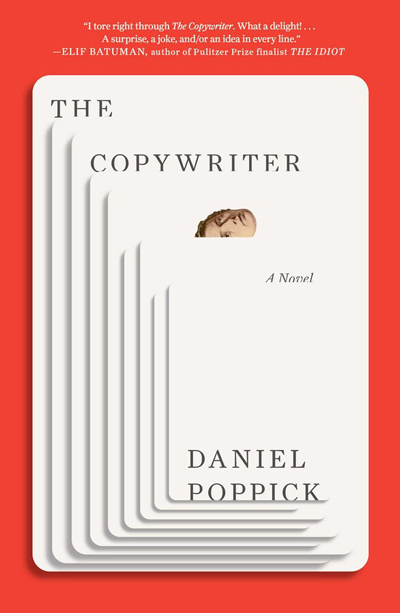
The Copywriter
By Daniel Poppick
Scribner, 224 pp.
This idea makes some sense. I buy that some people who once sought meaning in sermons and prayer groups might channel that energy instead into code reviews or all-hands meetings. But this framing assumes that the worker is a believer, rerouting her faith from the prayer hall into the conference room. What happens when the worker is a doubter, a skeptic of both God and a job? The Copywriter, the comic, cerebral debut novel from poet Daniel Poppick, follows such a doubter, a seeker called D__ who as a bar mitzvah student asks his rabbi whether he believes in God and, decades later, asks a rabbi colleague at his new nonprofit workplace the same question. For D__, work operates similarly to religion, not in the sense that it provides spiritual fulfilment, but in the way it serves as a site of deep ambivalence, uncertainty and obscure motives; both institutions, for him, deserve persistent questioning.
D__ is a poet who, at the start of the novel, fears that his days writing copy for an e-commerce startup—coming up with pithy descriptions for products like sand pails and LED boxes inscribed with “namaste in bed”—are numbered. When he indeed loses his job, he decides to take some time off, read Proust, focus on his writing. He flounders. Soon, his girlfriend dumps him, and the IRS requires of him an “almost Wagnerian sum of money—artful and shocking.” And he finds he can’t write. In his first month unemployed, all he manages to produce is a peculiar parable about Jesus being trash; the months go on sans poems. Before too long, he seeks another job.
In many recent workplace tales—think of the vexed yet pointless offices of Halle Butler’s The New Me or Ling Ma’s Severance—a job is presented as a soul-crushing, creativity-draining necessity, an entity that takes much and gives little, where the worker’s ambition is to escape. In The Copywriter, a job, rather than flattening and diminishing a writer, is a force that sharpens and usefully constrains its protagonist. Instead of obliterating D__’s spirit and capacity to make art, a job might actually be a prerequisite for him to create it. He reflects at one point, “I’m inclined to believe that the muse does exist, though we may not like it when we meet it.” Work, like it or not, seems to be D__’s muse.
D__, like many a fictional slacker, insists on indifference, even disdain, toward paid labor. He calls his job stupid, refers to an office as a “tomb for daylight and paper,” suggests a job’s core purpose is to stave off death. Applying for a gig on LinkedIn, he argues that the site’s founders should be prosecuted at The Hague. Still, he takes a perverse pride in producing pun-filled prose that will reach larger audiences than his poems ever will. He angles to impress his bosses, noting (boasting?) that “I know someone with an executive mindset when I meet them.” He finds, once he lands a new role, that language animates him again.
Poppick intersperses, between first-person narration recalling D__’s workdays, firing, and job hunt, a series of quasi-mystical “parables,” dream journal entries, Proust quotations, and poems. This scrapbook structure, which occasionally sees Poppick veer into over-the-top jokiness, succeeds at boxing a scrambled man into a character that coheres. D__ may not understand himself, but seeing which Proust lines and snippets of overheard dialogue catch his attention, the reader begins to.
Poppick’s writing is nutritious, dense with ideas and references and questions, including some that have previously cropped up in his poems about memory and time. D__ is grasping for something bigger, using his jobs not as an end in his quest for meaning, but as a structural constraint as he feels his way through a life. “I’m not a religious person,” he declares early on, “but sometimes I find myself in a situation that seems concocted elsewhere—in a parallel dimension, created by an intelligence with narrative omniscience.” (This line winks at the fact that he is, yes, in a novel. But it implies an earnest curiosity, too, about the unseen systems that make things how they are.) Recalling the John Ashbery line “everything has a schedule, if you can find out what it is,” D__ continues that “in these seemingly concocted moments, it feels as if some presence is trying to teach me a schedule, should I wish to learn.”
Along the road to enlightenment, D__ smokes weed, takes baths, tries to muster tears upon learning of Ashbery’s death, and has long, intricate discussions about poetry with his small group of friends who have also determined to structure their lives around it. He never introduces himself as a copywriter, insisting instead on identifying as a poet. He tells a therapist, nearing the end of his first session, “I think I forgot to mention—I’m actually a poet.” When a man points a gun to his head and asks about his line of work, D__ answers that “most of it doesn’t rhyme … but recently a lot of it does.” “You’re a poet,” his poet friend tells him as they set out on a road trip. “You’re a poet,” he says back to her a few pages and several hundred miles of driving later, repeating it like a validating mantra. Still, when he loses his job, he’s knocked off kilter about even this. A stranger at a party asks D__ and his friend if they are writers. “I’m currently unemployed,” D__ responds. “I’ve been reading Proust.”
Poppick (and the novel’s protagonist) seems interested in the gaps between language and reality, between what one says and what one means and how these statements shape and reflect the way things actually are. From a young age, D__ identifies that both religion and work present grown-ups with opportunities for dissembling and hypocrisy. He recalls that, as a child, “none of the adults around me seemed to give a flying fuck about God, Jewish or otherwise, but there was a mysterious motivation behind their thinking.” He wonders, considering the many things they do and say that don’t make sense: “Why did they have jobs that they clearly hated when they told us we could be anything we wanted to be when we grew up?”
This novel is very funny. “Baltimore has a wonderful puking culture,” D__ notes, watching his friend relieve herself there. In a locker room, a naked old man, seeing D__ cover himself with a towel, theatrically rolls his eyes. Encountering a 9/11 bumper sticker reading “Heaven just got one hell of a fire department,” D__ wonders: “Can we not let them rest?” But the parables and renderings of D__’s compatriots in his artsy, Brooklyn-y milieu are sometimes so absurd that they stumble into the generically parodic; these descriptions of people he meets are rare examples of imprecision in a text that is otherwise wonderfully well-observed. The stranger at the party, smoking a fancy herbal cigarette in clown pants, talks about cumming into spiderwebs at a prestigious fellowship in Stuttgart and asks if the cocaine is gluten-free. D__’s friend delivers ad copy reading “When you think of dish racks, you should think of postmodernity, because postmodern theory is often arid—or, in layman’s terms, dry.” A server offers “broccolini-wad tartine, tickled with pink Himalayan rainwater and butterfly-kissed with fermented dandelion hair aioli.”
“In many recent workplace tales—think of the vexed yet pointless offices of Halle Butler’s The New Me or Ling Ma’s Severance—a job is presented as a soul-crushing, creativity-draining necessity, an entity that takes much and gives little, where the worker’s ambition is to escape. In The Copywriter, a job, rather than flattening and diminishing a writer, is a force that sharpens and usefully constrains its protagonist.”
There is a Seinfeldian quality to the novel, in its close attention to the small indignities and inconsistencies of daily life. D__ flirts with the idea that his is a story about nothing—he makes much of the Proust line, “So what I believed to be nothing to me was simply my entire life.” And, like many office workers and Proust readers before him, D__ is haunted by time. His boss’s time, he believes, is valuable. He values his own time too much, he figures, to have kids. His new job puts him in the business of event promotion, of selling time. “But how am I to use the time I don’t sell?” he wonders, before looking through his notebooks and getting the idea to put together a project like the one we are reading. Much of the text is presented as the jottings of a guy going through life and taking it all in. Work, because it’s there, is a throughline. It enables him to interact with non-poets, the type of people who embrace corporate benefits and call each other on desk phones to ask for gum. (Though these normies, too, provide insight: “The highlight of my weekend was time,” one tells another, somewhat mystically.) It allows for conversations with his loving and indulgent parents. It lets him exercise something like agency, move in something like a direction.
Towards the novel’s end, after asking the rabbi about God at the water cooler, D__ performs one act of Bartleby the Scrivener-esque denial (acknowledging that this approach is “unoriginal”). But mostly, his resistance is a refusal to identify with, or give his all to, a job. When, in a moment of post-nut clarity, he tells a date that he needs a third thing, beyond poetry and love, to give his life meaning, she asks if he has considered money. He doesn’t think so. Still, a job, even if he wishes to deny it, structures his life and provides some kind of meaning: It lets him be a poet.