When I first heard John Darnielle’s music, it was in the stripped-down days of the Mountain Goats, when their music largely involved Darnielle recording vocals and guitar on a boombox—think “Going to Georgia” and “Cubs in Five.” The album Tallahassee, released in 2002, had a high-fidelity sound and came out on the influential indie label 4AD. It was during this period that the Mountain Goats recorded what is probably their best-known song, “This Year,” taken from the autobiographical album The Sunset Tree and later repurposed as a statement of anti-authoritarian defiance in the Trump era. And, of course, it gives the book we’re here to discuss its title: in This Year, Darnielle calls The Sunset Tree “the first [album] that will be mentioned in my obituary.”
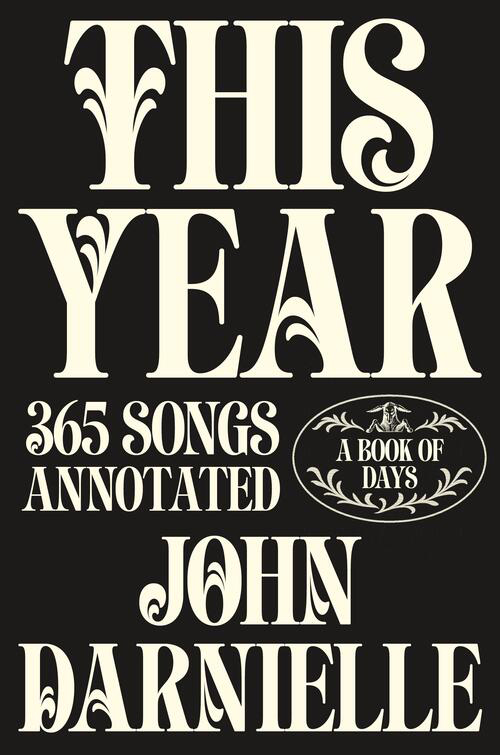
This Year: 365 Songs Annotated
By John Darnielle
MCD, 560 pp
Darnielle’s reputation has climbed ever higher in the years since. He has collaborated with filmmaker Rian Johnson, even landing an acting role in the Johnson-created series Poker Face and the Johnson-directed single-take concert film the Mountain Goats: The Life of the World to Come. He has also written—depending on how you keep track—three or four novels. The first, Black Sabbath’s Master of Reality, was published as part of the long-running 33 ⅓ series; since then, Wolf in White Van, Universal Harvester, and Devil House have followed. Wolf in White Van was longlisted for the 2014 National Book Award for Fiction, and Darnielle has since served as a judge for a subsequent iteration of the awards. Occasionally, you can even find him recommending literature in translation on the band’s YouTube channel. Plenty of artists known for their music also have a foothold in books; Darnielle is one of a few to do it well enough for either part of his discography to stand on their own. (See also: Patti Smith, Leonard Cohen, and Jace Clayton.)
To paraphrase a certain American poet, Darnielle contains multitudes. The Mountain Goats’ 2009 album, titled The Life of the World to Come, features 12 songs named for Bible verses. The Mountain Goats’ 2002 song “The Best Ever Death Metal Band in Denton” climaxes with a rousing shout of “Hail, Satan!” His readers and listeners have an innate trust—I won’t call it faith, at least not yet—in his ability to straddle seemingly disparate philosophies in a consistent body of work without hideous amounts of cognitive dissonance.
Which brings us to This Year. This book is—with the possible exception of the Mountain Goats’ album The Life of the World to Come—the most overtly religious of Darnielle’s works. That is not to say that his previous books have been avoided questions of faith: you can’t have a book called Devil House without the presence of the Devil, after all, and Wolf in White Van takes its title from a phrase that mysteriously emerges when listening to a song by Christian rock pioneer Larry Norman in reverse.
• • •
As a longtime listener and reader of Darnielle’s, there’s something almost anticlimactic about seeing him publish his collected lyrics. Lyrical collections often feel like a victory lap in a megastar’s career; some of the best-known examples in recent years have come from Jay-Z and Paul McCartney. Darnielle’s literary success makes the most basic idea of This Year feel, if not unnecessary, then a step down for Darnielle’s ambitions as a writer. It’s a good thing, then, that Darnielle has loftier goals here than simply packaging up every lyric he’s ever written. In the book’s preface, he explores the project’s evolution—essentially, an annotation to a collection of annotations.
“This volume began as Compleat Lyricks, the antiquated spelling there to mark the effort as out of step with the times: an enormous tome collecting everything, with the ones that still seemed good to me there in detail alongside their brethren, boisterous and vocal but occasionally unkempt.”
In one early chapter, Darnielle writes, “This is not a memoir; unless it is.” While I don’t think this goes quite so far as to be described as a stealth memoir, This Year definitely approaches the boundaries of the genre. Sometimes, this memoir-adjacent commentary takes the form of anecdotes: working with longtime collaborator Peter Hughes to record “Cubs in Five,” which references the new wave band Heaven 17, or—decades later— performing at a David Bowie tribute concert alongside Heaven 17 vocalist Glenn Gregory. (“I didn’t say anything,” Darnielle writes.)
Many of the songs annotated here will be familiar to longtime Mountain Goats listeners, which, ultimately, is who this book is for. At least one of the songs annotated here was never actually recorded. “The notebooks of this era are full of things like this: cast-offs and latter-round draft picks who never make the team,” Darnielle writes. “I have a great fondness for these stray fish.” It’s in the annotations that Darnielle also points to one of the poets who has influenced him: Karl Shapiro, whose V-Letter and Other Poems won the Pulitzer Prize in 1945. It’s one of several wide-ranging cultural references made over the course of the annotations. Darnielle also reveals that the song “Against Pollution” took inspiration from a section of C.S. Lewis’s Mere Christianity, while “Hebrews 11:40” includes imagery from Mario Bava’s horror film Black Sunday and “New Zion” “is kind of a riff on” the Matthew Arnold poem “Dover Beach.” You could create a syllabus of the works cited in here, and it would almost certainly make for a compelling course.
There are plenty of Mountain Goats lyrics in the book, but that isn’t Darnielle’s only musical project represented—fans of the Extra Glenns, Darnielle’s project with Franklin Bruno, will have something to savor here—and there are acknowledgements of his forays into prose as well. One of the more enlightening aspects that emerges from reading This Year is the way in which it reveals Darnielle’s music and prose to be part of a larger project. This becomes especially clear in the discussion of the Mountain Goats album Tallahassee, about which Darnielle observes, “I didn’t know it at the time, but the album was teaching me how to write a novel.”
“To paraphrase a certain American poet, Darnielle contains multitudes. His readers and listeners have an innate trust—I won’t call it faith, at least not yet—in his ability to straddle seemingly disparate philosophies in consistent body of work without hideous amounts of cognitive dissonance.”
The spirit of openness found throughout this book takes many forms. (There’s a running bit where Darnielle imagines an alternate world where the Mountain Goats are chart-topping rock gods, for instance.) In one of the annotations from The Life of the World to Come Darnielle gets candid about both a specific experience with and the broader genesis of the Mountain Goats. (“Of all our albums, The Life of the World to Come comes closest to confessional folk, the very genre whose existence led me to call my act the Mountain Goats as a distancing tactic.”) In the commentary on the song “Isaiah 45:23”—a song with the chorus “And I won’t get better/ but someday I’ll be free/ I am not this body that imprisons me”—he explains precisely which parts of his biography he was drawing upon here.
“This story pretty clearly has its roots in my time working in hospitals and in home care, but it won’t surprise you to learn that this is also me: not dying, not hospitalized, but at home, unable to sleep through the night because of a couple of chronic health matters that had descended on my house in 2008 and liked the view well enough to stay.”
In that same block of commentary, Darnielle also situates the album in question within his larger project. “Of all our albums, The Life of the World to Come comes closest to confessional folk, the very genre whose existence led me to call my act the Mountain Goats as a distancing tactic,” he writes. That album has also occupied a curious place for me as well. The very structure of the albums, and the repeated invocation of Scripture, meant that there was no room for ironic distance; this was not necessarily a religious work, but it was one that tangled seriously with religion. It’s also an incredibly subtle album. My breakthrough with it came from watching the aforementioned Rian Johnson-directed concert film, in which a camera circles Darnielle as he plays songs from the album, mostly solo, on guitar and piano, with an almost superhuman level of empathy. It was after watching this film that “Matthew 25:21” became one of the two Darnielle compositions basically guaranteed to reduce me to a devastated mess whenever I hear it.
The Life of the World to Come was also the Mountain Goats album that made it clear that Darnielle took his discussion of religion very seriously. In the case of This Year, one of the ongoing threads finds Darnielle’s own experience of religion evolving, from being a practicing Catholic to developing an interest in Gaudiya Vaiṣhṇavism to reconciling his political beliefs with Catholicism. (Some of the more interesting lyrical annotations are those where he describes using “you” as opposed to “You” in his work.)
Darnielle’s defiance of musical trends remains a hallmark of his career, having never pivoted to EDM or written a hit single for a blockbuster film. (Probably the closest he’s come to the latter is the song “The Ultimate Jedi Who Wastes All the Other Jedi and Eats Their Bones,” which does not actually appear in Rian Johnson’s Star Wars: The Last Jedi—oh, but what might have been!) Over time, the recording studios where Darnielle makes his albums have become less DIY and more storied: 2021’s Dark In Here was recorded in FAME Studios, a studio whose history includes sessions from the likes of Otis Redding and Aretha Franklin. As This Year makes clear, while Darnielle’s tireless search for lyrical inspiration has been a relative constant, so too has the ways in which faith and belief have informed his writing. Of “Song For the Julian Calendar,” from the 1997 album Full Force Galesburg, Darnielle gives both a history of the song’s formal release and one of the quirks within it.
We all have our tics. Sometimes we feel affectionate toward them, even protective of them. That this song addresses two different people as “you” when one of them requires a capital Y, but the person who released it was adamant that his albums didn’t have lyric sheets: I don’t have this tic any more, but when I remember it, I still like it.
As someone who can remember the hullabaloo about Christian artists making their way into the nominally secular indie rock and punk scenes in the 1990s, it’s amazing to read This Year and realize that Darnielle never tangled with this discourse, even though he was, at times, writing about a you with a capital Y. Some of that certainly has to do with the cosmology of Darnielle’s lyrics writ large: there is clearly plenty of discussion of Christianity here, but Darnielle is also willing to throw in a “Hail, Satan!” or muse on the afterlives of video game characters. One could be a devout believer or a dedicated atheist and still savor many of the same qualities of Darnielle’s work. But there’s also Darnielle’s willingness to draw both from his own life and from his own conclusions about that life. Or, as Darnielle writes of the song “Heretic Pride,” “Every good Catholic has pinups of the martyred saints on the dorm room wall of his mind, and no matter how many years ago you stopped going to church, you probably never left the Church.”
This Year: 365 Songs Annotated: A Book of Days may no longer be titled Compleat Lyricks, but the sense of a book slightly out of step with the times persists. That’s intended as a compliment. In the commentary found within these pages, Darnielle invokes everyone from poet John Berryman to dub producer Prince Far I to professional wrestler Ox Baker. In the introduction, Darnielle writes of the creation of this book that “[m]y misconception, for the first several years of the effort, had been that I was writing a book, but in truth I was making a book: These are two different things.” It’s through this making that Darnielle also shows us how he has assembled the ragtag group of icons who inform his work, drawing inspiration from the very specific and turning into something broadly gripping. One might say, in fact, that it’s a kind of revelation.