
What does it mean to hate what you’re instructed to love—family, community, state? The writer Inès Cagnati was born in the late 1930s to Italian immigrant parents in rural France. Though she was a naturalized French citizen, she makes clear in an interview included in her novel Free Day (Le jour de congé), published by New York Review Books in 2019, that she has never considered herself French, despite writing books in that language and teaching French language and literature at the college level: “[When] my parents had me naturalized, that was a tragedy, because I was not French. I wasn’t Italian anymore either. So I was nothing.”
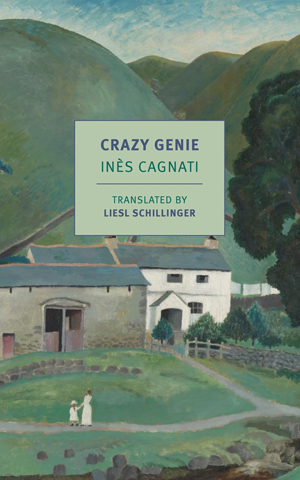
Crazy Genie
By Inès Cagnati
Translated from the French by Liesl Schillinger
New York Review Books, 161pp.
Cagnati’s books portray the experience of being nothing and rejecting the world which has made one nothing. What complicates these works, at least the two that have been translated into English, is that, unlike the hate-fueled novels of Thomas Bernhard and Louis-Ferdinand Céline, their narrators are girls who, as voices, as characters, aren’t nearly as embittered as their author. Far from mouthpieces of Cagnati, these credulous, innocent, wounded but almost hopeful narrators hardly reject their realities at all; it’s instead the structure and movement of the narratives surrounding them that execute this rejection, as though the story being told is revenge on behalf of the storyteller. This risky balance between contemptuous narrative and dovish narrator is particularly striking in the just-published Crazy Genie (Génie La Folle), presented in Liesl Schillinger’s clean, elegant translation of Cagnati’s heartbreaking novel.
The style of narration in Crazy Genie is a strategy of survival for the narrator, raising Cagnati’s book well above the contemporary trauma novel, with its sick insistence on tragedy and loss as slick entertainment. For its complexity hidden behind a haunting appearance of simplicity, Crazy Genie deserves to take its place in postwar French literature alongside Georges Perec’s W, or the Memory of Childhood and Claude Simon’s The Trolley, which also portray the nostalgia for childhood as the obverse of an inexpressible destruction.
The “Crazy Genie” of the novel’s title is a dayworker who, because she refuses to speak to them, is viewed as mute and mad by the farmers and other townspeople who employ her; like most villagers in world literature, they are largely stupid and cruel. About Crazy Genie, the narrator, her daughter Marie, says, “But me, I wanted to love her, to always be near her.” Marie repeatedly uses this formulation (“me, I…”) when telling the reader about her relationship with Genie, who often fails to express her love for, or even the desire to be near, her daughter. Possibly this is because so much of Genie’s life is characterized by roaming from household to household performing drudgeries—milking cows, skinning pigs—to which she feels ashamed to expose Marie. But the shame Genie feels in private, not unconnected to the pride she exhibits in public (“She walked along, eyes in the distance, me running after her, and they watched her”), is more morally complicated than that.
The indifference she shows toward her daughter sometimes edges into a willful blindness, almost as if she’s turning away from Marie, acting as if she doesn’t exist. As in most abuse-through-neglect situations, this only draws Marie in more. Toward the beginning of this short novel, Marie recounts her mother, who seems to be around thirty years old, crying. “Me, I would go to her. I would put my head on her knees and say: ‘Me, you have me.’” Genie does not seem to find this consoling: “But she would cry without hearing, her eyes taking on the color of tears.” Mothers are complicated creatures; Marie wants the comfort of mothering her mother, but Genie won’t permit her even that.
Cagnati braids this main narrative with chapters in which Marie is a grown but still young woman, living in La Rochelle on the Atlantic coast. In these chapters, she narrates her love for Pierre, a pilot who promises to take her to see “where I was born, among paths of wild orange trees,” where “you swim at night in water as soft as silk.” This image of Mediterranean bliss seduces Marie, so used to the marshlands and climate of home.
Home is deep in the Aquitaine (now Nouvelle-Aquitaine) region of France, to which the author and her family, along with many others, immigrated from Italy between the World Wars. This Aquitaine, a little grimmer than the 21st-century tourist’s wonderland of black truffles, Bordeaux wines, and Limoges plates, is a place of dehydrated dogs who “roamed the riverbed searching for any trickle” during a summer drought. In one scene, Crazy Genie puts “unusable scraps” into a pail for some dogs, and then some more into another pail for Marie.
That said, it’s still southwestern France. Marie picks wild fennel and adopts a calf she calls Rose, in addition to a duckling she baptizes Benoît, making a little family for herself that she attends to while her mother either works or recovers from work, the two main activities that occupy Crazy Genie’s days: “I sat near her [Rose] and waited for her [Genie] to come back. It was that night that I perceived Rose was blind. I stayed near her talking about Benoît …Rose quietly ruminated. She was pretty, with her white spots, and no doubt she didn’t know that other animals could see.” Rose the calf strikes the reader as a vulnerable, docile double of Genie, one who has no choice but to let herself be comforted and mothered. Lyrical and serene passages like these make the dark, decidedly unlyrical narrative developments feel genuinely surprising once they arrive. Marie’s absorption in the landscape, her picking of wild fennel and tending to cows and ducks, doesn’t feel like an escape from loneliness so much as a misanthropic refutation of it, an assertion by the writer that animals and nature are better anyway.
For its complexity hidden behind a haunting appearance of simplicity, Crazy Genie deserves to take its place in postwar French literature alongside Georges Perec’s W, or the Memory of Childhood and Claude Simon’s The Trolley, which also portray the nostalgia for childhood as the obverse of an inexpressible destruction.
• • •
While Crazy Genie’s back matter mentions Inès Cagnati’s status as an immigrant, the question of immigration in the novel seems to be metaphorical rather than literal. “The arrival of the Italians revived a failing region,” writes Schillinger in her introduction to the earlier Free Day, “but it also prompted French anxieties about alien invasion and cries for quotas.” Though the alienation of being seen as an invader is inseparable from the texture of both novels, neither one is quite a “us versus them” story, and are both better and more compelling for it. More accurately, they’re “me against the world” stories, in which family, one’s sole defense against masses of stupid, cruel villagers who amuse themselves by coining unimaginative nicknames for single mothers, is swampy, treacherous terrain, sucking one down like the marshes of Marie’s youth. Where Free Day can be self-pitying, Crazy Genie isn’t, in part because Marie doesn’t seem to realize, or be able to admit that everyone, starting with her mother, is against her in some sense.
Some of the book’s most resonant scenes concern Marie’s extended family, represented mainly by her grandmother and grandfather, always referred to as “the grandmother” and “the grandfather” in the novel. The grandmother is an imperious figure, a busybody who exerts her will over Marie’s aunts, uncles, and cousins, and who views Crazy Genie, her daughter, as a sinful aberration with a bastard child. The grandfather is kindlier— it’s not hard to be kindlier than the Grandmother, but along with Pierre, Marie’s love interest, he is a rare warm human presence in the novel. He occasionally offers Marie fruits, nuts, and other goodies from his musette bag—he’s no doubt a fashion-forward older gentleman—and goes out of his way to warn Crazy Genie of her mother’s wrath after she accepts a position with a farmer called Antoine, who is known about town for having lived in sin with his own sister, the sort of thing that might fly in Paris but not Aquitaine.
The grandfather is right: immediately thereafter, the grandmother comes to the cottage Marie and Genie share and berates her daughter, saying that she’s become “a gypsy” (horror!), has “dishonored the finest family in the region” (doubtful), and now is going to work for “the most sordid family in the village” (harsh competition, but possible). She even threatens to have Genie institutionalized as a “madwoman,” turning her from gossiped-about “folle” into state-certified “folle.”
For both Marie and Crazy Genie, then, maternal love proves elusive, but unlike Marie, Genie has stopped hoping for it. One senses in Marie’s plea, “me, you have me,” a suppressed and valid rage, the fury of a forceful reminder: I exist, notice me. Yes, Crazy Genie is traumatized in her own way, the novel seems to want to say, but that’s no excuse, only an explanation.
In his 1936 book The Transcendence of the Ego, Jean-Paul Sartre argues that the ego, the “me,” the “I” (which to him are basically the same), are each an “object rather than a consciousness,” a thing constantly being shaped and reshaped rather than an active agent of thinking or doing. At the same time, this object is constantly being mistaken for the latter by everyone from philosophers to everyday human beings.
In arguing for this rather radical idea, he brings up an expression that he says is common to the experience of surprising oneself, the repetition of the first-person pronoun, as in “I, I could do that!” or, “I, I could hate my father!” Presumably this expression was much more common in 1930s France than it is today, but we can perhaps imagine the speaker, in using it, glimpsing the true nature of the ego: that it is an object created by a consciousness.
When Marie says during the grape harvest, “And she worked, and me, I was happy,” a sentence that gets its own paragraph, one senses a character who is aware of this truth and fully in control of the illusion bound up with it. As her family rejects her, Marie asserts and even creates herself through her repetition of personal pronouns. Her plea, “Me, you have me,” is above all an act of persuasion—persuading not only her mother but herself that she exists, that Genie “has” her. Otherwise, there might not be any more “I” to speak of, and Marie would fall beneath the tidal pull of her life’s tragic details.