I’m sure you’ve read that George Saunders—avuncular moralist of American letters—is a Buddhist. It’s served him well in most every slavering profile during his prize-scooping, meteoric rise to the top of the literary tree, and indeed, if the fawning interviews are to be believed, of life. Saunders’s Buddhism hits just the right note (or some sort of temple chime) with a certain type of liberal reader. It gives that reader—along with reviewers and prize committees—an obvious framework through which to read his work, while flattering a mindset which privileges tolerance, compassion (karuna), political quietude, and, crucially, reading. His latest novel, Vigil, is an object lesson in the Buddhist art of metta, loving-kindness, proffering boundless, un-means-tested empathy as a practice for writing, reading, and life. “What I regret most in my life are failures of kindness,” he said, in a recent interview, a fact he seems to want to correct in his fiction. Failure of kindness, unfortunately, is also a neat way to describe the experience of reading this maddening novel.
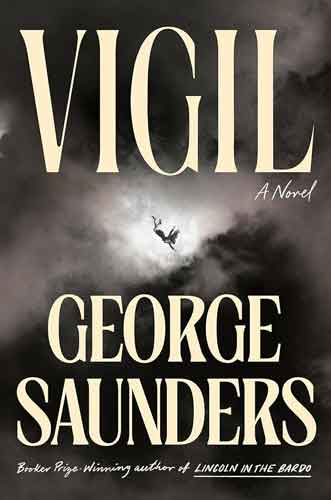
Vigil
By George Saunders
Random House, 192 pp.
Vigil is a sort of cli-fi Christmas Carol pastiche, in which our fearful narrator, Jill “Doll” Blaine, a long-dead apparition, visits the well-appointed deathbed of one KJ Boone, CEO of an evil oil company and not long for this world. After her very violent death (“Blown up. In Indiana”), Jill was elevated, eventually growing alienated from her past life, in both corporal form and affect. She now acts as a sort of Hoosier housewife Virgil, who offers her “charges” a graceful passage from this life to the next. Rather than passing judgement on the oilman’s manifold misdeeds, Jill’s role, as she sees it, is, “To comfort. To comfort whomever I could, in whatever way I might. For this was the work our great God in Heaven had given me.”
It reveals a lot about Saunders’s fictional—and indeed political— project, that the object of Jill’s comfort is “the son of a bitch who destroyed the planet” in the words of one lobbyist-ghost. In the dynamic between the elevated and her charge, Saunders puts his own spin on the existential binaries of Buddhist and indeed spiritual thought, a pitched battle between punishment and forgiveness, compassion and detachment, heaven and hell.
If this sounds like familiar territory, that’s because it is. Saunders’ previous novel, 2017’s Booker Prize-winning Lincoln in the Bardo, also took place in the shadowy netherworld between life and death. It too was teeming with goofball ghouls, who “whisk” about the mortal world (in Bardo it was “walk-skim”) talking in that heightened vaudevillian speech that characterizes his writing. Indeed, in Vigil, we’re deep in the flatlands of Saundersian diction, and any reader should gird her loins for a heroic dose of Midwest folksiness: “Goodness,” “goshdarnit,” “guff,” “grumpy-puss,” “dang,” “wrassling,” “kiddo,” etc.
Boone is a straightforward liberal bogeyman: he’s a self-made cornpone and a willing architect of the campaign of misdirection and obfuscation that has led to the planet’s undoing. Indeed, Saunders characterizes Boone as being as responsible as any single figure can be for the climate crisis writ large: “Only a handful of people in all of history had ever known that kind of power. Presidents, maybe, depending on the era; kings, sure.” This Boone is not a mere bad actor, he is, we quickly learn, a true unbeliever of climate science. Less an arch deceiver, it’s more that he’s a man incapable of doubt. “Within him abided a formidable stubbornness,” Jill thinks upon “entering the orb of his thoughts,” which is Saunders’s achingly literal neologism for his switches of narrative perspective. “A steady flow of satisfaction, even triumph, coursed through him, regarding all he had managed to do, see, cause, and create, especially given his humble origins.” This inveterate stubbornness is of course the Chekhovian pistol that must go off, unconvincingly, in the final act.
Enter the Frenchman. A bumbling, blustering phantom, with a catchphrase “quelle horreur.” Etienne Lenoir, inventor of the internal combustion engine. As with Nobel and Einstein, Saunders imagines Lenoir as having realized the destructive potential of his invention, although in his case, from beyond the grave: “It [CO2] poisons, madam, he said. I did not know it then. But I know it now. I have been corrected. As he must be. And you? You are here to help. To help me. Help me correct him.”
Reluctantly, the two team up to show Boone the error of his ways, in a series of gooey, spectral set pieces, conjuring imperiled birds. “Unprecedented Spring heatwave! […] Necklace-throated dayhawk!” they shout at the oilman’s bedside, followed by Mr. Bhuti, a departed Indian villager who intones, “the skin of our faces became shriveled like the skins of old apples. Also, the color of our urine went from yellow to black as coal. Sounds of suffering came from all over the village. Men fought at the well for the right to lick the bucket.” These maudlin homilies of Dickensian sentiment left me as unmoved as Boone himself.
Along with A Christmas Carol, an obvious touchstone to this novel is The Death of Ivan Ilyich, in which a self-satisfied civil servant whose life was “most simple and most ordinary and therefore most terrible” embraces the hollowness of his existence in the moments before his Christian death. In comparison to Tolstoy and Dickens’s contempt for the godless, emergent bourgeoisie that characterized their times, Saunders’s target seems altogether too broad. There is a great deal of narrative Sturm und Drang deployed to create the conditions for Boone to accept ecological truths which even grade schoolers understand.
Boone’s putative transformation is a chore, but the point of Vigil is to provoke our powers of empathy and understanding, at an interpersonal and political level. This is where the Buddhism comes in. Jill is a sort of aw-shucks determinist, who ultimately believes that actions, whether good or bad, are the result of a heady brew of genetic and socio-economic luck: “Who else could you have been but exactly who you are? I said. Did you, in the womb, construct yourself? All your life you believed yourself to be making choices, but what looked like choices were so severely delimited in advance by the mind, body, and disposition thrust upon you that the whole game amounted to a sort of lavish jailing.” Saunders’s ideas about the self and the soul have finally come to the fore: we must dispense with the Christian cycle of repentance, forgiveness, and absolution, and instead apply our finer feelings to attend to the comfort of others.
This is territory that Saunders already politely traversed in Lincoln in the Bardo: “The world was full of sorrow; that everyone labored under some burden of sorrow; that all were suffering; that whatever way one took in this world, one must try to remember that all were suffering (none content; all wronged, neglected, overlooked, misunderstood), and therefore one must do what one could to lighten the load of those with whom one came into contact.” Saunders’s short stories, too, use suffering as the keyhole through which to perceive the bad actions of his characters. But the ne’er-do-wells of Saunders’s stories were usually caught in the gears of capitalism. What, then, is the political import of applying this framework to a cartoonish character who is capitalism?
Though we can never enter the orb of the author’s thoughts, it’s telling that he takes such pains to contextualize Boone’s development into the man he became. He brings Boone’s parents to his bedside to remonstrate with him: first his father who “was missing the index finger of his left hand from the famous threshing accident,” a man who’d “said “ast” for “ask.”” And then there’s Boone’s mother, who appears just as he’s about to pass over. She makes one last plea for her son to admit fault. Instead, Boone remains convinced “he’d done nothing wrong. On the contrary, he’d always been a good boy, who’d become a good man.” Deep down, the novel’s antagonist is just a scared little boy desperate for love and approval. In Saunders’s cosmology, bad actions are a sort of pre-ordained happenstance, and blame is beside the point.
It gestures towards a politics of quietude, of Buddhist detachment. There’s a famous Buddhist parable, about a very monkish monk who is visited by his former wife and baby, who’d fallen on hard times. The monk ignores their entreaties for help, and she leaves cursing his name. He’s later praised by Siddhartha for his upekkha, or equanimity, his resistance to the demands of the ego. He demonstrates utter nekkhamma, detachment from the mortal world. It’s a detachment of care and attention, but it’s detachment nonetheless. Boone’s eventual renunciation comes “too late” for the state of his soul, but also for all of us. There’s little we can do, Saunders seems to suggest, in the face of such catastrophe, besides care and care and care.
Vigil at its core is a very liberal novel. It flatters a politics of pluralism and tolerance, of scientific knowledge, of reform rather than revolution. Take, for example, Saunders’s idea of empathy, the animating idea of his fiction: “entering the orb of another’s thoughts” is a rather crude metaphor for the experience of reading. Indeed, what is more “liberal” than reading literary fiction, and thinking it makes you a better person? Google empathy and fiction and you’ll be deluged with articles explaining, as if to a productivity commission, that fiction makes you feel more for others. Oftentimes, building empathy seems beside the point, in a world in which genocide is livestreamed, in which we live in a condition of informed helplessness, where the problems ruining the planet are all too legible and all too intractable. Buddhist or not, if you need to read a novel to understand the suffering of the world, then you may be too insulated against the world.
Putting aside the question of the individual, let’s return to the collective, to how a political project, insofar as it exists in fiction, is transmitted in Vigil. Does anyone, especially someone as intelligent and talented as Saunders, truly believe that the climate crisis is due to a lack of information (the gravest sin in the eyes of a liberal), and more crucially, empathy? Breezing right past Chekhov’s notion that artists need not solve the world’s problems so long as they formulate them correctly, Vigil wants its readers to believe that bad actors like Boone are misguided, deluding themselves, and that their consciences can be appealed to, can be elevated. In this world of magical thinking, fiction, when read or written, functions as an artistic act of empathy that can substitute for real politics.
“Saunders, ensconced is his world of fiction, wants us to collectively flap our limp, liberal white flag. But what if the men who’ve eaten the world feared punishment in this life, not the next? What would fiction look like if these characters were wracked with guilt and shame, if they dreaded the bullet, à la Luigi Mangione, with their names on it, and spent their lives trying to stop it from entering the orb of their thoughts?”
Surely the evil act evilly not because they no longer fear punishment from God, but because they no longer fear people? They know precisely what they are doing—they are paid handsomely to pretend they don’t, and to make the world pretend along with them. The sort of detachment that Saunders offers, whether Buddhist, liberal or otherwise, is a sort of resignation, a way to cede the world to power and capital.
While writing this review, I kept returning to Wave of Blood, Ariana Reines’s 2025 call to arms against the ongoing genocide in Gaza, which concludes “whoever the powerful are, however they get it, if their over you is conceptual, linguistic, or their literal boot in your face—they will shape what is to come for us, on top of us and against us, if we don’t shape it for ourselves.” Reines sees the present as the time to redouble our efforts in the real world, whereas Saunders, ensconced is his world of fiction, wants us to collectively flap our limp, liberal white flag.
But what if the men who’ve eaten the world feared punishment in this life, not the next? What would fiction look like if these characters were wracked with guilt and shame, if they dreaded the bullet, à la Luigi Mangione, with their names on it, and spent their lives trying to stop it from entering the orb of their thoughts?