I have a fantasy. It goes like this: I wave goodbye to urban life and move to a commune—specifically, a commune in the Missouri Ozarks I read about in a New York Times Magazine feature a few years ago. I learn to milk cows, grow vegetables, and chop firewood; I slaughter pigs, I make herbal tinctures, I tend to the children. At night, limbs pleasantly heavy from a long day’s work, I fall asleep unaided by melatonin, alcohol, or benzodiazepines, and in the morning I rise at the rooster’s crow. There is no internet, so I read and write for long hours. I see God in everything. Having shed my vanity and adopted in its place a wholesome asexuality, I cut my hair short, go without makeup, stop shaving my body, and don unflattering clothes chosen for utility—adjustments to my appearance which I could, of course, easily make here in New York City, if I really wanted to. Also, the toilets are actually buckets with seats affixed to them, and we communists take turns hauling them outside to empty onto compost piles where, after three years, the “humanure” becomes safe for the fertilization of our crops. Yes, my fantasy involves eating my own shit.
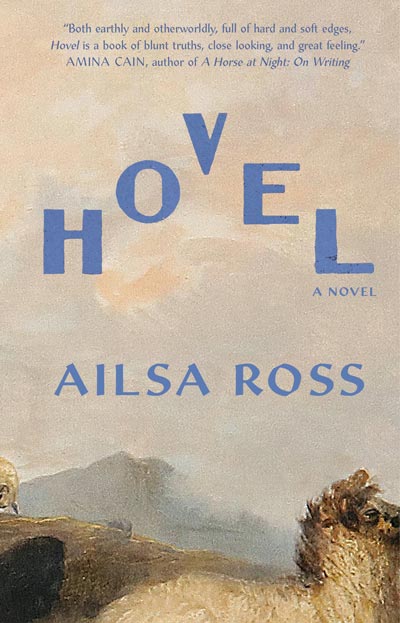
Hovel
By Ailsa Ross
Strange Light, 352pp.
When our fantasies become preoccupations, they pop up like ruderal plants in our daily lives, hardy and persistent, tempting us to upend everything. This is the starting point of Hovel, Ailsa Ross’s debut novel. Its unnamed narrator is a Scottish woman in her thirties who has moved with her unnamed husband to a small, unnamed Canadian mountain city for his unnamed job. “I don’t think I’ll ever not hate this place,” she says of their apartment. Homesick and bored, plagued by a “drifting feeling,” she complains of the mold and lack of sunlight, noise from the road and the transience of the local population, but also the elevation; at high altitudes, people get depressed and kill themselves. The city is described apophatically: it doesn’t have crops or fields or the freedoms she’s long taken for granted. Unlike in Scotland, you can’t camp wherever you want, and local ordinances prohibit berry-picking and the keeping of chickens.
The narrator has “not much of a job” as a video editor and spends most of her time wandering the surrounding woods with a hand lantern, camping, reading William Blake, or “sitting in the bath chewing on the razor handle.” She tries to appreciate the landscape, to desensitize herself to the noise of the nearby train tracks: “Looking at the trees with train sounds in my ears was like looking at a flower while eating a bag of dirt.” She tries to love her unfriendly neighbors. She tries to make a lamp out of olive oil and a tangerine. She stealthily cuts the ribbons off trees that mark them to be felled.
Her daydreams turn to the customs and rituals of her ancestors in Scotland, both long ago (she purchases a pair of cow’s shin bones with the notion of fixing them to her boots for ice skating “in vague emulation of prehistoric Nordic hunters”) and within the last century. She learns to darn socks and to can and preserve food, her kitchen lit only by candles. She wants to sleep peacefully “in an old garden cottage amid bluebottles” or a croft with “iron pots swinging from the ceiling.” She wants to forage and glean; she wants the life of a fishwife (“I’m not interested in statistics about how people’s life expectancy has improved exponentially,” she tells her husband after he objects that in fact, such a life would have contained a lot of rats, disease, dead infants, and misery).
Instead, she laments, “I exist in a world of ‘no loitering’ signs,” a world where people’s natural desire to be outside is constrained, a world in which old men can’t enjoy sitting on the grass in a public park without parents being wary of letting their children play nearby.
“It’s a harmless thing, going without shoes,” the narrator muses, deciding to go barefoot in the grocery store and see if anyone notices. “I don’t really know why it’s viewed with disdain. Only a few generations ago, harmless actions like this were not so suppressed. Singing while walking, doffing one’s cap to the sun—that was quite normal where I’m from.”
She imagines the minds of historical women—artists, writers, explorers—who adventured and confronted isolation. She describes the lives of Swiss explorer Isabelle Eberhardt and Austrian memoirist Christiane Ritter, both of whom found themselves on foreign shores because of their husbands’ work. She humorously excerpts the journals of Sei Shōnagon, a poet and diarist in Japan’s medieval court society, known for her compilations of complaints (“Things That Give an Unclean Feeling,” “Things That Give a Pathetic Impression.”)
Hovel is fragmentary and diaristic, its entries organized by date, some only a sentence or two long (“June 29: Sky’s the brown of soup and I feel like death”). Interspersed in the text, which often takes the form of lists or poetry, are photographs taken by the author, simple depictions of whatever scene is being described; after a passage about trying to love mosquitoes by allowing them to bite her (“To make suffering joy, I’ll think of the insects’ perspective when they’re drinking my blood”), there is a photo of one of these bite marks on her ankle. In black and white, these images don’t add much; I had the feeling of being subjected to a lengthy presentation of vacation photos on an older relative’s iPhone camera roll. There are also reproductions of artworks referenced by the narrator, such as a series of arresting photos of women laboring outdoors in rural Scotland in the 1930s by the Scottish-American photographer and scholar Margaret Fay Shaw.
If the visual elements are superfluous, it’s because Ross’s prose is evocative enough to limn both the Canadian landscape of her narrator and the bygone Caledonia she yearns for. There is some lovely descriptive imagery: “Sequins of moonlight” on the surface of water, flames “towering like irises” from candles. Of berry-picking, she says: “When my hands are flowing through these low, sweet bushes, I feel I’m gently combing a child’s hair.” Of a spider: “Its plump body was the size of a currant, its shadow the size of a plum.”
At times, her imaginative riffs veer toward the cloyingly whimsical—wondering what rocks would sound like if they could speak, or recalling a great-grandmother who would sing to seals on the Scottish shoreline (the seals would sing back)—but moments of self-awareness and unexpected humor cut through anything too precious. On a trip back home to Scotland, she visits Pluscarden Abbey, a monastery in use since medieval times, and admires a monk: “When light streamed upon the back of his shaven head as he dished holy water into a bowl, a perfect rim of gold outlined his skull in the shape of a sickle. Watching that light, I felt all kinds of possibilities open up. For here was a man who did not know what OnlyFans was.”
It’s to Ross’s credit that her narrator rarely slips into familiar grievances about the vulgarity of modern life. This is a woman who’s busy memorizing ancient Hebridean chants, not lamenting how much time she spends on her phone; the source of her kvetching is more a desire for the past than a hatred of the present.
Marketing materials describe Hovel as “a book for those fascinated by female interiority,” slightly curious phrasing that seems intended to evoke the prose of writers like Rachel Cusk and Claire-Louise Bennett. In other words: not much plot. I was reminded of Bennett’s voice at times, her playfully obsessive self-interrogation, but Ross doesn’t let her narrator linger too long on any one thing that nags at her. If Bennett decorticates a quotidian problem to reveal a complex emotional truth within, then Ross is content with collecting her character’s daily experiences and presenting them as a collage: the anti-foraging laws, or little disagreements with her husband form a tapestry of complaint and imagined possibility. There are a few references to sexual violence suffered in her youth, and vague allusions to wanting a child, but these are small details, not so much threads as stitches.
“Hovel does not describe a neat journey of coming to love a place one hates, or lessons learned from the ancients to alleviate our modern ills. It’s about how our fantasies reveal our limits. It imagines how things could be different not only if we existed in an alternative time and place, but if we were bold enough to live in accordance with what we find beautiful, real, and true.”
Hovel joins a suite of recent Anglophone novels narrated by solitary women desiring to rusticate their way to some kind of spiritual understanding, among them Bennett’s works, Nicolette Polek’s Bitter Water Opera, and Charlotte Wood’s Stone Yard Devotional. The narrator of Hovel, though, is not a woman setting out for the wilderness on her own terms, but half of a couple; she wouldn’t be disconnected from her homeland and yearning for inner peace if her husband hadn’t dragged her to Canada with him in the first place. “I do think meeting him will always be the great happiness and great sadness of my life,” she reflects, in a passage that made me wish that her relationship with him (or with any living human) was given more space in this book. It’s her choice, though, to keep his presence minimal: “My relationship with him matters but it is not the only one. There is also the relationship between my flesh and the world.”
Hovel does not describe a neat journey of coming to love a place one hates, or lessons learned from the ancients to alleviate our modern ills. It’s about how our fantasies reveal our limits. It imagines how things could be different not only if we existed in an alternative time and place, but if we were bold enough to live in accordance with what we find beautiful, real, and true. In an essay on the death of letter-writing, Vivian Gornick reflects on her own complicity when she puts down her pen and picks up the telephone instead: “It hurt me to lose the narrative impulse, but I could live with the pain. Because I could live with it I am living with it.” Hovel’s narrator feels the same sense of responsibility. After a week of attempting to pee only in the woods, she gives up, conceding: “My self, so used to ease, rarely chooses beauty when pressed.” If you believe, as she does, that acts like pissing outdoors can be a thing of beauty, then each of us chooses ease over beauty every day, unaware that we’re even making a choice. I probably won’t finish the application letter I have started drafting, in moments of boredom or desperation, to the utopian community in the Ozarks that is always accepting new members. But it sure is nice to daydream.