
I spent last summer reading every book by the Australian writer Helen Garner I could find. What I couldn’t find—some five titles that have not yet been reissued in the United States—I sourced from the far reaches of Australian eBay. I started with her colossal debut, Monkey Grip, and then, hooked, flew through The Children’s Bach, Cosmo Cosmolino, and The Spare Room. I spent the second half of summer on her nonfiction, with works like The First Stone, This House of Grief, and The Season, then finished with her staggering volume of diaries. Garner (or “Hel,” as I began to privately refer to her, following the lead of her parasocial Australian fanbase), came with me everywhere—on the subway, in the bath, curled on the couch next to my cat—and by September I had read everything. The truth was, having just turned thirty, I was out of sorts. A heady mix of feeling anxious and vaguely apathetic—about my life, my job, relationships. I had the distinct sense that, for the first time, certain doors were closing, or that there were paths I could no longer take. I was struggling to understand in what direction it was all going, to see a cohesive story. It being my life.
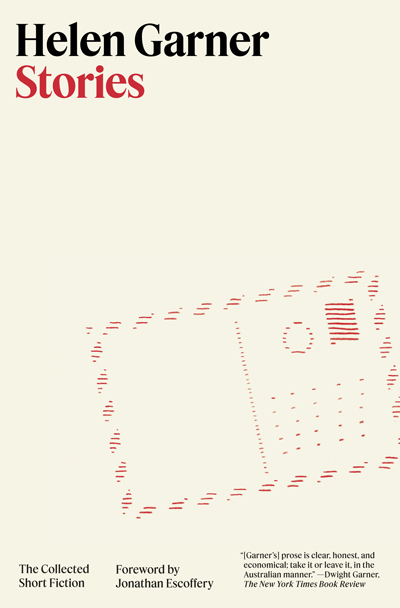
Stories
By Helen Garner
Pantheon, 208pp.
The best I could explain my fixation to others was that, quite simply, living in Garner’s head made me feel like everything was going to be okay. It was calming to realize that someone with a career like hers could still feel such doubt and wariness about her life, and even more comforting to understand that those feelings could actually form the basis of one’s own work.
In everything she writes, Garner proves over and over that the reality of our lives plays out in the immediacy of the present, in our mistakes and missteps, in what we call our daily “distractions” or domestic duties. “As my life thickened up and became more eventful, I could see that my experiences were forming themselves into the kind of curve that we call a story,’” she says in her Paris Review interview. Her gut-punching humor and unflinching prose reminded me that the least we can do is loudly admit to our own ambivalence and uncertainty, and that at its most basic, life still demands our curiosity and attention. (“I write to unburden myself, to amuse myself, to arrange in order the things that bulge in my head,” she writes in a 1978 diary entry. “To make myself notice things.”)
It is this attention—precise, economical, direct—that remains constant throughout Garner’s massive, genre-spanning oeuvre. She has the singular ability to notice and name the details of daily life because she’s unafraid to say the embarrassing thing or admit desire, pleasure, or shame. In Monkey Grip, for example, the narrator’s pining after her junkie lover Javo is almost pitiful. “He barely said goodbye to me, didn’t kiss me as he once would have done,” she laments at one point, keeping score in the way a teenager might. The novel’s engine lies in the type of toxic, unrequited longing one would rarely acknowledge, even to oneself. Yet Nora is unashamed of her obsession and easily confesses to each ugly feeling: “I wanted to get stoned and forget what I looked like and dance till I was loose all over,” she tells us. “It wasn’t being in love, or loving, that made the difficulty; but the awful silent fear of not being loved in return.” Similarly, Garner’s The Spare Room doesn’t shy away from the truth of complicated emotion. The novel follows a woman whose frustration mounts as she cares for a dying friend in denial of her own mortality. “‘I can’t even look at you, I’m so livid,’” the narrator yells, surprising herself with her outburst. “‘You’re angry and scared. But you won’t admit it. You dump your shit on me. I’m sick with it. I can’t breathe.’” In her typical way, Garner bravely bares her conscience, unafraid to “say the real say.” By admitting her own failure of compassion, Garner forces us to consider the limits of friendship and caretaking while acknowledging that fear is a part of dying—and anger a part of despair.
Admissions of doubt and uncomfortable truths are all over Garner’s nonfiction, too. In the intoxicating This House of Grief, following the trial of Robert Farquarson, convicted of drowning his three sons in a dam, Garner is everywhere. At times, she shows up not to weigh in with authority, but to give voice to the reader’s doubt: “This testimony filled me with skepticism, yet I longed to be persuaded by it,” she says when Farquarson takes the stand. “The phantom of failed suicide shimmered once more into view.” At other points, she inserts herself merely remind us, in that colloquial voice, of our own fallibility: “No matter how earnestly I strove to grasp it, his cross-examination felt cloudy and substantial,” she says of the prosecution, admitting her own feelings of unworthiness. “It made me—and, by the looks of them, also the jury—feel panicky and stupid.” Garner’s The First Stone is also full of this type of honesty. The controversial book, which follows a sexual harassment case between two students and the master of Melbourne’s Ormond College, is predicated on Garner’s suspicion that the women involved had overreacted by involving the law. “Has the world come to this?” Garner thinks, after learning of the charge against Dr. Shepherd. “I got on the phone to women friends of my age, feminists pushing fifty… He touched her breast and she went to the cops? My God.”
“In everything she writes, Garner proves over and over that the reality of our lives plays out in the immediacy of the present, in our mistakes and missteps, in what we call our daily ‘distractions’ or domestic duties.”
• • •
By the end of summer, the one thing I had left to read were Garner’s stories—a body of work I had mostly been ignoring because it had been difficult to find (when my scouring of Australian eBay did finally turn up a copy of Postcards from Surfers, it arrived at my apartment two weeks late, waterlogged and missing its cover). It was a relief, then, to learn that Garner’s stories—which have been published across several volumes in Australia over the years—would be reissued in the United States as a single collection this spring.
Before I began reading Garner’s stories, I wondered if they would be able to sustain the same capacious voice or emotional complexity I had found in the rest of her work. The short form felt almost hostile to the qualities I had grown to love in Garner’s writing—how the sprawling Monkey Grip or the meticulous This House of Grief or her massive volume of diaries let me exist alongside her for long periods of time, while allowing for the slow exploration of complicated admissions and questions. But I shouldn’t have been surprised to discover how characteristically full of feeling they are, brimming with all of Garner’s signature colloquialisms, wit, and wry humor.
In these stories, many of which center on Australian women in domestic settings, going about the business of living, Garner uses her wide stylistic and formal range to her advantage, employing quick dialogue, rhythm, and repetition to explore what at first might seem mundane or narrow—a mother drops off her daughter at a concert, a woman travels to see a man, a couple argues about dinner. By the end, it always becomes clear that, just below these apparently simple premises, some sort of disturbance is bubbling away. I often found myself reading with a sort of terrible excitement as I impatiently waited for that moment when Garner would reveal to me the truth of the story—either through some twisted detail or an off-beat conversation, a startling image or unexpected joke. “Little Helen’s Sunday Afternoon,” for instance, is a story that at first seems banal: written from a child’s perspective, a bored little girl tags along as her mother goes to visit her friend. At first, the story seems like it might be about close female friendships and secrets they harbor. Yet by the end, it becomes a story about the loss of innocence. Little Helen is caught climbing atop a bucket to spy on an older boy and his girlfriend in a shed while her mother is inside the house. She falls through the bucket, which remains stuck and cuts up her leg—which ought to be punishment enough—while the boy wrenches her into the world, showing her horrific photographs of war. Similarly, “This Life of Art” opens on two women walking through a graveyard while making lighthearted conversation, before unspooling—with an increasing velocity—into a winding story spanning twenty years that covers the trials of both their lives.
Many of the stories in the collection are succinct and tight in scope (as I read, I was reminded of Garner’s concise novel The Children’s Bach, which, in less than two hundred pages, explores the total disruption of a conventional married couple through nothing more than the arrival of their bohemian friends). Yet despite their concision, the fourteen stories in the collection exhibit a vast range in style and voice. Taken together, the reader is reminded of Garner’s mastery of craft—even if, in their brilliance and ease, they retain the impression of having been simply dashed off one morning. Following a story narrated by a child, for instance, Garner moves to a man’s drunken monologue in “All Those Bloody Young Catholics,” whose boisterous stream of consciousness prevents anyone from getting a word in edgewise. Elsewhere, we have “The Dark, The Light,” a six-pager written in first-personal plural, a chorus of anxious voices gossiping about a man who has returned to town (“We heard he was back,” it begins. “We heard he was staying in a swanky hotel. We heard she was American.”) Garner’s stories are visual and sensory, associative rather than plot-heavy, moving freely between quick dialogue and narration. In “A Thousand Miles from the Ocean,” for instance, about a woman who becomes disillusioned by her affair, the narrator’s inner voice butts in. “I am making a very expensive mistake,” the woman thinks as she sits in the hotel room. And then later: “Shutup, oh, shutup.”
Of course, these stories also offer up the same brutal admissions that make up Garner’s novels—bold responses to questions of sex and desire and the limits of relationships, friendships, motherhood. Often, the premise of each story is predicated on one of these admissions, big or small. For example, in “A Happy Story,” a mother realizes she doesn’t want to go to the concert her child is so excited for. Reading it, I was reminded of The Spare Room and its simple declaration of not wanting to do something for another person, regardless of their relationship to you. “The duty of going: I feel its weight,” the narrator tells us. “It’ll hurt my ears… I’ll get bored. I’ll get bored. I’ll get bored.” By contrast, in “Civilisation and Its Discontents,” a woman explains to her lover why she has cut her hair short like a man’s, saying it’s because she wants to “fuck like a boy.” “Who says we can’t?” she privately wonders. “Isn’t that why women and men make love? To bend the bars a little, just for a little; to let the bars dissolve?”
These days, Garner identifies more as a writer of nonfiction than fiction, though her career began with three novels before she moved to her reported works. I was thinking about this trajectory as I read through the collection, wondering what may or may not have been pulled from Garner’s own life (like many readers, the experience of reading Monkey Grip, born from Garner’s diaries, had me continually conflating the narrator and the writer). I was reminded of Garner’s deep ambivalence when it comes to genre in the first place, and how apparent that ambivalence is when you take her career as a whole. How else do you move from writing “Little Helen’s Sunday Afternoon” to something like The First Stone? And isn’t that part of the project of fiction, or writing, in all its forms?
Garner’s writing demonstrates the value of grappling with one’s doubt and putting it into words, in order to sort out our problems over time and maybe, as a result, make others feel less alone. It turns out that the project of Garner’s stories is the same as in all her writing: “Each morning I set out for my office weak with fear. I will never be a great writer,” she writes in one diary entry. “The best I can do is to write books that are small but oblique enough to stick in people’s gullets and make you remember them.”