
By the end of his life, Swiss anatomist Felix Platter was a renowned professor and a pioneer in the field that would become neuroscience. But in 1552, at the age of just 16, he travelled from Basel to Montpellier to begin his studies. The Diaries of Felix Platter are exceptional not just for their vivid descriptions of everyday violence and the confluence of religions in Renaissance Europe, but also because diaries and autobiographies such as these would not become common for another century.
Guillaume Dalençon of Mountauban, a former priest, was unfrocked on the 16th of October. He had turned protestant and had brought some books back with him from Geneva. He had been in prison for a long time. Dressed in his priestly robes, he was brought on to a platform before the bishop. After protracted ceremonies in Latin he was divested of his chasuble and the rest, and given secular clothing. His head was then shaved, and two fingers were cut off his hand. After this he was delivered to the civil justice and once more thrown into prison.
The professors recommenced their lectures on Saint Luke’s day, the 18th of October. They had ceased to teach during the summer, except for a few professors who had conducted private courses for extra fees.
On the 6th of November I sent a quantity of fruit and seeds to Basel, and I followed up this consignment with a letter to say that the Turkish fleet had arrived off Aigues Mortes, and that we had perceived it plainly at sea. The King of France had concluded an alliance with the Turks.
Johann Zonion, of Ravenspurg, came to Montpellier on the 9th of December. A schoolmaster in Little Basel, he had married a woman of seventy, who had given him money to enable him to study medicine in France. After her death he returned to practice in Ravenspurg.
He brought me a long letter from my father, and others from other persons. My father once more recommended the advantages of study and piety. I should need exceptional knowledge to succeed in Basel among so many doctors, both young and old. He told me that he had sold his printing house to Louis Lucius, but that the latter had not kept his side of the bargain, and the printing house was once more in my father’s hands. In his school he had put on his famous German comedy, in which I should have played the title role of Bromius, host of the Dead Tree; Gilbert had taken my part. All the notabilities of the town had been present, and had done my father great honour. Herr Binningen, the Hollander, who turned out to be no other than David Georgius in disguise, had offered a prize of a golden crown. Among items of political news, he told me that Albert, the Marquis of Brandenburg, was at war with the Bishop of Nuremberg. I had told him of my progress with the lute and he complimented me on it.
On the 11th of December Frederick Rihener, Hugguelin, and I went through the street, playing music. All three of us played the lute. The townspeople would willingly have chased us away, but in the end they left the way free for us. Marius Stibare left on the 14th of December, and I gave him a letter for Lotichius. I met Stibare again, in Stuttgart, where he had become physician to the landgrave, Ludwig of Hesse; he afterwards became a professor at Heidelberg. On the 14th of November there was an anatomy ses-sion. The subject was an old man, whose lungs were in a very bad state. Maître Guichardus presided.
On the 6th of January Guillaume Dalençon, unfrocked eleven weeks before, and since then held in prison, was condemned to death. In the afternoon a man carried him on his shoulders out of the town towards the monastery to the place of execution. A pyre had already been built there. Behind the condemned man two other prisoners walked, one a cloth shearer, in his shirt, with a bale of straw fastened to his back; the other of good appearance, and well dressed. Both of them had recanted and denied the true faith. Dalençon, however, sang psalms all the way. At the pyre, he sat down on a log and himself took off his clothes as far as his shirt, and arranged them beside him tidily, as though he would be putting them on again. He exhorted the other two, who were about to apostatize, so touchingly that the sweat stood out in great drops, as big as peas, on the forehead of the man in the shirt. When the monks, formed in a curve around him and mounted on horseback, told him that it was time to make an end, he leapt joyously on to the pyre and sat down at the foot of the stake that rose in the center of it. This stake was pierced by a hole, through which ran a cord with a running noose. The executioner put the cord round Dalençon’s neck, tied his hands across his breast, and placed near him the religious books he had brought from Geneva. Then he set fire to the pyre. The martyr remained seated, calm and resigned, with his eyes raised towards heaven. When the fire reached the books the executioner pulled on the cord and strangled him; his head dropped to his breast and he made no further movement. Little by little the body was reduced to cinders. His two companions stood at the foot of the fire, where they were made to watch his sufferings, and could feel the heat of the flame.
After the execution they were both taken to the Hôtel de Ville. Near there, in front of the church of Notre-Dame, a platform had been set up, with a statue of the Virgin on it, before which they would have to recant. The crowd had to wait for them for a long time. At last only one of the two men was brought out. The cloth shearer had refused to abjure and demanded that he should be executed without mercy for having failed his beliefs.
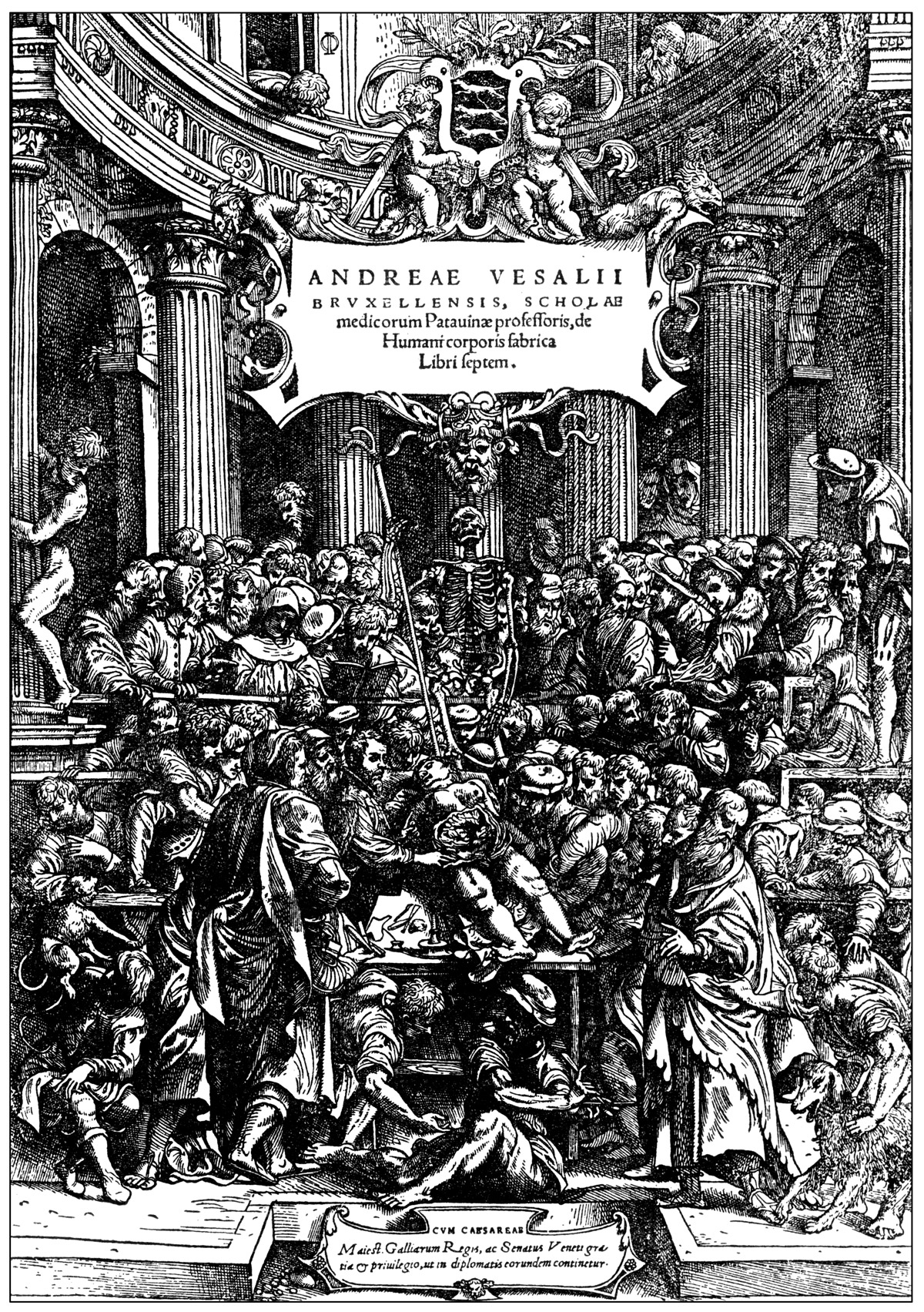
An anatomy theatre in the sixteenth century. A live model clings to a pillar on the left, a skeleton is in the center, and a corpse on the table. (From the title page of the works of Vesalius, printed in Basel)
He was therefore taken back to prison. The other man, who seemed to be a man of substance, was placed on his knees before the statue of the Virgin, with a lighted candle in his hand. A clerk read out various charges, to which he had to reply. In this way he saved his life, but he was sent to the galleys and there put in chains.
On the following Tuesday, the 9th of January, it was the turn of the cloth shearer again. He was strangled and burnt as the priest had been. He showed great courage, and no less repentance for having come so near to denying his faith. It had rained on that day, and the fire would not burn. The victim, who was not completely strangled, endured great suffering. At last the monks of the neighboring monastery brought some straw, and the executioner took it and sent for oil of terebinth from my master’s pharmacy to ignite the fire. Afterwards I reproached the assistants who had given it to him, but they advised me to hold my tongue, for the same fate could befall me also, as a heretic.
During these affairs an extraordinary phenomenon occurred. On the 6th of January, immediately after the execution of the first man, it began to thunder violently. I heard it plainly and so did many others with me; but the priests derided us and said that it was the smoke from the burning of heretics that produced that effect.
On the 7th of January the wedding of Doctor Fontanonus took place. He was in a poor state of health, and quite withered and yellow, though only a young doctor. He was the son of Denys, the author of a Pratique. He always went about mounted on a mule, which had served his father for many years, so that, as he told me himself, it must have been more than forty years old.
“When the monks, formed in a curve around Dalençon and mounted on horseback, told him that it was time to make an end, he leapt joyously on to the pyre and sat down at the foot of the stake that rose in the center of it. This stake was pierced by a hole, through which ran a cord with a running noose. The executioner put the cord round Dalençon’s neck, tied his hands across his breast, and placed near him the religious books he had brought from Geneva. Then he set fire to the pyre. The martyr remained seated, calm and resigned, with his eyes raised towards heaven.”
According to custom the young couple were con-ducted to church on Sunday evening, in a procession with numerous torches and musical instruments, and afterwards were taken home in the same manner. After the meal, and while everyone was dancing, with the doors open, a Monsieur Le Beau presented himself. He was a young, good-looking student, who claimed to be of noble birth, and therefore always carried a sword, a thing that students did not customarily do. He was accompanied by one of his friends, a man called Miliet, a good dancer, as indeed Le Beau was, and who never missed a ball. Now, there was another student there, called Flaminius, a burly and arrogant Italian. He mocked at Le Beau, and tripped him, so that he nearly fell. Le Beau replied to this with a box on the ear. They would have fought on the spot if they had not been separated. Flaminius swore to have his revenge.
On Monday, after dinner, Le Beau was walking, as usual, on the paved Place Notre-Dame, when Flaminius came up like a madman, brandishing a dagger. Le Beau retreated and drew his sword, and presented the point, saying ‘Go away, Flaminius!’ But the other tried to knock up the sword and throw himself on Le Beau. Then Le Beau thrust his sword into Flaminius’s chest, through and through, so that the steel showed a foot behind his back. Flaminius cried out ‘I am killed!’ and died at once. He was carried away on a ladder. Le Beau fled with his sword in his hand and hid in a house, but he was pursued. The bailly and his sergeants entered the house and searched it, while

