It’s a writer’s prerogative to decide how much to reveal up front, but in Paradise Burns, Pol Guasch might have gone too far. In the first chapter of his second novel, the author maps his plot and themes directly: Líton, who narrates, announces, “All lives begin before birth,” twice, bookending the first paragraph. He also reveals that he’s dead, having succumbed to an illness, which goes unnamed, at twenty-four, his life as “fleeting as a shooting comet”; he’s left behind a friend, Rita, the novel’s second protagonist, and the region, likewise unnamed, in which they grew up, wracked by fire. It’s not uncommon for a novelist to divulge a character’s fate in the first pages, but Guasch dictates the scope of the book’s ideas, too. “My story,” Líton says, is “about time. About time you can’t get back. … And about fear, too.” It feels ironic that Líton then complains, as the chapter concludes, “People don’t know that stories, if you give them order, aren’t stories but lies.” In the narrative that follows, Guasch might embrace disorder in structure, chronology, and plot, but he continues to steer, and confine, the reader’s interpretation throughout.
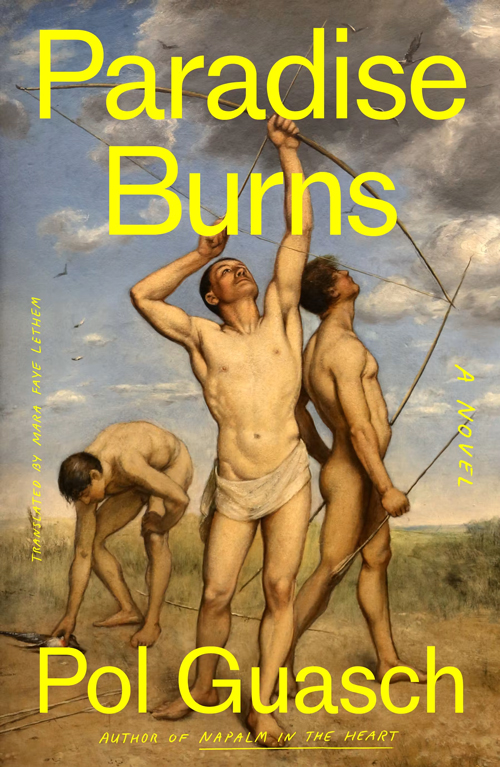
Paradise Burns
By Pol Guasch
Translated from Catalan by Mara Faye Lethem
Farrar, Straus and Giroux, 160 pp
At least Guasch commits to his experiment: Paradise Burns is decidedly unpredictable in form. Rita and Líton are consistent anchors, but the novel’s thirteen chapters track back and forth in time, encompassing two decades or so, and cycle through virtually every tense and point of view available. He writes in first, second, and third person; one chapter takes the form of Rita’s childhood diary, another a chorus of three old women. We learn certain biographical facts: Líton sleeps with men, Rita likes both men and women. He grew up in “the city,” with money, while she grew up poor, three valleys away, in a mining outpost referred to as “the Colony.” They meet as young adults at a house party in “the town” next to the Colony, where Líton’s parents have bought an additional home. They also both feel, differently, constrained: Rita is anxious and introverted, Líton fatalistic. Part of the gambit of the novel’s structure—in the different views it offers of the characters’ lives—might be to help the pair prove to themselves that they can exceed their biographies and circumstances. That their lives really did “begin before birth,” and will endure even after death.
Guasch’s choice not to name the era lends the characters’ story a certain timelessness and enduring relevance—that is, Líton and Rita’s world can read as both near-future and near-past. One the one hand: mass extinction and the climate crisis have progressed (if only slightly) beyond reality. Animals have all but abandoned the land and air; the two friends visit a high-security greenhouse to see a swarm of bees, which they have never previously seen alive; floods devastated the area during their childhoods, followed by a lasting drought, thus requiring young men, including Líton, to enlist in a public fire service, called, simply, the “Service.” On the other: the setting bears traces of the 1990s, and of Guasch’s native Catalonia. Characters exchange mixtapes that are actual cassette tapes. Líton’s illness, of which many other young men are dying, resembles AIDS. In 1994, Catalonia weathered its worst wildfires on record, and, in 1995, AIDS deaths peaked in Spain. In this bridging of the speculative and the historical, Guasch persuasively conveys the continuity of these crises. (That is, the HIV epidemic persists, in various regions, and once-futuristic visions of ecosystem collapse are already upon us.)
But when it comes to the actual experience of his characters, Guasch reaches too often for a dramatic register. His writing of the illness plot, in particular, is washed out by poetry. Líton says, “I died of silence, the diagnosis was silence, the cause of death was silence, what was waiting for me on the other side was silence.” At a party, he wonders “if death is also dancing here, tonight. Will they see the disease in your eyes? If death is here, with a drink in one hand, waist loose, arms unbraided, dancing among you, will you see the disease in its eyes?” In these labored turns, it can feel as if Guasch is straining to evoke the drama of his epidemic, which would be dramatic enough with less ornament. The authorial voice can also undermine otherwise promising efforts to capture the physical reality of the illness, from the anticipatory dread to the pain of the symptoms. Ahead of a screening test, “Líton, seated on the chair, was waiting as if he’d done so his entire life”; that alone would capture the enormity of his overwhelm, but the sentence continues, “and perhaps it was true that he’d always been waiting and that, after waiting for something, he’d had to wait for something else.” Elsewhere, in a chapter narrating Líton’s death, Guasch lands on simple expressions of his character’s hyperawareness of his body (“his heart beats in his heart”), but any sense of immediacy is quickly overshadowed by fanciful lines: “He wants to leave taking with him everything that can make a life true.”
Meanwhile, Líton himself can feel thin, more symbol than fleshy character. He’s cast twice in spiritual terms: a group of old women refer to him as a “porcelain angel,” a “fallen angel”; and Rita, before the two meet, describes him as “a ghost lording over the town, his name on everyone’s lips.” The labels feel unfortunately apt because his life, beyond his friendship with Rita, is drawn in overly general, sympathetic terms. Líton’s mother chooses to hold his funeral in the town—instead of the city, where her son had lived most of his life—because she “didn’t want people like him filling the funeral with flamboyant bodies and inappropriate exclamations.” It reminded me that we have only a glancing sense of his social scene and the “flamboyant bodies” that might populate it. In a late chapter, Líton takes Rita out with a group in the city, but his friends remain an amorphous mass. Any intimacy is gleaned indirectly; these friends welcome Rita, “explaining their secret codes, their tips for understanding one another, sharing their most important shared memories.” If only they explained them on the page!
Even in the scenes we most expect to be specific and embodied, Guasch tends toward grand gesture. In a chapter about Líton’s time in the Service, he falls in love with a man named René, whom he meets in the latrines for sex: “Líton fell to his knees, his legs felt the watery mud covering the ground, which he knew must also be urine and shit.” But in the world of Paradise Burns, this “urine and shit” cannot stand for itself. Instead, it evokes “sin and urgency, because sex like theirs always mixed with crude stories of sin and urgency, of semen and urine and shit and blood.” The scene is no longer about two specific characters, but about a type of person, a type of sex—not their sex but “sex like theirs.” Guasch spins out about love, too: “loving is nothing more than finding the fantasy you’ve imagined for so long” is closely followed by “love crumbles when others begin to listen to it.” (In a later chapter: “loving should mean being happy for your beloved even if he is not by your side.”)
Rita, at least, emerges more whole; we learn more particulars about her past, and the place that she grew up. Backstory isn’t a prerequisite for depth, but the details lend substance to her reticence to talk about her past. (When given enough context, I could almost forgive pronouncements like “We didn’t speak the word Colony just as we didn’t speak the word father, the word childhood,” as Líton once says.) She memorably describes the annual ritual of repainting the Colony’s houses, to obscure all the soot that has drifted from the mine and settled on the walls. And, in the chapter that takes the form of her childhood diary, she traces the high of her first love, with a girl, and its precipitous end, in an incident that deepens her class shame. (Nonetheless, the reader must first grit their teeth through the stylistic imitation of an adolescent journal, realized primarily through strikethroughs and underlines.) In the time after she meets Líton, Rita also falls in and out of love with a boy named Fèlix—and Guasch writes delicately about their loss of desire for each other, their boredom in the relationship, a salve in an otherwise hot-blooded novel. Still, when the couple have a date by a polluted lake, in the end-stage of their relationship, Guasch must reach for something bigger: “The scene was that fragile, some type of model protected by a glass case: they could have served as a perfect example—lying there, inaccessible, isolated—to explain to the children of the future what heretofore life had become.”
These moments of pulling back also occur at the level of grammar, particularly through the conjunction “as if.” The phrase appears over one hundred and sixty times in the novel—more than once a page, on average. It becomes unrelenting—this specific filtering of experience through figurative language—and the execution often feels anemic. Shortly after Líton and Rita exit the greenhouse, Guasch writes, “It’s as if they are also tired of themselves, of the thoughts they each carry.” But it’s clear they are tired of their thoughts. At a house party, “it is as if bodies are falling as people dance jerkily around them.” Why not simply observe that the bodies are falling against each other? Stars “appear beating as if they were ablaze.” Stars are ablaze! The chapter with the fewest “as if”s (two), titled “The Altarpiece,” is not incidentally one of the stronger in the novel. In it, Guasch catalogues a collection of mementos in Líton’s room at the hospice. Attending to specific materials—each paragraph begins with and is anchored by a different object—he settles into a more natural voice; he speaks plainly, even as the objects inspire digressions into memory. Prompted by an image of a discotheque, Líton recalls the climate of a particular night out with elegant simplicity: “Outside, the wind turned around corners.”
But there is, more often, a basic issue of excess: Guasch is prone to use two (or more) words where one would do. A farmer, crossing a field, is likened to both a “comet, an asteroid raking the sky.” A silence is likened to “a bombshell, a mine, a grenade.” This perhaps reflects some vestige of orality, of a story told on the fly, but in a novel, it reads like an early draft in which the writer still means to decide which word is best. In more awkward cases, these combinations introduce contradictions. During a fire, the clouds are “stained, embroidered” with dust. Does the dust appear as a wash of darkness, or something speckled and fine? Líton’s affair with René is “a fleeting, artificial love, a countdown love, like a little wet bird of stifled joy, a mere trinket”—a pile-up that overwhelms with its disparate and clunky metaphors.
Even specific word choices jarred—often enough that I sought out the Catalan text, and the advice of a Catalan speaker, to try to better understand the selection. Was the original word peculiar, or was it a feature of the translation? The question of word-for-word fidelity is a rabbit hole, but a translator is, holistically, responsible for immersing us in the way an author’s fictional world feels and functions, and Mara Faye Lethem’s rendering, however accurate, too frequently distracts the reader from settling in. Líton feels “tranquilized” by the fit of Rita’s chin into his neck when they embrace; why opt for a clinical term that can connote catatonia, especially when, in the same moment, Líton will notice Rita slip something into his back pocket? What’s wrong with “calmed” or “soothed?” In another passage, fire “splatters” the landscape—does fire splatter? If Lethem is striving to remain faithful to Guasch’s voice, it’s to a fault. Take, for example, the line “soot scales his arms and scampers over his chest.” In the Catalan, the verbs are “escala” and “escampa,” which look and sound like “scales” and “scampers,” but could more simply be translated as “climbs” and “spreads.” She has carried forward his alliteration and meaning, but, in English, the verbs are too conspicuous. If there is elegance to the line, in the original, it’s not well approximated here.
• • •
Perhaps Guasch was after a certain freedom, for himself and for his characters. Operating outside of historical realism, he could take up these issues intimate to him, without the preemptive judgments and expectations that can accompany a book about a specific illness or region. And in style and form, he could surface latent connections between those issues—develop a language that might make pain and loneliness easier to bear, and restore hope for a future. (Most explicitly, the chapter that narrates Líton’s death and a chapter that narrates a firefight echo each other in structure and language, sharing some exact sentences.) You can sense his faith in storytelling to achieve this, a faith he imparts to his characters. Líton seems aware of his audience: “I want to keep going, keep telling and telling and telling stories.” But become too conscious of telling a story, and it begins to slip. Thus, the characters themselves succumb to the temptation of excessive self-interpretation. Líton said his story is “about time” and “fear.” Rita reflects, elsewhere, “She too will tell stories. … Like the story of the fire, which is about chaos. And the story of Líton, which is about fear. Or shame. The story of the town is about time. The story of her parents is about distance. The story of Fèlix is about mystery.”
This impulse toward meaning-making even seems to affect how the characters relate to each other in real time. Líton and Rita can become caught up in the aestheticization of their friendship. At the party where they first meet, the two start to dance but, under a strobe light, the moment fixes into a “film still”:
you start dancing under those flashing lights, his face, your face, splatters of black and splatters of white like scraps of night and day on you, the night and the day, the beginning and the end, you before him in a discontinuous film still, your body jagged as if a bolt of lightning ran through it, now far away and now close.
Near-identical versions of this passage appear in two other chapters: at the greenhouse, the noise and shadow of the swarm of bees recall the lights of the party; later, during a visit to a night club, the effect repeats directly. In these two instances, Guasch also adds a sentence that fixes Líton in time: “all the truth of time” is “contained in Líton’s face, standing before her as if frozen.” Guasch might’ve intended to demonstrate how memory can give shape to and sustain a friendship, but in its dramatic playback, the moment more closely resembles an Instagram Reel than reality. Are such glossy images really what constitute a bond? Certainly, elsewhere, he does attend to the more imperfect, awkward moments between the pair; there’s a fallow period in which Líton and Rita “stop seeing each other” for a while, when Líton’s parents move back to the city, and yet the prevailing portrait of their friendship is one of earnest awe, without meaningful conflict.
“Guasch commits to his experiment: Paradise Burns is decidedly unpredictable in form… The choice not to name the era lends the characters’ story a certain timelessness and enduring relevance.”
Líton, in one of the novel’s many asides, claims that “we exist because others remember us,” and if there’s always some truth to a cliché, he repeats it uncritically, putting undue pressure on memory, and the collection and ornamentation of moments. I’m more convinced when Guasch turns the volume down and shows us what can pass between two people, indirectly. There are those thoughts and feelings that we are certain are ours alone, but which bring us into proximity with others, without our knowing it. Líton and René first notice each other after another man in the Service (implied to be gay) abruptly disappears, leaving a gap in the morning lineup, which they happen to be positioned on either side of. The absence preoccupies them both:
René thought about him, about the guy who disappeared, he thought about him as Líton also thought about him. They thought about him without telling each other because they didn’t yet know each other, but they didn’t speak of him even after they’d met because doing so would have been like acknowledging a threat. … Later they couldn’t be sure whether that thinking was part of what had brought them together.
It’s one of the novel’s more convincing renderings of intimacy. In its uncertainty, it can’t be assimilated into an orderly narrative. It reminds me of the pleasure of being next to someone, whether someone you love or a total stranger, and having no idea what they’re thinking. The challenge for the novelist is to translate this feeling, without making too much sense of it.