What is art to the man who has it all? The world’s richest have taken a particular interest in antiquity, especially epics of an empirical persuasion. It’s a genre that allows venture capitalists to self-insert as mythic founders, casting their egocentric desires as the lofty ambitions of brilliant men. As John Berger, patron saint of English art critics, wrote in his seminal book Ways of Seeing: “The classic texts supplied the higher strata of the ruling class with a system of references for the forms of their own idealized behaviour.”
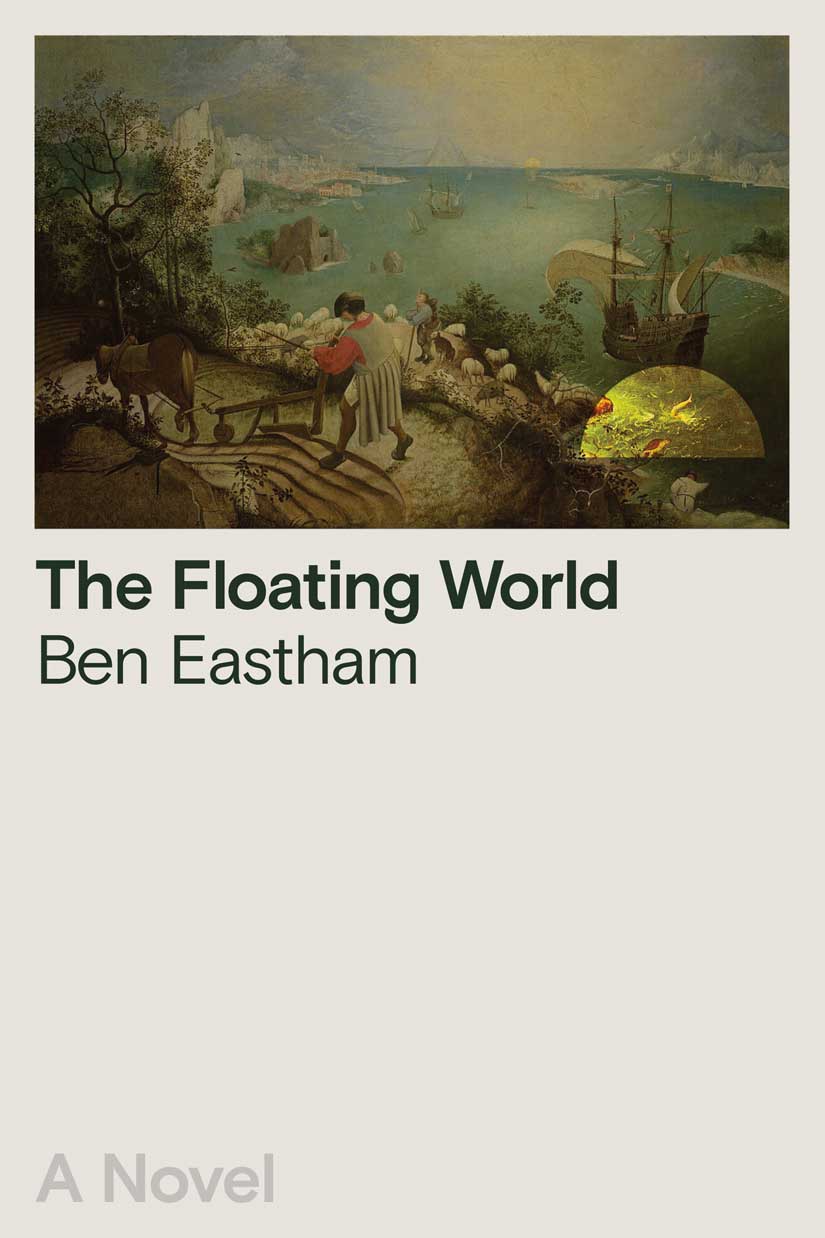
The Floating World
By Ben Eastham
Astra House, 288pp
Take, for example, Mark Zuckerberg’s Carthago delenda est t-shirt—a call to war that he wore on his 40th birthday in an apparent reference to the longstanding feud between Google and his own tech conglomerate. Or Elon Musk’s musings on the “very competent soldiers” who travelled from Troy to eventually found Rome, no doubt identifying with these resourceful warriors in the context of his quest to terraform Mars.
The drive among billionaires to build settlements in outer space is part of the same Silicon Valley-brained philosophy that seeks to call it quits here on Earth; these are attractive prospects for a ruling class that’s desperate to escape accountability for its crimes against the environment. Perhaps these people don’t believe the planetary problems they’ve helped to create are actually fixable, but it would be naive to discount their monetary incentive to continue with the status quo.
While we wait for the super-rich to run their space race, there’s still plenty of ocean on Earth to property develop. The Seasteading Institute (a project brought to life by a $500,000 Peter Thiel-funded seed round) was initially conceptualised as a start-up society where individuals could live in autonomous pods and choose their own form of governance. In 2017, the organisation founded its first host nation in French Polynesia, whose islands are at risk of sinking entirely by the end of the century.
A “seastead” connected to an extant coastal locality could hypothetically benefit both parties, but the reality was far more asymmetric. In essence, the seastead became a tax haven for the wealthy that created practical issues for local inhabitants, such as the need for offshore medical attention or refuge in extreme weather. Hundreds of Tahitians marched to protest the use of their fishing waters as a proposed food source for the new community, and against “technocolonialism” more broadly. The seven-year agreement eventually lapsed, and the government announced they would not be renewing it.
Such is the terrain, as it were, of Ben Eastham’s novel, The Floating World. If a piece of art is moving (as Berger argues) “in direct ratio to the degree to which it extends our experience of significant, objective facts,” then the poignancy of the novel feels rooted in its sharp rendering of all-too-recent history: a precarious future of medical and environmental crises, crypto-plutocrat cultural dominance, and widespread geopolitical conflict—as well as the violence underpinning the resultant protest movements and adjacent refugee crisis. The novel’s eponymous city seems to draw on failed architectural ventures like Thiel’s, or the Saudi desert city Neom: bankrolled by billionaire hubris and built at enormous human and ecological cost.
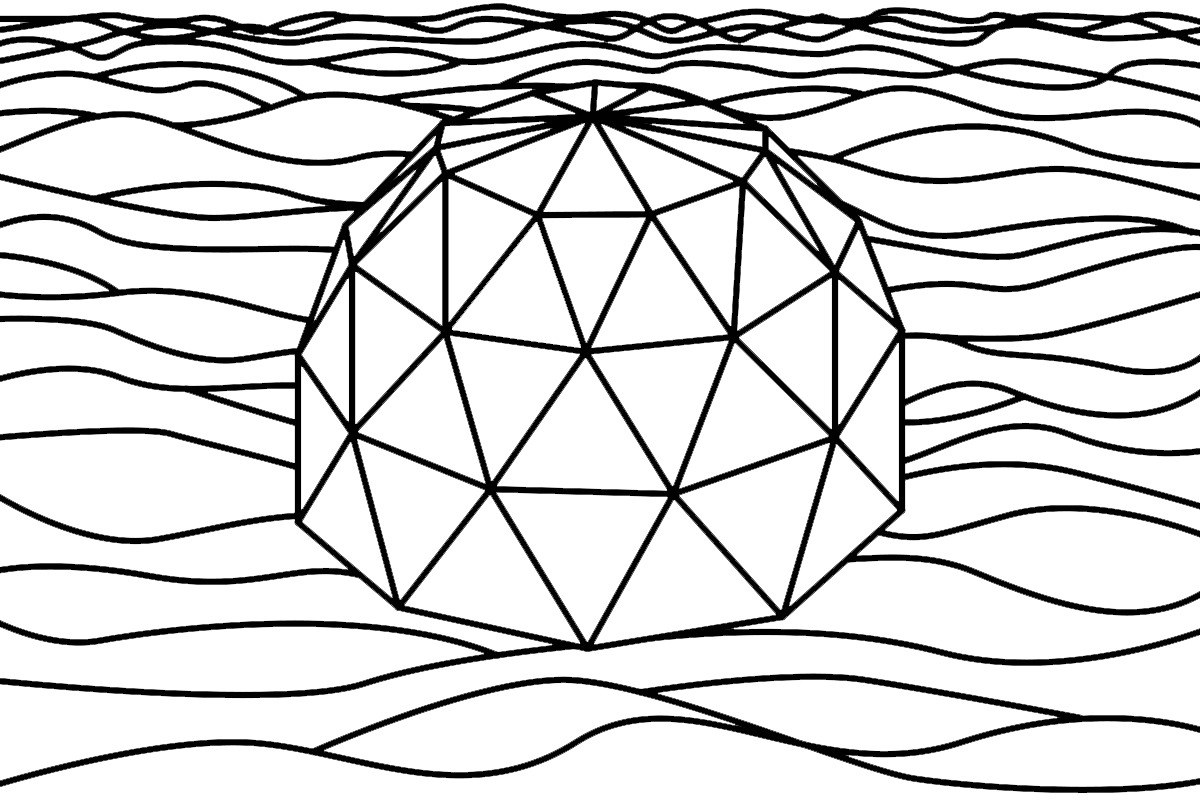
This fictional island in the Aegean—paradise built beneath the ersatz sky of a geodesic dome—becomes a geopolitical flashpoint around the time of its elaborate inauguration. The book’s protagonist, a bumbling English writer, accepts a contract creating press materials for the Floating World’s opening installation and effectively gets into bed with the Morel Foundation—a shifty, arms-dealing corporation disguised as a non-profit and headed by enigmatic industrialist scion Thanasis Morel.
Ben Eastham, a British critic with a background not dissimilar to his journalist narrator, previously reported on global media and propaganda for BBC, as well as working on various art exhibitions around the world and co-founding The White Review in 2011. In his first book, The Imaginary Museum, he writes that contemporary art “is less about the formal or aesthetic properties of an object than a way of talking about our different perspectives on the entangled, unstable world in which we live.”
In this vein, The Floating World is characterised by believers as “sustainable, holistic, homeostatic community” and skeptics as “a doomsday bunker for billionaires.” The subjectivity of sight is a key theme in Eastham’s novel, a dystopian satire that grows in scope as its setting becomes increasingly mired in conspiracy. The book is also concerned with the neo-religious function of art—in particular, how its purpose is too frequently compromised by capital (effectively neutering any political utility) and co-opted to paper over rapacious misdeeds.
But visual art with intention isn’t the only aesthetic force at play here. As Eastham demonstrates in his description of Athens, the rose-tinted bifocals of opportunity and xenophilia can cause even the most commonplace mise-en-scène to take on a painterly hue. “Neon-pink light” illuminates “men drinking nacreous liquors at wooden tables;” even the riot police appear “like inverted putti” before violence skewers the image and our protagonist is washing tear gas out of his eyes.
When a pandemic hits, his friends beseech him to return home, but the protagonist is too pleased with his aesthetic fortunes to want out of his gilded cage:
Not only was this room a series of reflections but the interior of the whole apartment was, I realized only then, abstracted from the world surrounding it. The pastel pink of the kitchen walls matched the facade of the facing hotel, the bathroom’s mint green was from a neon sign advertising a shuttered bar on the street, the blue of the sky had been concentrated into the baseboard beneath a sunset cornice. The apartment was a mirror box refracting colours pulled from the surrounding world, and I was trapped inside it.
This artistic literary mode serves to highlight the kind of kaleidoscopic spectacle found in the mundane, though the above description is primarily an illustration of the narrator’s willful ignorance. In The Floating World, ignorance is portrayed as an absence of sight—which is why Eastham is careful to breadcrumb details of his protagonist’s racial identity (through reference to the “white poles” of his legs) and background (once a “provincial adolescent” of “Catholic religious inheritance”) to set out his ostensible blind spots.
Perhaps the most revealing passage in the book is his discussion of Albrecht Dürer’s Saint Eustace, an engraving in which a Roman general named Placidus witnesses a miracle that converts him to Christianity. A reproduction of the image appears in the novel as a treasured postcard from the narrator’s late wife Cora. Unlike the Pisanello painting on which the print is likely based, where there is “no room” for doubt:
Dürer left open the possibility that the miracle might be a mere trick of perspective. That the hunter’s vision was confused, that he mistook an optical illusion for a revelation of the divine. This leaves open an interpretation which is seductive to modern sensibilities, and their conviction that everything can be explained by appeal to human reason.
Dürer was not so backward. Look closely and you can see that he has created in the engraving a series of formal sympathies or correspondences expressing a range of possibilities that might lazily be called magic: every form is interconnected and every figure has a shadow, so that the antlers might also be branches sprouting from the tree directly in front of the soldier.
Here, the protagonist expresses a skepticism of contemporaneity, an acknowledgement that “it would be a relief to immerse myself in the past.” Why wouldn’t he, when the present only seems to offer illness and dystopia? Later in the passage he lists various miracles contained in the print: “a deer, a tree” and “the texture of leaves” among them. Like Placidus, he has been utterly taken in by environmental spectacle in its holistic sense, such that his previous worldview has lapsed.
Eastham’s narrator operates with a delusional faith in Morel’s intentions for the Floating World—a bolthole for the wealthy built upon an island that was previously known as Harmonia, a place where mine workers and their families settled when rare mineral deposits were discovered on adjacent land, but abandoned amid economic downturn and military repression.
He is also overcome by hallucinations at multiple points in the narrative. In one scene, the city’s dome becomes an “intricately petalled rose, radiating pink light” as he chokes while swimming in the sea before dawn; in another he sees “a great white bird swooping out of the clouds” to rescue him when he ventures into the water during a dangerous storm.
Both of these mirages are of a naturalistic persuasion—and occur in baptism-like circumstances on the open ocean—perhaps hinting at the possibility of redemptive freedom for our hapless narrator, trapped between the conditions for creation and the demands of commerce. That they also comprise near-death experiences is likely an indication of the gravity of his situation, something like the battle for his soul. But, like so many of the extraordinary signs he is shown, the protagonist can’t quite manage to parse their significance.
Even as the initial sheen of the place wears off, the cityscapes remain picturesque in their uncanniness. An Athenian neighborhood is described through its ghoulish “skeletons of unfinished buildings […] spiked with rusting steel rebars picked out by the beam of the headlights, lending the scene an expressionist temper.” A later scene depicts “a particularly unhinged fauvist landscape: the sea leached green by the chemicals, the sharp red slopes of the valley gridded with alabaster buildings, abandoned machinery rusted orange by sea winds”—the caustic erosion wearing on both sides, if unequally.
By locating the natural in the constructed (“illuminated elevators rise like bright sap through glass buildings”) and the manufactured in the wild (“long black girders stretching from isolated trees fix the landscape in place”) Eastham characterizes the Anthropocene as a thing of unsteady symbiosis and terrible, technicolor beauty; in evoking emotion-led art movements to describe the anthropogenically-corrupted scenery, he implicitly argues that while these scenes possess a radicalizing potential, they won’t—or couldn’t possibly—be legible to all. His oblivious protagonist is the case in point.
Imminent cataclysm is foreshadowed throughout the novel, with the narrator consistently hedging his own complicity. A melancholy widower distracted by a new crush and the Hellenic beauty of his surroundings, he couldn’t have possibly predicted this outcome, or thought to ask questions about it. Ignorance becomes tragicomedy in The Floating World, as in this early scene where the narrator examines etched tablets at a local museum:
“The language is Linear A,” my guide explained to me. “You would think it was poetry, it looks so beautiful.” I nodded. “But it is the announcement of a new tax on grain. Every time I hope for a lost fragment of verse by Homer, every time it is a tax on grain. Sometimes I think, maybe it’s better not to know.”
Our faith in culture is often misplaced, our belief in the transformational power of art too frequently superseded by the financial realities of the world—whether it’s stone poetry that’s really tariff prose, or artwork that creates a “tradeable commodity, [an] aid to intellectual masturbation or [a] networking opportunity,” for “megalomaniacs” like Morel, in the narrator’s telling.
Art and religion are synonyms in the The Floating World—or, more accurately, the book illustrates how art is able to displace faith as a means of social control. Towards the end of the novel, Eastham compares doctrinal and imagistic modes of divinity, affirming the link between tangible craft and metaphysical influence:
[Doctrinal] religions are more likely to endure and spread because they do not depend on ritual experience. You don’t have to take people out into the forest at night and introduce them personally to the gods, for example, only get a vernacular translation of the holy book into their hands. These literary forms of religion are much easier to reconcile with legal and political power.
The imagistic mode […] works through the production of experiences so extraordinary as to imprint themselves on the minds of all who witness them, creating what are called episodic or flashbulb memories. This mode of religious experience is direct and nonverbal, and its origins are bound up with the earliest appearance of art in the cave paintings of about thirty thousand years ago. Which is to say that the earliest form of religious experience was also the earliest form of art.
Here, biological language appeals to our sense of the sublime. The success of major religions is chalked up to their inanity, or how easily they can ally with institutional forces. The imagistic, by contrast, is a purer thrill—one akin to casually socializing with deities themselves. It’s a minority view by definition (“characteristic of small communities,” we are told) but Eastham presents the idea (that “apprehension of the divine is […] a characteristic of art, not a function of literature”) as his protagonist speaks with an almost-unnerving clarity of thought.
“Art and religion are synonyms in the The Floating World—or, more accurately, the book illustrates how art is able to displace faith as a means of social control. Eastham compares doctrinal and imagistic modes of divinity, affirming the link between tangible craft and metaphysical influence.”
This digression feels especially Bergerian. Ways of Seeing also discusses “the experience of art [being] at first the experience of ritual,” existing within the preserve of the “magical or sacred,” but above all the physical: “the place, the cave, the building in which, or for which, the work was made.” Berger concedes that this art has lost authority, and in its place “there is a language of images.” Transmuting words into paintings and drawing lessons from the art, Eastham has produced a work of literature that is very much an aesthetic triumph: comedic, sensory and serious in equal measure.
If our apocalyptic present has anything to teach us, it’s probably something about the value of art as an experience—or a caveat concerning its weaponization. In a society overrun with memecoins and cyclical discourse about tasteslop, value seems increasingly situated in physical practices over and above the technologies that diminish them. Of course, the way you feel about these things largely depends on how you stand to benefit from them personally, and your particular social milieu. As ever, it just depends on where you’re looking from.