Before there was Nathan Fielder, there was Tom McCarthy. Fielder’s HBO series The Rehearsal recreates mundane situations in compulsive and absurd re-renderings of reality, building, for example, a simulacrum of The Alligator Lounge, an unremarkable bar in Brooklyn, complete with the same crumpled balloon deflating in the corner. In Tom McCarthy’s 2005 novel Remainder, an unnamed narrator with a traumatic brain injury uses the money from his accident’s settlement to reenact and re-create scenes from life, like a woman cooking liver in a neighboring apartment, hiring people to go about mundane tasks on a loop that he manipulates for his own private, wordless pleasure. The latest season of The Rehearsal concludes with Fielder captaining a 737 full of people, taking off through a legal loophole that stipulates that while he does not have the requisite training, he is allowed to fly an actual plane full of actual people as long as it’s a theatrical performance and all the passengers are actors. Similarly, McCarthy’s characters’ re-enactments, which begin innocently enough, become progressively more transgressive: drive-by shootings he hears about on the news, performed using blanks and recreated down to the oil splotches on the ground. Like The Rehearsal, Remainder culminates in a performance that breaches containment; a “bank heist” slips out of its safely controlled play-loop and into the realm of the real when, through an accidental firearm discharge and some carefully withheld information, it becomes an actual bank heist. The Rehearsal and Remainder share a vertiginous sense of lift-off: you get the sense that reality can be shifted, even hijacked, by its representation.
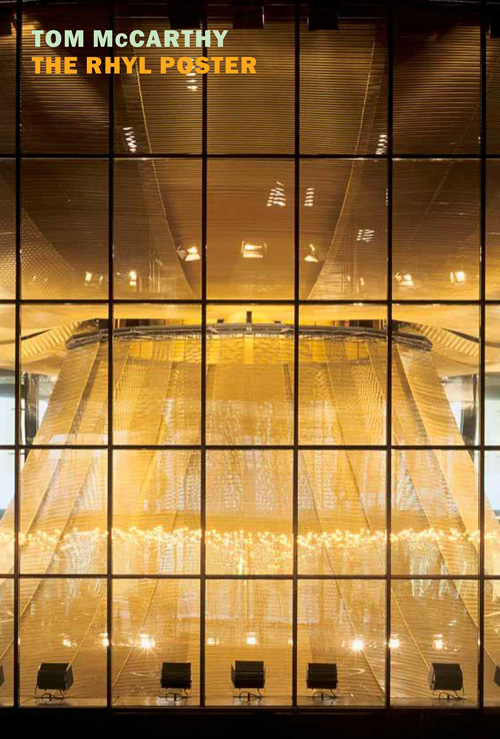
The Rhyl Poster
By Tom McCarthy
New York Review Books, 240pp
If Fielder was indeed inspired by McCarthy, then Fielder was also transitively inspired by the philosopher Simon Critchley, whose book about disappointment and the impossibility of redemption in Beckett, Heidegger, and Adorno, Very Little… Almost Nothing McCarthy cribs for the first line of Remainder (“About the accident I can say very little, almost nothing.”) McCarthy and Critchley have been friends for nearly thirty years, and McCarthy’s The Rhyl Poster is dedicated to the Northern English philosopher. In 1999, McCarthy and Simon Critchley formed a “semi-fictional avant-garde organization” called the International Necronautical Society whose First Manifesto proposes to “map, enter, colonise, and eventually inhabit” spaces produced by death and its signs. If this sounds a little morose, it’s worth noting the pair’s approach retained a healthy ludic quality. To deliver the Necronautical Society’s “Declaration on Inauthenticity” in 2010, McCarthy and Critchley sent imposters, paid actors in essence, to Greece and Shanghai to advocate against the contemporary notion of the “authentic” heroic individual subject, and instead advocate on behalf of the “dividual.”
One doesn’t read a McCarthy novel for what critics might call ‘character-driven psychological realism,’ nor does one read Critchley’s work for its warm, comforting conclusions about the triumph of the individual liberal subject over despair. A question that dogs many of McCarthy’s novels is: How does the social system—any system, really—handle surplus? And when it can’t, when a loop gets obstructed, or redirected, what happens in the breakdown? In Remainder, the “breakdown” of the fake bank heist into a real crime occasions a delightful scenario involving the pawning of a counterfeit—bringing the real under suspicion. Men in Space is about societal disintegration, and disintegration in general, in Prague. In Satin Island, another pun on a post-industrial city that people associate with waste, a corporate anthropologist becomes convinced that the only way he can write the great ethnography of our time is by looking at the broken bits of the world that can’t quite get incorporated into its system of meaning-making. And in The Making of Incarnation, the characters are searching for time and motion studies pioneer Lillian Gilbreth’s unpublished writings, which would presumably solve the problem of energy lost to a system when workers in factories move their limbs and trunks to regulate machinery⏤a desire for perfect efficiency that Frederick Winslow Taylor called “The One Best Way.” In The Rhyl Poster, whose gnomic title includes a choose-your-own adventure pronunciation, the reader finds a Joycean logic of surplus and proliferation on nearly every page. The novel, a mashup of a spy thriller, a treatise on the philosophy of law, and a Thomas Cole painting (among many other sources), follows Benjamin Stanton, a référendaire, a sort of jurist at the EU court, who is penning a “counter-confession” in a cryptic shorthand that he believes will change the fundamental structure of societal order: “The text’s difficult nature, its opacity, hybrid typography…would help produce the readers it demanded; mould them, like so many figures pressed, scraped, stretched and stroked into existence from wet clay…”
Stanton, like U. in Satin Island before him, is interested in waste—specifically, in recycling. His first legal opinion at the Center for Juridical Collaboration (CJC) was about a company redeploying toxic waste for their operations without environmental recapture, a “sleight of hand that, if endorsed by the Court’s nodding such behavior through, risked sanctioning a sophistic (yet, for all that, no less consequential) loop whereby hazardous wastes might be reclassified as non-hazardous if there was a chance (and when is there not one?) of their being—somehow, anyhow, at any later stage—repurposed.” This decision on waste management bears on future intellectual property cases, too: “Given that all things have their source and genealogy, their past loops, how much should a new ‘cycle’ (of software, design, music, cinematic storytelling, etc.) differ from its predecessors? Where to draw the line between influence, citation, sampling, plagiarism?” The Rhyl Poster presents itself as a recycling machine—drawing not only on McCarthy’s usual tropes, but also on many other novels, stories, poems, paintings, games, and films. The ideal reader of The Rhyl Poster is, as Umberto Eco says of Finnegans Wake, “afflicted by an ideal insomnia.” She is also a geometer, with an intimate knowledge of that discipline’s jargon. While Remainder achieves a lift-off that anyone is capable of recognizing even if they aren’t familiar with the structure McCarthy borrowed from Georges Perec’s Life: A User’s Manual, The Rhyl Poster requires a real curiosity about legal philosophy, the various acronyms associated with the EU courts, and delta patterns following the law of distribution through Euclidean space, for the reader to appreciate the formal exercise McCarthy is working through.
In the first scene, our protagonist Stanton is ascending the wrong way up a spiraling ramp from an underground Paris car park, carried by a driver for Voitures Faucon (“Falcon Cars”) on the way to the Ministry of Justice. They narrowly avoid a head-on collision and, as we learn later, a terrorist attack, and slip out through the in-gate, without redeeming their parking slip. The first chapter of The Rhyl Poster, “Corkscrew”, is so-named for the widening spiral shape that Yeats believed history to take, depicted in “The Second Coming”: “Turning and turning in the widening gyre/The falcon cannot hear the falconer/ Things fall apart; the centre cannot hold.” At its widest point, chaos comes again. But Yeats’s widening gyre is not the only reference in which our référendaire is pitched into. Nor is the parking slip the only piece of paper that evades the system. Nor is the falcon (the one which cannot hear the falconer) the only symbolic falcon in this endlessly tessellating novel.
Stanton, as référendaire, serves under the Madame Advocate General Sorcha Gerachty (whose surname has Gaelic roots that trace to “law”). The référendaire negotiates “the perpetual and restless correlation of internal rules and settings with external contingencies, codes with events, systems with phenomena, systems with other systems” within “this ceaseless drive of reference, this inexhaustible parade of referentiality.” Drives. Reference. A référendaire is a translator or communicator between the material world of chaos and the geometric rule of law and order. And Stanton, like a helmsman navigating a boat, or perhaps like a novelist constructing a fiction, is particularly good at steering through and rendering legible the flux around him—which, in the book, is often framed in riparian (Heraclitan?) terms. Stanton’s preternatural ability is explained, we are led to believe, by his service during the Iraq War for the British Army in Ordnance Survey, Maps and Signals. He was in charge of mapping territory. Out of the darkness and opacity of unknown terrain, the Iraqi land survey seemed to be “sweeping and gathering them up into the bright new geometric Kingdom it was founding” much like the voyage down the Congo River in Heart of Darkness.
There are also multiple allusions that tie Stanton to one of the figures in Thomas Cole’s five-painting series The Course of Empire, specifically the geometer drawing with a stick in the dirt in the Pastoral State panel. Like Yeats’ poem, these paintings suggest the cycle of civilization. It’s a temporal series that takes place in a lush river valley, viewed from a bird’s-eye perspective, or from atop a mountain: 1. Ancient hunter-gatherers become 2. Happy pastoralians, become 3. Decadent Greeks, become 4. Embattled Greeks, become 5. Nothing but a cracked and crumbled ruin. The painting’s curtains in panel three, the boy playing in panels two and three, a particular column around which women are dancing like it were a maypole in panel three are referenced so many times, and Stanton is compared so frequently to the geometer/architect drawing with a stick in the sand in panel two, that you could make up a drinking game about it and get pretty sloshed.
Pulling again from the dress-up box of Western narratology, Stanton is a “chosen one,” an orphan who was left with a painful scar on his knee that other characters tell him makes him “marked” or a “leader of men,” and for which he was prescribed opioids. His addiction to opioids has made him an easy mark for extortionists like the mysterious Pirotti, whom he meets on a mountain during a conference. “I believe in the future,” Pirotti explains when Stanton asks him why he’s feeding him pain pills in exchange for documents meant for the CJC shredder that the référendaire purloins instead, “in creative energies, the dynamism at work in the world.” Pirotti is an agent of flux, an apolitical hub, the Dionysian foil to Stanton’s boss, Gerachty, the Apollonian paragon of justice. Pirotti is also a recurring character from The Making of Incarnation, where he plays a similarly shadowy agent searching for the goods. I gathered after some Wikipedia snooping that the name “Pirotti” also refers to something else (just as everything refers to something else in this novel): Pyrrhotite, a mineral with a magnetic property that causes it to undermine foundations and bridges made of concrete, producing cracks and even structural collapse—itself, I gather, a reference to the philosopher Pyrrho, the first skeptic of ancient Greece.
“One doesn’t read a McCarthy novel for what critics might call ‘character-driven psychological realism.’ A question that dogs many of McCarthy’s novels is: How does the social system—any system, really—handle surplus? And when it can’t, when a loop gets obstructed, or redirected, what happens in the breakdown?”
Somehow, between assignations with a courtroom sketch artist (an echo of Kafka’s Trial? Or another Thomas Cole reference?), watching his son and his friends play a video game (Grand Theft Auto, one surmises) whose story grammar also creeps into the novel, attending hearings for a case that would set the precedent for future disputes about privacy and big data, called Kohlhas (as in the architect Rem?) v. Elrond (like Palantir by way of LOTR?), taking his pain pills, also called petits bleus (named for the Parisian pneumatic telegraphy system), and getting over a Heart of Darkness-like experience in Iraq, Stanton also has the time to draft an explosive document, a “counter-confession” (not like Rousseau’s) that he believes will, once posted, set society on a new course, inaugurate a new era (a Yeatsian Spiritus Mundi?). Busy guy! Surely, some revelation is at hand!?
Many of McCarthy’s novels deal with repetition and loops involving protagonists with drug habits that numb their traumatic cathexis, who wish to transcend or overcome their circumstances through some grand project whose very form is often its own undoing. His tweaks and readjustments sample and mix different source texts the way Remainder remixes a Georges Perec novel with Critchley’s book and its shared absorptions. McCarthy, just like his unnamed narrator, always returns to the same set of fixations: geometry, death, materiality, loops, and the impossibility of recovering an original. As other critics have noted, McCarthy often compares writing to DJing, remixing reality and the texts within it. C, for instance, samples Ada, The Magic Mountain, Gravity’s Rainbow, and Tintin.
In The Rhyl Poster, the drive of reference is extreme and more blatantly self-aware than in his previous novels, and the space it renders is at its most geometrical. In one instance of failed recovery (Temps Perdu?), Stanton is trying to replay a half-remembered scene from his time at the orphanage and wonders if it was composed of a real memory, his imagination, a dream, a daydream, or “from all four source modes under the shaping guidance of a fifth, a fairy tale or Dickens fable that he’d once been read by some librarian or foster parent.” I found myself wondering the same thing about the source texts McCarthy was pulling from in every chapter, which felt at times like watching a clever student reel off the hundred places of π that he’s memorized. Even if he’s a beloved student, it gets a little trying.
But let’s return to the falcon reference in the first scene. The falcon also appears in The Rhyl Poster as Han Solo’s spaceship from Star Wars, as the Egyptian god of justice Horus’ symbol, and as a high-quality pilot pen, the pen Stanton uses to draft his “counter-confession.” But is the falcon also Maltese? Is meaning just a Dashiell Hammett-style MacGuffin? Critchley believes that to worry about meaning, or “the meaning of life,” is to miss the point. In Very Little… Almost Nothing, he asserts, with Beckett and Adorno, that the path to any kind of redemption for a philosophy of the present would be to overcome the desire to overcome nihilism, and to embrace the fundamental brokenness of the world—to embrace the “achievement of meaninglessness.” Perhaps, just like Critchley’s philosophical cold comfort and every McCarthy protagonist, The Rhyl Poster also succeeds because it fails.