
Emotion without reality; sentiment without stakes. Electric Shamans at the Festival of the Sun by Mónica Ojeda (translated from the Spanish by Sarah Booker) follows the Ecuadorian poet and author’s novel Jawbone, which was originally published in Spanish in 2018 and translated into English in 2022. It centers around the promise of music as redemption and freedom: a group of sun-seekers bows out of their daily reality and ascends the páramo deep in the heart of the Ecuadorian Andes in search of release through music, dance, and drugs. In some ways, they find it. In others, they fall short. The indifference of nature keeps them bound to the land, even when its violence and chaos spills over and engulfs them.
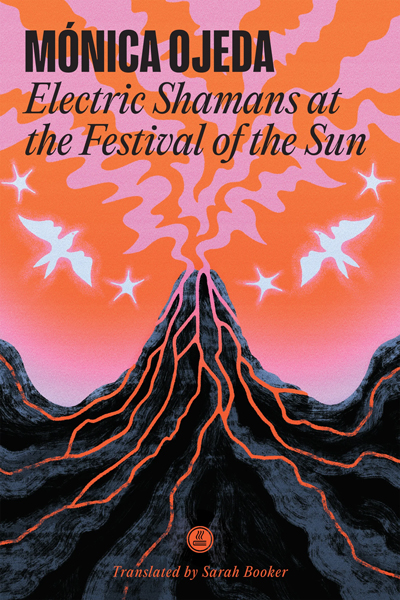
Electric Shamans at the Festival of the Sun
by Mónica Ojeda
Coffee House Press, 240pp
I write this review while teaching Olivia Laing’s The Lonely City to my Freshman English class. Here’s Laing on David Wojnarowicz: “[He] articulated a sense of being not just outside society, but actively antagonistic to its strictures, its intolerance of different life-forms. ‘The pre-invented world,’ he’d started calling it, the pre-invented existence of mainstream experience, which seems benign, even banal, its walls almost invisible as you are crushed against them. All his work was an act of resistance against this dominating force, driven by a desire to contact and inhabit a deeper, wilder mode of being.”
Ojeda’s sun-seekers crash against the pre-invented world’s structures like all-elbows kids in a mosh pit, finding themselves repeatedly ground down and crushed. This festival is their annual shot at freedom, at a reprieve from their difficult lives, and they’re united by a constantly thrumming desperation: to escape these structures-as-strictures and to tap into a deeper, wilder mode. Noa and Nicole, best friends since childhood who find themselves drifting apart, are fleeing the state-sanctioned violence of their native Guayaquil but unsure what the wider world has to offer them; Pamela is searching for ways of relating to the baby she’s still carrying but not likely to bring to term; Pablo seeks a community to buoy him as he makes beats using stones and grieves a lost love. Their stories clash against each other in a violent cacophony; the novel is divided into sections with each of them narrating, and we follow their literal and metaphysical journeys against the backdrop of Sublime Nature.
Derealization is a constant threat for Ojeda’s characters—through drugs, through anonymous sex, through other boundary-dissolving modes of being. But it’s also something they seek. The boundaries drawn around them have not treated them kindly, and only those driven by deeply embedded fear and loneliness would risk the harsh conditions of this physical and emotional journey.
Solar Noise, the festival of music, dancing and copious hallucinogens that brings them together, coincides with Inti Raymi, which in Ojeda’s rendering has become a fascinating syncretization of indigenous Andean and Catholic beliefs. If Catholicism informs indigenous religions and vice versa, each blending into the other, then Solar Noise—a kind of Burning Man-esque spectacle centered around an Inca holiday—adds a level of profanity to the profundity. Mysteriously, it features an annual reemergence of past festival participants who disappeared from quotidian life to live full-time in the mountains, now donning masks in the cast of the devil, or Diabluma (Diablo Huma), to participate in the festival.
Wojnarowicz was also concerned with the true vs. masked self, and with the way these distinctions break down under the pre-invented world’s constant assault (nowhere is this more apparent than his Rimbaud in New York project, a series of photographs featuring a man in an exaggerated mask of Rimbaud wandering a desolate cityscape). A mask—such as the Diabluma masks of Inti Raymi—serves to hide one’s true face but also protect it, offering a layer between oneself and the world that the disappeared Solar Noise participants desperately need in order to rejoin the annual revelry.
For Mario, one of the traveling sun seekers, his fascination with the Diabluma masks—which come from Quechua tradition and are a popular part of the real-life Inti Rami celebration—symbolizes the novel’s dialectical project: “I wanted to be a devil head and embody the light and darkness of the world. We took our masks and whips. Our lambskin chaps. Our chica. A Diabluma has two faces: one that looks forward and another that looks back.” Good/evil, night/day, safety/peril, music/silence: there is peace to be found in embracing these dualities, in making space for their contradictions and gray areas.
Pamela, for instance, lives in the gray area of pregnancy ambivalence: her possible lives fork out in front of her as the life inside her remains pure potential, both fact and not. At one point, she turns to Noa as the ethereal Poet intones and the music shakes the ground beneath them, stating that “Nothing compares with the spectacle of nature, nothing, and if you look up, you understand that only violence can engender the life we so love…and that’s music: Let’s rejoice in tears!”
Let’s rejoice in tears. They do. Then when the festival ends, Ojeda’s group of sun-seekers decide to keep ascending the mountain to mark the end of Inti Raymi in the shadow of Chimborazo, an active volcano. The journey is perilous—untamed nature makes no concessions to this strung-out band of travelers—but implied is the worse reality of violent (human) nature awaiting these characters back home.
They’re on their way to find Noa’s father. Much of the novel’s second half revolves around Noa, although we never really hear from her directly. Her father, who abandoned the family when Noa was small, lives somewhere in this isolated landscape, and Noa is determined to find him and glean what answers she can. The more Noa withdraws into herself, the more her friend Nicole pries: they are each other’s mirror images, Noa reeling from the withdrawal of a father who couldn’t love her and left, while Nicole contends with scars left by a violent father who stayed. If either is going to escape the forces tossing them around—patriarchy, poverty, state-sanctioned violence, and the broken families caught in the crosshairs—then they will have to separate, to leave each other and their shared past behind. In a novel that deftly explores how trauma informs all kinds of human connection in unspoken ways, Noa and Nicole’s friendship is especially moving.
This is where the novel finds them by the end: cleaved apart. Noa manages a return to the spirituality of her grandmother upon discovering her books and prayers, a way of recapturing the safety and solidity of family while bypassing her absentee father’s generation, and Nicole returns to the city and resigns herself to a period of separation from her friend. In Noa’s case, her grandmother’s tradition of incantation—her ancestral myths and legends—help her continue the difficult journey of understanding how her past in Guayaquil has marked her. Nicole understands that their intertwined friendship needs to either morph or end if they’re both to face their unique traumas. She also comes to realize that their lives, while forged by a similar damage, can’t be compared: “No wound is better, and any damage puts down roots in us. A father can hurt us by leaving or staying: My envy was unfair, though I supposed all envy is.”
The narrative occasionally slips into Noa’s father’s perspective as he tries to make sense of her presence in his idyllic hideaway: “The sorrow that feeds on vulnerability exists outside of time, and we, wandering the earth, bear it while trying to recover the earth as God made it. I do it in this forest and on the mountain; my daughter is too young to have discovered her own place of solace.”
At the core of Electric Shamans at the Festival of the Sun is the loneliness of living on the fringes of an increasingly violent society. Each character must navigate the question of how to manage it: how will community solidarity, inward-looking solidity, and family ties intersect?
Virginia Woolf: “If I could catch the feeling, I would: the feeling of the singing of the real world, as one is driven by loneliness and silence from the habitable world.” The idea that loneliness drags you kicking and screaming into a kind of suprareality. Laing again, on Wojnarowicz: “Why do you put yourself in unsafe places? Because something in you feels fundamentally devoid of worth. And how do you break out, reclaim your right to difference?” Noa is shackled by a sorrow that feeds on her vulnerability, the open father-wound at her core, and desperately needs to recapture her source of self-regard and reclaim her right to inhabit the world in her own way. If she doesn’t, she’ll be constantly imperiled and unable to survive for long. She has been driven from the habitable world—by loneliness, by silence—and must find her way of existing in the real one. Both Noa and Nicole need answers to Laing’s questions, even if their respective answers lead them apart.
“Sound waves travel faster than seismic ones. Sound reaches consciousness before light and before despair,” says Nicole. Also, before language: whereas language is full of pitfalls, misunderstandings, and failed attempts to breach the communication gap, a kind of perilous delayed reaction, sound and music are a constant thrumming force—all things constantly resonate—that one can tap into at any moment.
It’s just that language is a blunt instrument. I say this as a writer. It’s hard to write a novel around an absence of stable language…but not without postmodern precedent. Ojeda does so with prose that mirrors her characters’ profound disorientation, both ornate on the sentence level and digressive on the level of plot. But where the thread of language breaks is where music picks up—a fact Ojeda’s seekers know well. As they flee any number of things—hometown violence, lost loves, the consequential decisions forced by the end of young adulthood—they turn to languageless mechanisms of communicating to better understand themselves and their place in a world that wasn’t constructed with their safety in mind. Despite the bind Ojeda puts herself in—writing a novel about silence using language—she conveys these characters’ anxieties and inner worlds with remarkable sensitivity, with writing that is often virtuosic at the line level.
At the core of Electric Shamans is the loneliness of living on the fringes of an increasingly violent society. Each character must navigate the question of how to manage it: how will community solidarity, inward-looking solidity, and family ties intersect?
And what can we make of the people—like the Disappeared in their Diabluma masks, or Noa’s father—who opt out of this pre-invented world altogether?