On the first page of Transcription, American poet Ben Lerner’s latest novel, a version of his long-fidgeting semi-autobiographical narrator has been molded into the angel of history by his daughter. Falling asleep on a train to Providence on the way to interview Thomas, a mentor from his years at Brown who recently turned ninety, he remembers that Eva, his ten-year-old daughter, told him that when facing “opposite the direction of travel,” one is “facing the past.” Unlike Lerner, the narrator does not see the wreckage of the bygone piling up and, in fact, worries that he will fail to do so in the near future, craning his neck to look ahead: “My main concern was that I would somehow fail to record us on my phone, or that I’d manage to delete the voice memos when I tried to send them to the magazine.” Transcription is a story of regret and invention, the passage of history and experience and the novel’s capacity to capture them, of “art and life, and the hinge between them.”
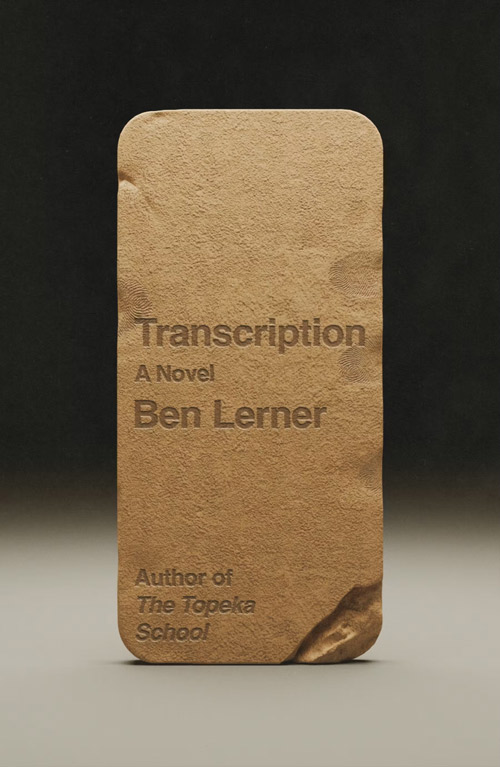
Transcription
By Ben Lerner
Farrar, Straus, Giroux, 144pp.
Anxiety’s self-fulfilling prophecies bear out: after checking into the Hotel Providence and calling Eva (and Mia, his wife, Eva’s mother), our narrator drops his phone into the sink. “For the duration of this sentence, it was submerged,” and since the “screen was cracked in places,” liquid seeps in. “I watched it spread, like the solution across a rapid antigen test,” the narrator tells us. The book takes place around October of 2023—strained references to COVID-19 and masking abound. The novel logs historical time and current events, the insistent intrusion of the present into the narrative mind, without fear of obsolescence.
Such intrusions run even deeper, into syntax and duration. In his recent writing, Lerner has cultivated his interest in the relationship between text and time. He described an essay for the New York Review of Books about his open-heart surgery, for instance, as “a test of how changes in my pulse pressure waves,” produced by the replacement of flawed aortic tissue, “have altered my sentence rhythms.” This amounts to an investigation into how text can inhabit time and the world, instead of sheltering from it. In Transcription, the mediation of text itself is a concern: how can a phone be submerged for the duration of a sentence? Which duration is being referenced—the time it took to write, to read, the arbitrary time it occupies within the narrative?
The phone, alas, is dead, fried definitively when he tries to turn it on. As befits a Lerner narrator, panic sets in: the Apple Store is closed. Instead of considering any other kind of recording device, he’s going to wing the interview with Thomas, have some kind of preparatory conversation, and buy another phone tomorrow with which to record the real thing.
Thomas, with his quantum genius and selfishness, is Transcription’s gravitational center. The book’s three sections orbit him, his life and work, his irreducibility. The first part, “Hotel Providence,” recounts the unregistered interview with the eccentric, charming artist, who scrambles conversations and travels along unpredictable tangents. Thomas spiels with little prompting. When asked about early memories, he begins: “The first experience of voice is disembodied, yes? Voices heard in utero: your mother’s voice, your father’s. The postman’s. Your sister singing ‘Ein Männlein steht im Walde,’” and so on. “Radio, it is a recovery. Of the voice without the body. That like everything new, it is also ancient. The truly new touches something before the merely recent.” Thomas has always spoken this way, with “sudden changes of scale, rapid juxtapositions of images and registers.” At the same time, the narrator’s inability to record the interview parallels a slow realization that Thomas’ memory is going, that the genius has grown truly old, that death comes for him too.
The impermanent conversation is haunted, somehow, by the dead cell phone’s ghost and the narrator’s constant preoccupation with FaceTiming his daughter. The world comes alive in the midst of “a withdrawal indistinguishable from mild intoxication,” though phonelessness also offers culpable realizations: “I wanted—I needed—to check my texts, my email, to swipe and scroll and photograph, to frame and filter and archive, to share my location, etc., so as not only, not fully, to be where I was; since at least 2008, to be where I was was too much for me, or too little.” Such reflections on phones (and even the pandemic) feel trite in 2026, when the languages of technological dependency and compulsion have exhausted themselves, when phones have become more a noxious extension of our minds than anything resembling a drug. But Lerner weaves these ideas into a compelling theory of mediation through the anxious disposition of his narrator. Stripped of the ability to consume and share the past through a phone, memory speaks: the narrator’s college-age crisis, when his then-girlfriend Mia (now his wife) dumped him from her study abroad program in Spain and he spiraled into psychiatric hospitalization. “It was conventional undergraduate stuff, but then, so is suicide.” He grew close, though never quite romantically, to Anisa, a friend of Mia’s who fed him details of her new life with Andrés, the Spaniard for whom she’d left the narrator. Mia was studying part time to be with Andrés, who had moved to the United States, and the two are building a life together in New York.
The narrator and Anisa visit the Harvard Natural History Museum, which holds the Glass Flowers made by Leopold and Rudolf Blaschka, a father-son pair of glassmakers working in Dresden for half a century from 1886 to 1935. There are almost 5000 flowers, including intricate depictions of disease and rot. He’s stunned: “I couldn’t quite believe that this moth orchid was glass, that this pear blossom was lampwork, that these objects had been blown and shaped and painted, that these impossibly delicate things were the result of a thousand rapid choices and adjustments.” A few weeks later, he finally re-encounters Mia and, in speaking with her, realizes that a fiction had been spun around him, that Anisa’s dispatches on Mia’s life were lies, that Mia and Andrés did not last, nor did Andrés ever cross the Atlantic. The reasons for Anisa’s lies remain opaque—perhaps she wanted to get close to him and could only do so by spinning a yarn. Fiction, in Transcription, works as a form of preservation, at once eternal and delicate, deceptive and precarious and gregarious and cowardly. Life-like and glassy at once, fiction never quite makes sense.
Such acts of human artmaking are, however, the only true sources of beauty. “I was typically unmoved by ‘unspoiled’ mountain views; after the glass flowers, I would see cracks in the rock face as penciled, as a history of small decisions, and then experience the view as beautiful.” Though never mentioned outright, with the book set on the knife’s edge of AI’s explosion into popularity around late 2023 or early 2024, Transcription seems particularly haunted by the technology’s intrusions into making or so-called creativity. Adam taught himself to see humanity, traces of intentionality or manufacture, in the most sublime and superhuman natural sights. “Eventually I’d call this ‘fiction,’” he writes.
Indeed, a delicate fictionality lingers over the book, even though the central invention in its pages—the reconstituted interview—never, in fact, appears. In the novel’s second section, titled “Hotel Villa Real” and set some time after the interview’s publication, Lerner’s narrator has just given a talk at the Reina Sofía museum in Madrid about Thomas and his work. Rosa, a Thomas mentee and longtime friend of the narrator, lobs an accusation: “You, well, you more or less confessed that you falsified a big part of what many of us thought of as his last, I don’t know, testament. A deepfake.” The now-outdated reference does not soften the blow. The narrator defends himself, describes the interview as “reconstructed” while Rosa insists that the interview was “conducted under false pretenses,” before conceding that Thomas “would have loved it. Loved the idea that his last published statement was—unstable.”
The “Hotel Villa Real” section reminded me of Adam Gordon, narrator of Lerner’s debut novel, Leaving the Atocha Station, published to acclaim in 2011. Adam appears as a 23-year-old Fulbright Scholar in Madrid, a pathological liar who spends his days smoking spliffs and pretending to read and write, worried about his numerous deceptions—a dead or dying mother, a project about Spain’s disappeared—being uncovered. In fact, asked to partake in a panel on literature’s relationship to politics, Adam’s bullshitting collapses around him when he’s asked to name a Spanish poet who influenced him, and he garbles names as a storm of shame floods his mind. A young man instead of a well-known writer, Adam soothes himself by repeating that “none of this is real,” that he can just go home and forget it ever happened. No such luck now, of course, but fiction may remain a respectable form of bullshit.
At the same time, one wonders whether reality can (or should) survive fictionalization. Lerner’s 2014 follow-up, 10:04—the author’s best, and among the best American novels of the 2010s, though that isn’t saying much—left its narrator unnamed but was explicitly semi-autobiographical, becoming a landmark work of autofiction. In its pages, Lerner worried about futurity: how to produce a follow-up to Atocha based on a story published in The New Yorker, finding love, dealing with a life-threatening diagnosis. The point, he wrote, was to write “a present alive with multiple futures,” a “flickering” between fiction and non-fiction that resolved its open-ended presentness into the literal, reproductive futurity of children, dissolving its singular narrator into a collective “we.” The Topeka School, published in 2019, returned to Adam Gordon’s Topeka, Kansas adolescence, his career as a debater and the lives of his psychoanalyst parents, fictionalized versions of Lerner’s own. Sections from the perspective of Gordon and each parent were interspersed with a stream of consciousness segment about Darren, Adam’s low-income classmate who serves as an unconvincing metonym for whatever Lerner understood as a Trumpist subjectivity. The critic Becca Rothfeld lambasted the novel’s veer into “sanctimony,” its emphasis on Gordon’s virtue or pursuit of a lazily defined idea of “the good.” In The Topeka School, reality—where personal virtue is never quite so straightforward —had not, in fact, survived fiction.
Thankfully, in Transcription, Lerner’s narrator is kind of an asshole again, possessed by a bumbling anxiety and unchecked arrogance and an unfortunate tendency for dishonesty. The question of generational inheritance and disinheritance—of the making and unmaking of what Irving Howe termed “the world of our fathers,” and of their literature—has occupied Jewish American novelists for a century, from Mike Gold to Cynthia Ozick. Transcription, like its cousin Joshua Cohen’s The Netanyahus, worries about the passing of a post-World War II generation that witnessed Jews’ ascent into the American bosom. Thomas, more brilliant, arrogant and bumbling than the narrator, is not just a forebear but a kind of ideal, a man who “used to go to concerts with Adorno!” much like Harold Bloom embodied, for Cohen, the flustered, frustrated aspirations of an assimilationist Jewish American liberalism. Yet, most of all, one finds the wry humor of an impossible parallel. The great, declining artist, representative of a bygone Mitteleuropa, “among the world’s most renowned thinkers about art and technology” who can’t do basic computer tasks, interviewed by the harried, pathologically anxious and phone-addicted millennial who is the closest thing to his inheritor. After Thomas retreats upstairs for the night, the narrator stuffs four dinner rolls in his mouth “like an animal” or Saturn in Goya’s painting, his boundaries in quick, desperate crisis. Making up the interview, a playful and writerly tribute, is also a ritual slaughter of the lettered father.
Having failed to slay the progenitor, the narrator retreats to the margins in the book’s final section, titled “Hotel Arbez” after the establishment set atop the Franco-Swiss border since the 1920s. During World War II, with German soldiers prohibited from crossing into Switzerland, members of the French resistance and Jews hid on the hotel’s upper floors, which, jurisdictionally, lay in neutral Switzerland. The book’s longest and most compelling section, “Hotel Arbez” is told through an interview, sans contexte, between the narrator and his college friend Max, Thomas’ son and now a lawyer. Emmie, Max’s young daughter, is the conversation’s central node: Max’s apparently happy little girl simply won’t eat and no one can explain why. “She’d take these cartoonishly small bites: imagine her sheathing each tiny prong of her tiny fork with a tiny macaroni noodle, then eating them off one by one—‘OK, I’m full.’” Though its cause is mysterious, Emmie is eventually diagnosed by the idiosyncratic Dr. Sato with ARFID, “avoidant/restrictive food intake disorder.” In a moment of desperation, a drunken Max approaches the vanishingly thin Emmie in her sleep and blubbers to her in desperation that she must eat. He confesses to Adele, his wife: “Two parents, two lawyers, two self-loathing elites, weeping over overpriced salads—people at other tables pretending not to look—because our child, for reasons we couldn’t fathom, would not let nourishment pass her lips, because we’d failed to help our child thrive.” Max’s desperation produces one of the book’s most moving scenes, where the reader witnesses his own loss of emotional and linguistic boundaries, filled with the sincere and familiar panic of parental failure and freed from even the narrator’s anxious solipsism.
“Transcription is a story of regret and invention, the passage of history and experience and the novel’s capacity to capture them, of “art and life, and the hinge between them.” Fiction, in the novel, works as a form of preservation, at once eternal and delicate, deceptive and precarious and gregarious and cowardly. Life-like and glassy at once, fiction never quite makes sense.”
In fact, the narrator and Max are remarkably alike, differentiated most by their relationship to Thomas. The two are not, like Lear’s daughters, in pursuit of inheritance, nor are they, like Golyadkin, incapable of coexisting with their double, though their relationship is uncomfortable. In fact, when the narrator first realized, as an undergraduate, that Max was Thomas’ son, he was shocked, “because there was nothing about my way of being in the house, or his and my way of relating to one another, that indicated that we were family,” Max explains. Max has little patience for Thomas’ intellectual pyrotechnics, and the interview is peppered with his rectifications of the narrator’s admiring idealizations. The chosen and distant son, the intellectual and conceptual heir, stands opposite the unelected scion, the biological spawn who opted for a career in media-adjacent contract law instead. (Max once “helped with Godard permissions” from his job at Canal Plus in Paris, never quite leaving art behind.) In its doubling, its overwrought structure and proximity to consciousness, its two paths for the literary heir, Transcription eulogizes the modernism that dies with Thomas, the giant at its heart.
In Transcription, Lerner’s subtle play of motifs—ingestion, mediation, repetition, fabrication—has never been sharper, his fictional architecture wrought finely like a twinkling Blaschka flower. His prose has shed some of the sparkle from 10:04 or Topeka School, and the constant efforts to map the Phone Mind, from obsessive news consumption to FaceTime to iPhones to COVID, tire quickly for a book with fewer than 150 pages. But by the book’s end, with the choral subjects of Max, Thomas, and Adam, of fathers and sons, what glows brightest is the parental, and especially fatherly, love. Such love—which, to his credit, Lerner manages to describe beyond sentimentality—is presented to the reader as an end: of meaning, of literature, of the purified thing beyond the thing. Thomas, the renowned artist capable of great leaps of insight and extraordinary creation, only ever glimpses it before hopping toward another image, another reference. Speaking with Max, he describes the emaciated Emmie as a Hungerkünstler: “Before he could quote his beloved Kafka at me, or launch into some discourse about the history of pre-Christian ascetism, I snapped at him in German: This is not fucking theater, Dad, this isn’t art or literature, Emmie isn’t a character in a fiction, she’s my fucking daughter.” Thomas, unmoved, at once reductive and honest, replies: “Of course,” his mind already somewhere else, “and all will be well.”