When I was 16 I spent 24 hours alone at a San Francisco Airport Comfort Inn after missing a connecting flight. It was devastatingly stressful, sure. But it was also surprisingly relieving. There was something calming in knowing there was nothing I could do but sit around, wishing I had had the foresight to pack my toothbrush in my backpack. In Maria Stepanova’s The Disappearing Act, the novelist M experiences a similar serenity in transit when she is unexpectedly waylaid in F, an unfamiliar European city, on her way to a literary festival.
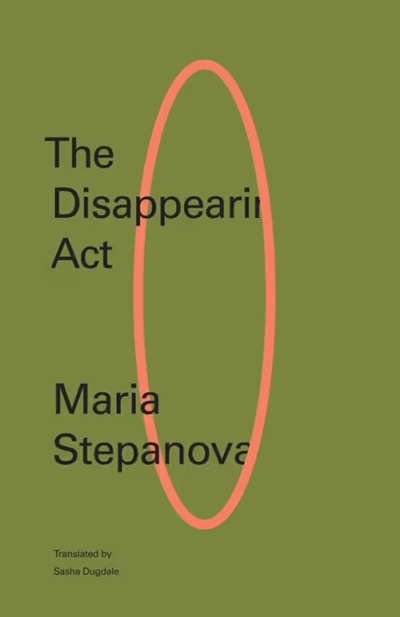
The Disappearing Act
By Maria Stepanova
Translated from the Russian by Sasha Dugdale.
New Directions, 144 pp.
M is not a spontaneous person. She is a fan of “the predictable dynamic from promise to fulfillment,” of moving swiftly from point A to point B. So she is surprised when she begins to relish the curious suspension of travel en route to the festival. She experiences glimmers of travel as a kind of deindividuated transcendence while on a long-distance train:
…you share the space not with a singular other but with a multitude of others who resemble you, it takes a conscious effort to single out any particular individual from that crowd, to look properly at them, to consider them for more than a moment. Far easier not to; to use that special absentminded gaze that registers only distance and movement, the millimeters of air between you and another person’s shoulder, and how everyone is crushed together by the movement of the train, or how the mass of people begins to strain towards the doors as the station approaches.
M finds herself yearning to extend the anonymity of travel just a little bit longer, to savor this relief from everyday existence. When a train strike, a dead phone, and a misbegotten taxi ride strands her in F, she is not entirely displeased to find herself checking into a basic hotel: “One of those chains where they take pride in making the traveler forget she has traveled a long way and is now in a very different place.”
The novel provides a striking articulation of the incongruity in M’s anonymity. Travel is, after all, an experience historically conditioned by the commercial networks of a densely interconnected world—and yet it simultaneously seems able to offer a rare suspension of our participation in the very conditions that sustain it. M does not so much go off the grid as temporarily disappear into it—she finds herself in movement without the structure of departure and arrival.
The Disappearing Act is Stepanova’s reflection on her experience of self-imposed exile following Russia’s invasion of Ukraine in 2022. Maria Stepanova now lives in Berlin; M lives in a city called B. M is ashamed not just that her home country is waging a brutal war, but that she had the privilege to leave it behind. Movement and travel in the novel are, thus, not just a matter of personal refuge, but a nagging ethical problem. The easy mobility M finds in drifting around Europe is both a testament to her privilege and the rootlessness of her exile. Conditions of globalization, Stepanova suggests, have rendered transit not just effortless but aimless, and increasingly indistinguishable from the experience of deracination, of being uprooted.
This is also a novel about national guilt in a postnational world. M avoids telling not just the other characters, but the reader, where she is from. She never mentions Russia by name. This kind of linguistic avoidance is something of a literary trend, also on display in Yoko Tawada’s Scattered All Over the Earth, in which the country of Japan physically disappears from the face of the earth and is simultaneously erased from collective memory. In Stepanova’s book, the inverse takes place—it is not Russia, but M, that disappears. Where the Japanese character Hiroko in Scattered All Over the Earth embarks on a search to find people who speak her language, M refuses to speak Russian at all, preferring the anonymous comfort of English.
…Many people now expressed themselves in a foreign language every day, inhabiting it, adapting it to their needs and finding refuge not in the words themselves but somewhere in between them, so that reality itself seemed like a dream in which you are traveling endlessly on a train or a plane or a bus, standing in passport lines or looking over heads in a waiting room while your flight is repeatedly delayed and you are never able to reach your destination. And that is for the best, because you can no longer remember where you are going, nor what you left behind.
English, for M, is the linguistic equivalent of the chain hotel—serene and impersonal. When we call English a global language what we mean is that it is a language of travel and sameness, of travel as sameness. M says that speaking English has a kind of oneiric quality—like the kind of dream where you are perpetually traveling without remembering either where you’re going or where you’re coming from. English also provides the comfort of relieving responsibility, a temporarily release from the obligation M feels towards her origins. The very concept of national identity, and the claims it makes upon us, has come to feel increasingly perilous to M. Is she accountable for the crimes of the Beast, as she hyperbolically refers to her native country? Is she more, or less, responsible for having left? Is rejecting the Russian language an act of evasion or disavowal?
During her stay in F, the relief M finds in the temporary anonymity of the city gives way to a deeper desire not simply to go unnoticed, but to cease, even temporarily, to be a self. This attenuated sense of self registers in Stepanova’s prose, which has a muted, insubstantial quality. M feels herself to be increasingly inanimate—as “in a waking dream in which she was a balloon on a thread and someone was by turns jerking on that thread and then slowly and agonizingly letting the balloon rise.” This yearning for depersonalization is, ultaimtely, a fantasy of non-agency, of being controlled by someone else “like a windup toy monkey.” There is a freedom to be found in being relieved of your personhood, but it is of a purely negative kind—the freedom from having to make decisions, from having any will at all.
Her desire to disappear is briefly challenged when M meets a man she refers to only as “the man with the paper clips.” The two of them do an escape room together, though instead of hunting for clues they decide “to do nothing, simply to wait for the situation to resolve itself.” Afterwards, over a bowl of cucumber soup, the man with the paper clips reveals that he recognizes M as a writer, having seen her speak at another literary festival. Her first reaction is a sense of mistaken identity: “M was no longer a novelist, although she kept quiet about this in polite society, because if she wasn’t a novelist, then what was she?” But it also entails the realization that “her ability to be no one” is still merely tentative, “like dipping a toe in the ocean.” She mourns their temporary existence as “people without provenance” and leaves the man with the paper clips behind as if he had never existed.
“Conditions of globalization, Stepanova suggests, have rendered transit not just effortless but aimless, and increasingly indistinguishable from the experience of deracination, of being uprooted.”
M’s yearning for depersonalization finds its next expression as a fantastical memory of childhood, when she goes to see a circus performance in F on a whim. “In the front row, right next to the ring door curtain, in a delightful new world, and one that was totally indifferent to her, the novelist M fell back into her childhood, or perhaps out of her own self, as a key falls out of a pocket.” This fall into the oblivion of childhood is a substitute for the possibility of returning home, for someone “certain that there could never be any going back home.” When M overhears some of the circus workers despairing in Russian that they need help with an act, she doesn’t think twice before volunteering. Her fantasy of returning to childhood here reaches back into the womb as she finds herself curled up “like an embryo in an old medical illustration” inside of a sarcophagus, ready to be sawed in half.
M hopes to be reborn from the sarcophagus as a New Being—not as novelist M, perhaps not even as M, but as A, a new beginning. She decides to join the circus full-time, leaving her keys and passport behind, but packing three changes of underwear. When she reaches the festival grounds, however, the circus has vanished, leaving only a tin can of used cigarette butts behind.
The whole adventure in F, perhaps, has amounted to “a kind of childish self-indulgence,” a reluctance to face the life she has known “she would have to return to sooner or later.” And it seems as though later has arrived. A fishes an old cigarette butt out of the can and finds a lighter still in her pocket, grateful that “she hadn’t managed to relinquish everything in her life after all.”
It’s a fittingly irresolute ending to an irresolute book.