My messages with friends are mainly “brb, battery low” and heart emojis, interspersed with interminable meandering voice memos. Glimmerings—an edited collection of correspondence between Christian Wiman, a poet, and Miroslav Volf, a theologian, both of whom teach at Yale—is something altogether different and delightfully antiquated: a longform attempt, over email, to probe their different understandings of faith and perhaps even grow closer to God.
In the background of this correspondence, and sometimes the foreground, is Wiman’s cancer. He has lived with a terminal diagnosis for decades and is approaching another invasive experimental treatment as the letters begin. Facing death, Wiman turns here to one of his most trusted friends to explore the largest questions of life. The reader is left with the impression of dropping in midway through the kind of conversation that usually only happens late at night over wine when no one has to drive home.
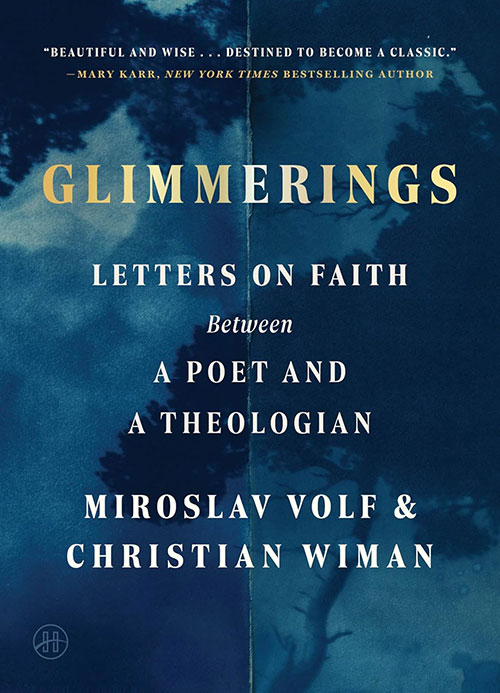
Glimmerings: Letters on Faith Between a Poet and a Theologian
By Miroslav Volf and Christian Wiman
HarperOne, 272pp
The correspondence begins with Wiman questioning, if not his faith, then faith at large: “I don’t know what faith means any more.” Quoting Ulysses, Wiman confesses, “I fear those big words—faith, grace, sin, redemption, love—which make us so sad.” It is a striking thing for a poet to say, not least about love. Words, big and small, have been his raw material. But he has seen close up, therefore, their tendency to become semiotically evacuated, to “seethe and shift and slip free of meaning.”
Volf, meanwhile, comes at “those big words” from another angle, as antidote to the words imposed on him by “finger-wagging…fist-slamming…semi-dictatorial rulers” in his Yugoslavian childhood, words like “revolution,” “brotherhood,” and “proletariat.” In contrast, he experiences the big words associated with Christianity as “hospitable spaces where I could live without pressure.”
I am interested in what—to use the biggest word—we call “God,” but I do not read a lot of “religious” writing. I have too often found books written by Christians in particular (a label both Volf and Wiman sit under, with varying degrees of discomfort) too careful, too tidy, presenting a level of certainty I don’t recognize. Wiman describes what I too often feel: “Poetry remains perpetually open. God moves through art but doesn’t get stuck there. I sometimes think He does get stuck in theology—fixed, frozen and therefore inevitably falsified.”
Glimmerings is not tidy, fixed, or frozen. Volf admits that he often ceases to comprehend the concept of God, sees the word slip free of meaning, and that it happens most regularly while he is praying. The title of the book comes from Seamus Heaney—“Glimmerings are what the soul’s composed of”—to which Wiman adds, “one gathers one’s soul, one’s god, fitfully, fugitively and is content with that.”
Wiman writes the most delicious sentences, which I found myself mouthing aloud as if to taste them. Writing about Etty Hillesum he says, “crafting sentences and crafting herself were one and the same process of acting and writing herself into holiness,” and I sense the process at work for him. It is not fair to compare Volf’s prose to that of one of our greatest wordsmiths, but initially, I had to fight the impulse to speed-read his sections. Over the course of the book, however, Volf’s steady, honest, faltering attempts to be a good friend to a man living on the edge of a physical and existential cliff moved me deeply.
The conversational format enables the two to pick up each other’s threads, to take a thought and deepen it, or take it in unexpected directions. It leads to fascinating questions like whether they would want Jesus to raise their kids (not keen, actually, for reasons neither can fully articulate) and how they experience the divine spatially. Volf answers, “I sense God more behind and underneath me, but that somehow the space above me and in front of me into which I could stretch feels void of God,” which a therapist could do a lot with.
Some of the most interesting tensions emerge from the interplay of a poet who is prepared to reimagine all received truths and a theologian concerned, even in the most generous, hospitable way, with orthodoxy. Wiman admits he never feels further from God than while reading the Bible, and he wonders if is possible to just play with the text like any other. Volf replies, “how can I ‘play’ with the text that has for me the authority of the bearer of the moral measure of my life?” Similarly, Volf balks, politely, when Wiman says, “God is relation, full stop….God doesn’t exist until I turn my attention to him. Relation brings him into being, or more accurately, enables his being to be perceived, experienced, shared.” To Volf, Wiman sounds a bit too much like a universalist mystic here. Indeed, Wiman catches himself: “We have not mentioned Christ who slams reality into place around us in a way what makes all talk of existence and being seem like evasions.”
Wiman’s honesty about his ambivalence towards faith will be a relief to many and uncomfortable for some. He admits to craving communal worship and then “crawling out of [his] skin” in church, bored and anxious. “I sometimes wonder, Miroslav, if my very obsession with God is an idol, if life is not meant to be this single-minded chase. Maybe grace, for some, is God forgotten.”
There are sections of the book that drift slightly towards purely intellectual, overly doctrinal debate for my tastes, though beautifully expressed. Wiman and Volf notice it themselves (“arguing about the Bible makes me feel legalistic and small”). What kept me reading was the tenderness of the friendship as it repeatedly broke the surface of the ideas. They admit when they’ve touched a nerve in each other: “I was eager to answer because I felt a certain combativeness/supercilious pity (‘Poor Chris and his false God’) in your letter.” They feel slightly abandoned when one takes a long time to answer and say so. Volf concludes, “I love this conversation. I love observing how well you see and describe what you see. I love how disagreeing with you feels like disagreeing with myself, free of envy and malice, which is how Augustine describes disagreement between friends.”
Wiman, in touching proximity to his own death, is ballasted by this friendship. Reflecting on a walk he and Volf took, when Wiman questioned if his work mattered and Volf admitted to sharing this fear about his own writing sometimes, Wiman describes the consolation he experienced: “The feeling wasn’t gone. The recriminations still seethed and roiled in my soul like those little blurps of air in cooking oatmeal. I still felt the cold undertow of oblivion. But I also felt lightened, alive in the spring—gleaming streets, myself and glad for that. Why? Nothing had changed. I can only think that the act of two bare forked creatures acknowledging their bare forked creatureliness enabled Christ to come among them, in them and between them. I carried the moment with me for days. I carry it now.”
“It is a book ostensibly about the ‘big word’ of God which turns out to be more about what is often seen as a small word, friendship. I was left wondering if they are two different words, after all.”
At Easter, Wiman receives unexpectedly good news after an experimental cancer treatment. He notices that “having prepared so assiduously to die,” he must now learn to live again. They both speak of it as a kind of resurrection, and Volf says, “Jessica and I, along with your many other friends, were raised too. An individual event was a communal event. Who God was for you became who God was for all of us, because our lives are mutually implicated… Imagine me writing this letter with champagne in hand.”
In the end, after pages of Wiman’s incandescent, almost acrobatic writing, it was his simplest words which stuck with me: “People sometimes say that God becomes clearer in moments of suffering, but this is not necessarily true. What becomes clearer is one’s longing for God…What I fear is dying without God. These letters help me feel God’s presence, or at least the possibility of that.”
This book helped me feel God’s presence too. I felt it more keenly in the raw human display of imperfect affection than in any of the theological concepts, profound as they are, more even than in the wealth of poetry quoted and reproduced. It is a book ostensibly about the “big word” of God which turns out to be more about what is often seen as a small word, friendship. I was left wondering if they are two different words, after all.