Paul Dalla Rosa spends a week reading Marcus Aurelius’ Meditations, and does his best to live stoically.

Marcus Aurelius reigned as emperor of Rome for nineteen years (161-180 AD) until his death on one of the empire’s many warfronts by the Danube, dying most likely from the Antonine Plague. He is regarded as one of the last great emperors of Rome, with his death often dated as the end of the Pax Romana. His victory column, commemorating his battles against barbarians to the North and Sarmatians to the East, still stands in Piazza Colonna, over 100 feet tall.
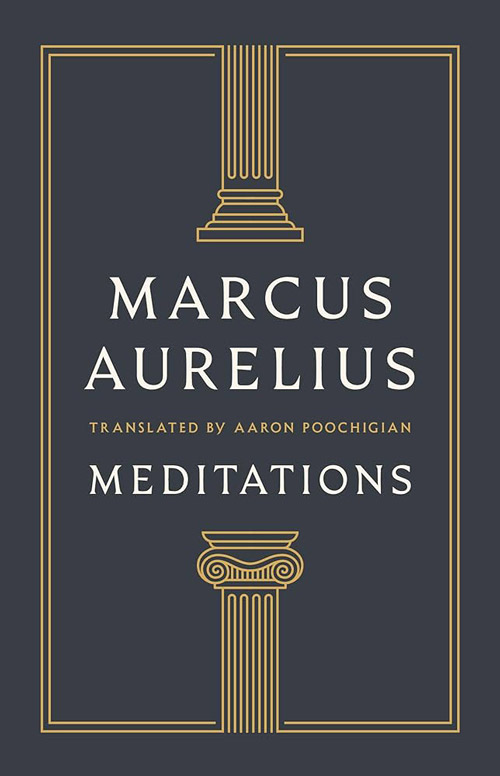
Meditations
By Marcus Aurelius
Translated from the Latin by Aaron Poochigian.
Liveright, 288 pp.
He is perhaps the closest example we have of Plato’s philosopher king. He attempted to govern and live according to the principles of Stoicism and recorded this struggle in his Meditations. Stoicism, described simply, holds that we are made of matter, of nature, and that it is the law of nature that all things change. Nature, the entire cosmos, is suffused with divine fire or reason (the Logos); things are as they are because they are meant to be so. A lick of that fire, or maybe only a spark of it, resides in each of us and allows us to be our highest, most virtuous selves: rational beings that can connect with other rational beings.
For a week, I read a new edition of Meditations, translated by Aaron Poochigian and newly published by Liveright, and tried to live virtuously. Here, in the words of Marcus Aurelius, is my attempt to “try the life of a good person on for size” (Book 4, 25).
Monday
Each morning I wake in Melbourne, Australia, and on the screen of my phone see things that enrage me, things that are meant to enrage me, for commercial reasons. More and more, the words and images my eyes light across aren’t even made by someone, but by a machine or perhaps by someone who, alas, is happy to think like one.
There’s a reprieve in Meditations. It’s one thought following another.
This seems lacking in contemporary life. Everything is about maximum stimulation. Maximum dopamine. Television shows designed to be watched with a second screen in hand. When one flags, we reach for the other. Our cognition is interrupted, fractalized, broken down again and again.
The times are accelerationist and tend towards emotionality or, rather, to immediate reaction. It is the age of reactionaries, and I fear, no matter the side, we’re all playing the game. But we don’t have to do this.
“You are entirely capable of having no opinion whatsoever about a matter and, thus, of suffering no disturbance in your soul because of it” (Book 6, 52).
It’s a nice thought.
I want to compare a passage from Poochigian’s Meditations with the Martin Hammond translation (2006) but can’t find my copy. I search the shelves in the living room, the shelves in the bedroom, the study, the book stacks lining the hallway floor.
I used to read a few pages each night before sleep. In this way I have read Augustine’s Confessions, Plato, Jung, the works of Marianne Williamson, Deepak Chopra, and, lately, the memoirs of Shirley MacLaine.
Remembering this, I find it beneath my bed. For a year, possibly longer, I have been sleeping above a copy of Meditations, a bronze of Aurelius looking up at my mattress board. This unnerves me.
I have been sleeping above reason. I have kept it out of sight.
Tuesday
I spend too long today thinking about my herb garden to avoid thinking about anything else. I have thought about it at the office and now at home. My husband has planted French tarragon, basil and parsley, but the parsley is growing too quickly and will soon overtake the others.
I need to cull it, to cook something with a large amount of it, but I can’t bear the thought of eating it. Weeks ago, I gorged myself on sweetbreads cooked with parsley at a dinner party hosted by a psychoanalyst and a philosopher.
Each time the plate of sweetbreads was passed to me, I took it and heaped pieces of thymus onto my plate. I was ill for two weeks. It was not the sweetbreads that harmed me but my lack of self-restraint.
I suppose I could cut the parsley and gift bundles of it to a neighbour or a nearby friend. I resolve to do this, but do not do this.
Marcus had an empire. I have much less.
As I write this, the parsley still grows.
Georgia Meloni, the Italian Prime Minister, has a phone case on which are printed affirmations. I have seen images of it online. They read, “Affirmations for Anxiety.” “I am.” “Tomorrow is a new day.” They appear to be typed in Comic Sans.
I don’t have anything to say about this, it is simply what comes to me. Perhaps it comes from reading such a contemporary translation: “Remember that if you change your mind because someone has set you straight, you aren’t any less independent” (Book 8, 16).
There’s a grandeur in the Hammond that’s less present in Poochigian’s. It isn’t a flaw of the new translation, it’s just that in the intervening twenty years between editions, the language of self-help has become so common, so tawdry and cheap.
Wednesday
I am waiting for an important email. Because the email will be sent from New York it is likely the email will come to me in the middle of the night, though not necessarily. Sometimes this man emails me, or perhaps schedules emails to be sent to me, in the middle of my afternoon. I expect its arrival at any moment. Before I go to bed, I place my phone in another room.
In the night, I wake, move through the house and look at my phone. The email has not arrived.
It really makes no difference if it arrives today, tomorrow or in a month’s time. I say this to myself because it is true. In fact, I once delayed sending an important email to this same man for an entire year. Neither of them is really that important when considering the gulf of time behind me and the gulf of time in front.
Hours pass. I open my inbox once more. Later, I will open it again.
I see a cap online and covet it. Summer is beginning in Melbourne and I think how wonderful I will look in this cap, how splendid. I walk home in the afternoon light still thinking on it. Then I remember I do not wear caps. I have many and wear none. I think, perhaps I will wear this one. I am, in other words, a fool.
At home, I copy down:
“Halt your urges. Stamp out your appetites” (Book 9, 7).
How paltry are these desires that fill my days?
I have a single glass of wine with a friend. I drink it slowly. It strikes me that most people I know are searching for a purpose. I know this because they all tell me.
I have a purpose and yet I don’t quite know if it qualifies as a virtue.
If I stopped writing tomorrow, the world would be no better and the world would be no worse. I do it anyway. It is my nature to do it.
It is a poor nature, but it is my own.
When I was single and in my twenties, I lived in a share house and my room was so small it couldn’t fit both a double bed and my writing desk. I decided the desk was more important than having other men share my bed.
Thursday
I delight in reading the work of the long dead. Our manias, hopes, resentments, and fears span centuries, millennia. It’s easy to understand this intellectually, but one tends to forget: “It’s all one whether you observe humanity for forty years or ten thousand” (Book 7, 49).
We are not a new animal, I write. Remember this.
“Very soon all there is will have forgotten you” (Book 7, 21).
Almost two thousand years later I’m reading Marcus Aurelius and yet, I know he’ll win out in the end.
The meditations are recursive. Yes, yes, I say. Marcus, I’ve got the message. I’ve heard it. We all die.
Life is recursive, though, our thoughts too. I open a diary I wrote seven years ago, and think, well, yes, pretty much the same.
For a long time, I wanted to experience everything, great passions, great highs, despairing lows.
Now, I have works before me to complete, and all I want is to execute them well.
“The actions you perform in accordance with your nature should be what are causing pleasure in you” (Book 10, 33).
There’s only one topic that interests me: the movement of the human soul.
Friday
In pursuing one duty, I neglect another.
As I ride the tram, the tram stops and through the window I watch a fight break out in front of a formerly grand building, which is now a H&M. Men yell and kick and flail. They pace, circle each other, and return like children squabbling or a pack of dogs.
Walking home, four teenagers riding dirt bikes tear past me on the footpath.
I think: This city is in total anarchy.
What seems clear to me in the disordered thoughts of others is not always clear in my own.
Weeks ago, I agreed to accompany a friend to a fashion fitting. My day has been long and I am tired. Standing before the photocopier I draft an apology on my phone. Then I remember I am living the life of a good person, for Kismet Magazine. I am living a life of virtue. I message my friend and say I will see him shortly.
At the fitting I watch the designer, his delicacy and purpose, as he holds a pin in his hands.
If I say I will do something, I will do it. I will not be “a flunky and a braggart” (Book 5, 5).
Saturday
I am a stoic Monday to Friday, and the rest of the week I revolt.
On the dance floor, in the early hours of the morning, a friend glares at me. He leans into my ear and shouts, “You are a bad person.” Then in flashes of white and red light, he looks shocked then meek. He leans over again and says, “Sorry, I don’t know why I said that.”
I get home close to dawn. I lie in bed and hear birdsong. I roll from one side to another.
I think: “Do you want to keep consorting with vice?” (Book 9, 2).
The answer is, sometimes, yes.
I have traded today’s acts for the acts of the preceding night. I scowl and wait for sleep to take me.
“Scowling is very much at odds with Nature” (Book 7, 24)
Saturday, I lie in bed feeling wretched with the blinds drawn. A real Cheever morning.
One escapes one thought by quickly thinking another. In fact, with the right stimuli, one doesn’t have to think at all. I think this, while watching a video of three Czech altar boys dancing to Taylor Swift.
I have no greater disgust for myself than when I am watching Reels.
I think of a passage as I shut my phone.
“Here I am, then, in darkness, filth…” (Book 5, 10).
“I am a stoic Monday to Friday, and the rest of the week I revolt.”
Sunday
The passages I copy down in my journal tend toward self-castigation, chastisement. This all seems rather Catholic of me.
If a church’s doors are open, I will step inside. I like the facial expressions of the saints and the smell of frankincense. I grew up Roman Catholic and still believe we have the capacity, the compulsion, for base acts, base thoughts, but we also have the grace for something else. I don’t always achieve it, and I don’t achieve it in a particularly Catholic way. But I do think of it often reading Marcus Aurelius:
“Say you’re in self-exile from the cosmic unity. You were born to be a part of it, but you have cut yourself out of it, anyway. The remarkable thing is that you can rejoin the universe at any time” (Book 8, 34).
So that’s what I do. I turn towards it.